---
title: Pharaoh
author: Joshua J. Mark
source: https://www.worldhistory.org/pharaoh/
format: machine-readable-alternate
license: Creative Commons Attribution-NonCommercial-ShareAlike (https://creativecommons.org/licenses/by-nc-sa/4.0/)
updated: 2022-10-03
---
# Pharaoh
_Authored by [Joshua J. Mark](https://www.worldhistory.org/user/JPryst/)_
The Pharaoh in ancient [Egypt](https://www.worldhistory.org/egypt/) was the political and religious leader of the people and held the titles 'Lord of the Two Lands' and 'High Priest of Every [Temple](https://www.worldhistory.org/temple/)'. The word 'pharaoh' is the [Greek](https://www.worldhistory.org/disambiguation/greek/) form of the [Egyptian](https://www.worldhistory.org/disambiguation/Egyptian/) *pero* or *per-a-a*, which was the designation for the royal residence and means `Great House'.
The name of the residence became associated with the ruler and, in time, was used exclusively for the leader of the people. The early monarchs of Egypt were not known as pharaohs but as kings. The honorific title of `pharaoh' for a ruler did not appear until the period known as the [New Kingdom](https://www.worldhistory.org/disambiguation/New_Kingdom/) (c.1570-c.1069 BCE). Monarchs of the dynasties before the New Kingdom were addressed as `your majesty' by foreign dignitaries and members of the court and as `brother' by foreign rulers; both practices would continue after the king of Egypt came to be known as a pharaoh.
### The Kingship is Established
In 3150 BCE the First Dynasty appeared in Egypt with the unification of Upper and Lower Egypt by the king [Menes](https://www.worldhistory.org/Menes/) (c. 3150 BCE, now believed to be [Narmer](https://www.worldhistory.org/Narmer/)). Menes/Narmer is depicted on inscriptions wearing the two crowns of Egypt, signifying unification, and his reign was thought to be in accordance with the will of the gods; but the office of the king itself was not associated with the divine until later.
During the [Second Dynasty of Egypt](https://www.worldhistory.org/Second_Dynasty_of_Egypt/) (2890-2670 BCE) King Raneb (also known as Nebra) linked his name with the divine and his reign with the will of the gods. Following Raneb, the rulers of the later dynasties were equated with the gods and with the duties and obligations due to those gods. Chief among these was the maintenance of *[ma'at](https://www.worldhistory.org/Ma'at/)* - harmony and balance - which had been decreed by the gods and needed to be observed in order for people to live the best possible life.
[Osiris](https://www.worldhistory.org/osiris/) was considered the first "king" of Egypt and so earthly rulers honored him, and established their own authority, by carrying the crook and the flail. The crook stood for kingship (guidance of the people) while the flail was associated with the fertility of the land (threshing wheat). The crook and flail were associated with an early powerful [god](https://www.worldhistory.org/God/) named Andjety who came to be absorbed by Osiris. Once Osiris was established in tradition as the first king, he son [Horus](https://www.worldhistory.org/Horus/) also came to associated with a pharaoh's reign.
The cylindrical objects sometimes seen in the hands of statues of Egyptian monarchs are known as the Cylinders of Pharaoh and the Rods of Horus and are thought to have been used to focus one's spiritual and intellectual energy - much in the way someone today might use Rosary Beads or *Komboloi* (worry beads).
As supreme ruler of the people, the pharaoh was considered a god on earth, the intermediary between the gods and the people. When the pharaoh came to the throne he was instantly associated with Horus - the god who had defeated the forces of chaos and restored order - and when he died, he was associated with Osiris, the god of the dead.
As such, in his role of 'High Priest of Every Temple', it was the pharaoh's duty to build great temples and monuments celebrating his own achievements and paying homage to the gods of the land who gave him the power to rule in this life and would guide him in the next.
Additionally, the pharaoh would officiate at religious ceremonies, choose the sites of temples and decree what work would be done (although he could not choose priests and very rarely took part in the design of a temple). As 'Lord of the Two Lands' the pharaoh made the laws, owned all the land in Egypt, collected taxes, and made [war](https://www.worldhistory.org/disambiguation/War/) or defended the country against aggression.
[ 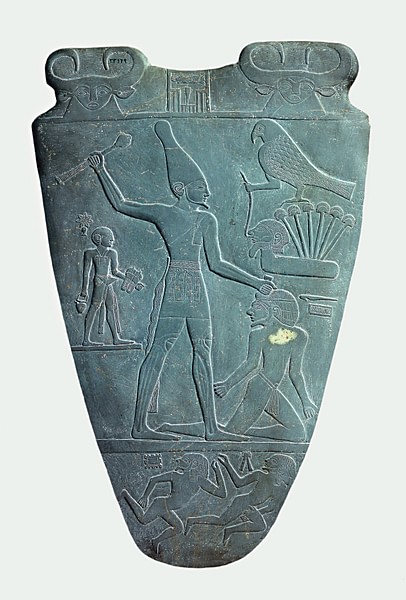 Narmer Conquering His Enemies Unknown (Public Domain) ](https://www.worldhistory.org/image/4526/narmer-conquering-his-enemies/ "Narmer Conquering His Enemies")The rulers of Egypt were usually the sons or declared heirs of the preceding pharaoh, born of the Great Wife (pharaoh's chief consort) or sometimes a lesser-ranked wife whom the pharaoh favored. Early on, the rulers married female aristocrats in an effort to establish the legitimacy of their dynasty by linking it to the upper classes of [Memphis](https://www.worldhistory.org/Memphis_(Ancient_Egypt)/), which was then Egypt's capital.
This practice may have begun with Narmer, who established Memphis as his capital and married the princess Neithhotep of the older [city](https://www.worldhistory.org/city/) of Naqada to consolidate his rule and link his new city to Naqada and his home city of Thinis. To keep the blood-line pure, many pharaohs married their sisters or half-sisters and Pharaoh [Akhenaten](https://www.worldhistory.org/Akhenaten/) married his own daughters.
### The Pharaoh and Ma'at
The chief responsibility of the pharaoh was to maintain *ma'at* throughout the land. The goddess Ma'at (pronounced 'may-et' or 'my-eht') was thought to provide harmony through the pharaoh but it was up to the individual ruler to interpret the goddess' will correctly and to then act on it.
Accordingly, [warfare](https://www.worldhistory.org/warfare/) was an essential aspect of the rule of pharaoh, especially when it was seen as necessary for the restoration of balance and harmony in the land. This concept of war is exemplified in The Poem of Pentaur, written by the scribes of Rameses II, the Great (r. 1279-1213 BCE), regarding his victory over the [Hittites](https://www.worldhistory.org/hittite/) at the [Battle](https://www.worldhistory.org/disambiguation/battle/) of [Kadesh](https://www.worldhistory.org/Kadesh/) in 1274 BCE.
[The Hittites](https://www.worldhistory.org/hittite/), according to [Ramesses II](https://www.worldhistory.org/Ramesses_II/), had disrupted the balance of Egypt and so needed to be dealt with severely. The pharaoh had a sacred duty to defend the borders of the land, but also to attack neighboring countries for natural resources if it was thought that this was in the interest of harmony.
### Pharaohs and the [Pyramids](https://www.worldhistory.org/pyramid/)
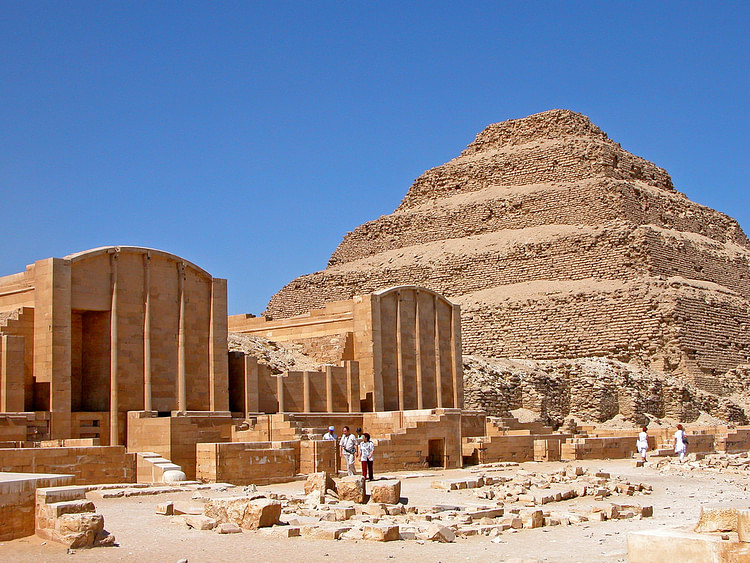
By the 3rd dynasty King [Djoser](https://www.worldhistory.org/Djoser/) (r. c. 2670 BCE) commanded enough wealth, prestige and resources to have the Step [Pyramid](https://www.worldhistory.org/pyramid/) built as his eternal home. Designed by the vizier [Imhotep](https://www.worldhistory.org/imhotep/) (l. c. 2667-2600 BCE), the Step Pyramid was the tallest structure of its day and a very popular tourist attraction then, as it is today. The pyramid was designed primarily as Djoser's final resting place but the splendor of the surrounding complex and great height of the pyramid were intended to honor not only Djoser but Egypt itself and the prosperity of the land under his reign.
Other 3rd Dynasty kings such as Sekhemkhet and Khaba built pyramids following Imhotep's design (the Buried Pyramid and the Layer Pyramid) and created a type of monument which would become synonymous with Egypt even though the pyramid structure was used by many other cultures (notably the [Maya](https://www.worldhistory.org/disambiguation/Maya/), who had no contact at all with ancient Egypt). [Old Kingdom](https://www.worldhistory.org/disambiguation/Old_Kingdom/) monarchs (c. 2613-2181 BCE) then followed suit culminating in the [Great Pyramid](https://www.worldhistory.org/Great_Pyramid_of_Giza/) at [Giza](https://www.worldhistory.org/giza/), immortalizing Khufu (r. 2589-2566 BCE) and making manifest the power and divine rule of the pharaoh in Egypt.
[  Step Pyramid Complex at Saqqara Dennis Jarvis (CC BY-SA) ](https://www.worldhistory.org/image/4548/step-pyramid-complex-at-saqqara/ "Step Pyramid Complex at Saqqara")### The 18th Dynasty and Egypt's [Empire](https://www.worldhistory.org/empire/)
With the collapse of the [Middle Kingdom](https://www.worldhistory.org/disambiguation/Middle_Kingdom/) in 1782 BCE, Egypt came to be ruled by the mysterious Semitic people known as the [Hyksos](https://www.worldhistory.org/Hyksos/). The Hyksos, however, emulated all the trappings of the Egyptian pharaohs and kept the customs alive until their kingdom was overthrown by the royal line of the Egyptian 18th Dynasty which then gave rise to some of the most famous of the pharaohs such as Rameses the Great and [Amenhotep III](https://www.worldhistory.org/Amenhotep_III/) (r. 1386-1353 BCE).
This was the period of Egypt's empire and the prestige of the pharaoh was never greater. Egypt controlled the resources of regions from [Mesopotamia](https://www.worldhistory.org/Mesopotamia/) down through the [Levant](https://www.worldhistory.org/levant/), across to Libya, and further south into the Nubian Kingdom of [Kush](https://www.worldhistory.org/Kush/). When Ahmose I (r. c.1570-1544 BCE) drove the Hyksos from Egypt, he established buffer zones around the borders so that no other invasive people could gain a foothold inside Egypt. These zones were eventually fortified and goverened by Egyptian administrators who would report to the pharaoh.
These pharaohs were predominantly male but Queen [Hatshepsut](https://www.worldhistory.org/hatshepsut/) (r. 1479-1458 BCE) of the 18th Dynasty ruled successfully as a female monarch for over twenty years and, during her reign, Egypt prospered. She re-established [trade](https://www.worldhistory.org/disambiguation/trade/) with the Land of [Punt](https://www.worldhistory.org/punt/) and encouraged trade expeditions elsewhere which caused the [economy](https://www.worldhistory.org/disambiguation/economy/) to boom. Hatshepsut was responsible for more public works projects than any pharaoh save Rameses II and her rule is marked by peace and affluence throughout the land.
When Tuthmose III (r. 1458-1425 BCE) came to power after her, he had her image removed from all her temples and monuments in an effort, it is thought, to restore order to the land. According to tradition, a woman should never have held the title of the pharaoh - that was an honor reserved for males in keeping with Osiris as the first king of Egypt and his sister [Isis](https://www.worldhistory.org/isis/) as his consort, not reigning monarch. It is thought, then, that [Thutmose III](https://www.worldhistory.org/Thutmose_III/) feared Hatshepsut's example might inspire other [women](https://www.worldhistory.org/disambiguation/women/) to 'forget their place' in the sacred order and aspire to power the gods had reserved for males.
### Decline of the Pharaoh
The New Kingdom was the period of Egypt's greatest success on many levels but it could not last. The power of the pharaoh began to decline after the reign of [Ramesses](https://www.worldhistory.org/disambiguation/ramesses/) III (r. 1186-1155 BCE) during which the [Sea Peoples](https://www.worldhistory.org/Sea_Peoples/) had invaded. The cost of the Egyptian victory over the Sea Peoples, both financial and in lives lost, was considerable and Egypt's economy began to decline.
The [first labor strike in history](https://www.worldhistory.org/article/1089/the-first-labor-strike-in-history/) also occurred under Ramesses III which called into question this pharaoh's ability to maintain ma'at and how much the upper classes actually cared for the people. A number of other factors also contributed to the end of the New Kingdom that ushered in the [Third Intermediate Period](https://www.worldhistory.org/Third_Intermediate_Period_of_Egypt/) (c. 1069-525 BCE) which concluded with the Persian invasion.
The prestige of the pharaoh waned considerably after the defeat of the Egyptians by the Persians at the Battle of Pelusium in 525 BCE and, still further, after the conquests of [Alexander the Great](https://www.worldhistory.org/Alexander_the_Great/). By the time of the last pharaoh, the well-known [Cleopatra VII](https://www.worldhistory.org/Cleopatra_VII/) Philopator (l. c. 69-30 BCE) of the [Ptolemaic Dynasty](https://www.worldhistory.org/Ptolemaic_Dynasty/), the title no longer held the power it once did, fewer monuments were erected and, with her [death](https://www.worldhistory.org/disambiguation/Death/) in 30 BCE, Egypt became a [Roman](https://www.worldhistory.org/disambiguation/Roman/) province and the glory and might of the pharaohs of old faded into memory.
#### Editorial Review
This human-authored definition has been reviewed by our editorial team before publication to ensure accuracy, reliability and adherence to academic standards in accordance with our [editorial policy](https://www.worldhistory.org/static/editorial-policy/).
## Bibliography
- [Ashton, S. *The Last Queens of Egypt.* Longman, 2003.](https://www.worldhistory.org/books/0582772109/)
- [Bunson, M. *Encyclopedia of Ancient Egypt.* Gramercy, 1999.](https://www.worldhistory.org/books/0517203804/)
- [David, R. *Handbook to Life in Ancient Egypt Revised.* Oxford University Press, 2007.](https://www.worldhistory.org/books/0195366719/)
- [Durant,W. *Our Oriental Heritage.* Simon & Schuster, 1954.](https://www.worldhistory.org/books/B00005WJGO/)
- [Shaw, I. *The Oxford History of Ancient Egypt.* Oxford University Press, 2004.](https://www.worldhistory.org/books/0192804588/)
- [Silverman, D. P. *Ancient Egypt.* Oxford University Press, 1997.](https://www.worldhistory.org/books/B01NGZXOC2/)
- [Van De Mieroop, M. *A History of Ancient Egypt.* Wiley-Blackwell, 2010.](https://www.worldhistory.org/books/1405160713/)
- [Wilkinson,R. H. *Symbol & Magic in Egyptian Art.* Thames & Hudson, 1999.](https://www.worldhistory.org/books/0500280703/)
## About the Author
Joshua J. Mark is World History Encyclopedia's co-founder and Content Director. He was previously a professor at Marist College (NY) where he taught history, philosophy, literature, and writing. He has traveled extensively and lived in Greece and Germany.
- [Linkedin Profile](https://www.linkedin.com/pub/joshua-j-mark/38/614/339)
## Timeline
- **c. 3150 BCE**: King [Menes](https://www.worldhistory.org/Menes/) unifies [Egypt](https://www.worldhistory.org/egypt/) through [conquest](https://www.worldhistory.org/warfare/).
- **c. 3150 BCE - c. 3100 BCE**: Reign of [Menes](https://www.worldhistory.org/Menes/), a.k.a. [Narmer](https://www.worldhistory.org/Narmer/), first king who is thought to have unified Upper and Lower [Egypt](https://www.worldhistory.org/egypt/).
- **3150 BCE - 2613 BCE**: [Early Dynastic Period in Egypt](https://www.worldhistory.org/Early_Dynastic_Period_In_Egypt/). First Kings.
- **2613 BCE - 2589 BCE**: Reign of Sneferu, first king of 4th Dynasty of [Egypt](https://www.worldhistory.org/egypt/).
- **c. 2613 BCE - c. 2181 BCE**: The Period of the [Old Kingdom of Egypt](https://www.worldhistory.org/Old_Kingdom_of_Egypt/).
- **2589 BCE - 2566 BCE**: Reign of King Khufu (Cheops), builder of the [Great Pyramid of Giza](https://www.worldhistory.org/Great_Pyramid_of_Giza/), in [Egypt](https://www.worldhistory.org/egypt/).
- **2566 BCE - 2558 BCE**: Reign of King Djedefre in [Egypt](https://www.worldhistory.org/egypt/).
- **2558 BCE - 2532 BCE**: Reign of King Khafre, builder of the second [pyramid](https://www.worldhistory.org/pyramid/) at [Giza](https://www.worldhistory.org/giza/), in [Egypt](https://www.worldhistory.org/egypt/).
- **2532 BCE - 2503 BCE**: Reign of King Menkaure, builder of the third [pyramid](https://www.worldhistory.org/pyramid/) at [Giza](https://www.worldhistory.org/giza/), in [Egypt](https://www.worldhistory.org/egypt/).
- **2503 BCE - 2498 BCE**: Reign of the King Shepsekaf in [Egypt](https://www.worldhistory.org/egypt/).
- **2498 BCE - 2491 BCE**: Reign of the King Userkaf in [Egypt](https://www.worldhistory.org/egypt/).
- **2490 BCE - 2477 BCE**: Reign of King Sahure in [Egypt](https://www.worldhistory.org/egypt/).
- **2477 BCE - 2467 BCE**: Reign of the King Neferiskare Kakai in [Egypt](https://www.worldhistory.org/egypt/).
- **2460 BCE - 2458 BCE**: Reign of the King Neferefre in [Egypt](https://www.worldhistory.org/egypt/).
- **c. 2458 BCE - c. 2457 BCE**: Reign of King Shepseskare in [Egypt](https://www.worldhistory.org/egypt/).
- **c. 2445 BCE - 2422 BCE**: Reign of the King Nyussere Ini of [Egypt](https://www.worldhistory.org/egypt/).
- **2422 BCE - 2414 BCE**: Reign of King Menkauhor in [Egypt](https://www.worldhistory.org/egypt/).
- **2414 BCE - 2375 BCE**: Reign of King Djedkare Isesi in [Egypt](https://www.worldhistory.org/egypt/).
- **2375 BCE - 2345 BCE**: Reign of King Unas in [Egypt](https://www.worldhistory.org/egypt/).
- **2345 BCE - 2333 BCE**: Reign of King Teti in [Egypt](https://www.worldhistory.org/egypt/).
- **2333 BCE - 2332 BCE**: Reign of King Userkare in [Egypt](https://www.worldhistory.org/egypt/).
- **2332 BCE - 2283 BCE**: Reign of King Pepi I in [Egypt](https://www.worldhistory.org/egypt/).
- **2283 BCE - 2278 BCE**: Reign of King Merenre Nemtyensaf I in [Egypt](https://www.worldhistory.org/egypt/).
- **2278 BCE - 2184 BCE**: Reign of King Pepi II in [Egypt](https://www.worldhistory.org/egypt/).
- **c. 2184 BCE**: Reign of King Merenre Nemtyemsaf II in [Egypt](https://www.worldhistory.org/egypt/).
- **2184 BCE - 2181 BCE**: Reign of King Netjerkare, last ruler of the [Old Kingdom of Egypt](https://www.worldhistory.org/Old_Kingdom_of_Egypt/).
- **2040 BCE - 1782 BCE**: The [Middle Kingdom of Egypt](https://www.worldhistory.org/Middle_Kingdom_of_Egypt/).
- **c. 1550 BCE - 1525 BCE**: Reign of Ahmose I, [Pharaoh of Egypt](https://www.worldhistory.org/collection/25/pharaoh-of-egypt/).
- **1525 BCE - 1504 BCE**: Reign of Amenhotep I, [pharaoh of Egypt](https://www.worldhistory.org/collection/25/pharaoh-of-egypt/).
- **1504 BCE - 1492 BCE**: Reign of Thutmose I, [Pharaoh of Egypt](https://www.worldhistory.org/collection/25/pharaoh-of-egypt/).
- **1492 BCE - 1479 BCE**: Reign of Thutmose II, [pharaoh of Egypt](https://www.worldhistory.org/collection/25/pharaoh-of-egypt/).
- **1479 BCE - 1458 BCE**: Queen [Hatshepsut](https://www.worldhistory.org/hatshepsut/) rules [Egypt](https://www.worldhistory.org/egypt/).
- **1473 BCE**: [Hatshepsut](https://www.worldhistory.org/hatshepsut/) has herself crowned [pharaoh of Egypt](https://www.worldhistory.org/collection/25/pharaoh-of-egypt/) and begins to be depicted as a male [pharaoh](https://www.worldhistory.org/pharaoh/).
- **1458 BCE - 1425 BCE**: Reign of [Thutmose III](https://www.worldhistory.org/Thutmose_III/) in [Egypt](https://www.worldhistory.org/egypt/).
- **1427 BCE - 1400 BCE**: Reign of Amenhotep II, [pharaoh of Egypt](https://www.worldhistory.org/collection/25/pharaoh-of-egypt/).
- **1400 BCE - 1390 BCE**: Reign of Thutmose IV, [pharaoh of Egypt](https://www.worldhistory.org/collection/25/pharaoh-of-egypt/).
- **1353 BCE - c. 1336 BCE**: Reign of [Akhenaten](https://www.worldhistory.org/Akhenaten/), [Tutankhamun](https://www.worldhistory.org/Tutankhamun/)'s father, 'Heretic King' of [Egypt](https://www.worldhistory.org/egypt/).
- **1327 BCE - 1323 BCE**: Reign of Ay, [pharaoh of Egypt](https://www.worldhistory.org/collection/25/pharaoh-of-egypt/).
- **c. 1303 BCE**: Birth of [Ramesses II](https://www.worldhistory.org/Ramesses_II/) of [Egypt](https://www.worldhistory.org/egypt/).
- **1295 BCE - 1294 BCE**: The reign of [Ramesses](https://www.worldhistory.org/disambiguation/ramesses/) I in [Egypt](https://www.worldhistory.org/egypt/).
- **1294 BCE - 1279 BCE**: The reign of Seti I in [Egypt](https://www.worldhistory.org/egypt/).
- **1279 BCE - 1212 BCE**: Reign of [Ramesses II](https://www.worldhistory.org/Ramesses_II/) (The Great) in [Egypt](https://www.worldhistory.org/egypt/).
- **1212 BCE - 1202 BCE**: Reign of Merneptah in [Egypt](https://www.worldhistory.org/egypt/).
- **1202 BCE - c. 1200 BCE**: Reign of Amenmesse in [Egypt](https://www.worldhistory.org/egypt/).
- **1200 BCE - 1194 BCE**: Reign of Seti II.
- **1194 BCE - 1188 BCE**: Reign of Siptah in [Egypt](https://www.worldhistory.org/egypt/).
- **1188 BCE - 1186 BCE**: Reign of Queen Twosret in [Egypt](https://www.worldhistory.org/egypt/).
- **1186 BCE - 1184 BCE**: Reign of Sethnakht, [pharaoh of Egypt](https://www.worldhistory.org/collection/25/pharaoh-of-egypt/).
- **1184 BCE - 1153 BCE**: Reign of [Ramesses](https://www.worldhistory.org/disambiguation/ramesses/) III, [Pharaoh of Egypt](https://www.worldhistory.org/collection/25/pharaoh-of-egypt/).
- **1153 BCE - 1147 BCE**: Reign of [Ramesses](https://www.worldhistory.org/disambiguation/ramesses/) IV, [pharaoh of Egypt](https://www.worldhistory.org/collection/25/pharaoh-of-egypt/).
- **1147 BCE - 1143 BCE**: Reign of [Ramesses](https://www.worldhistory.org/disambiguation/ramesses/) V, [pharaoh of Egypt](https://www.worldhistory.org/collection/25/pharaoh-of-egypt/).
- **1143 BCE - 1136 BCE**: Reign of [Ramesses](https://www.worldhistory.org/disambiguation/ramesses/) VI, [pharaoh of Egypt](https://www.worldhistory.org/collection/25/pharaoh-of-egypt/).
- **1136 BCE - 1129 BCE**: Reign of [Ramesses](https://www.worldhistory.org/disambiguation/ramesses/) VII, [pharaoh of Egypt](https://www.worldhistory.org/collection/25/pharaoh-of-egypt/).
- **1129 BCE - 1126 BCE**: Reign of [Ramesses](https://www.worldhistory.org/disambiguation/ramesses/) VIII, [pharaoh of Egypt](https://www.worldhistory.org/collection/25/pharaoh-of-egypt/).
- **1126 BCE - 1108 BCE**: Reign of [Ramesses](https://www.worldhistory.org/disambiguation/ramesses/) IX, [pharaoh of Egypt](https://www.worldhistory.org/collection/25/pharaoh-of-egypt/).
- **1108 BCE - 1099 BCE**: Reign of [Ramesses](https://www.worldhistory.org/disambiguation/ramesses/) X, [pharaoh of Egypt](https://www.worldhistory.org/collection/25/pharaoh-of-egypt/).
- **1099 BCE - 1069 BCE**: Reign of [Ramesses](https://www.worldhistory.org/disambiguation/ramesses/) XI, [pharaoh of Egypt](https://www.worldhistory.org/collection/25/pharaoh-of-egypt/).
- **664 BCE**: Psamtik I becomes Pharoah in [Egypt](https://www.worldhistory.org/egypt/).
- **664 BCE - 610 BCE**: Reign of Psamtik I, [pharaoh of Egypt](https://www.worldhistory.org/collection/25/pharaoh-of-egypt/).
- **610 BCE - 595 BCE**: Reign of Necho II, [pharaoh of Egypt](https://www.worldhistory.org/collection/25/pharaoh-of-egypt/).
- **595 BCE - 589 BCE**: Reign of Psamtik II, [pharaoh of Egypt](https://www.worldhistory.org/collection/25/pharaoh-of-egypt/).
- **589 BCE - 570 BCE**: Reign of Apries, [pharaoh of Egypt](https://www.worldhistory.org/collection/25/pharaoh-of-egypt/).
- **570 BCE - 526 BCE**: Rule of [Pharaoh](https://www.worldhistory.org/pharaoh/) Amasis of [Egypt](https://www.worldhistory.org/egypt/), who built a shrine to [Ammon](https://www.worldhistory.org/disambiguation/Ammon/) at Siwa.
- **526 BCE - 525 BCE**: Reign of Psamtik III, [pharaoh of Egypt](https://www.worldhistory.org/collection/25/pharaoh-of-egypt/).
## External Links
- [Who was King Tut... really?](https://www.missedinhistory.com/podcasts/who-was-king-tut-really.htm)
## Cite This Work
### APA
Mark, J. J. (2009, September 02). Pharaoh. *World History Encyclopedia*.
### Chicago
Mark, Joshua J.. "Pharaoh." *World History Encyclopedia*, September 02, 2009. .
### MLA
Mark, Joshua J.. "Pharaoh." *World History Encyclopedia*, 02 Sep 2009, .
## License & Copyright
Submitted by [Joshua J. Mark](https://www.worldhistory.org/user/JPryst/ "User Page: Joshua J. Mark"), published on 02 September 2009. The copyright holder has published this content under the following license: [Creative Commons Attribution-NonCommercial-ShareAlike](https://creativecommons.org/licenses/by-nc-sa/4.0/deed.en). This license lets others remix, tweak, and build upon this content non-commercially, as long as they credit the author and license their new creations under the identical terms. When republishing on the web a hyperlink back to the original content source URL must be included. Please note that content linked from this page may have different licensing terms.