---
title: Persephone
author: Mark Cartwright
source: https://www.worldhistory.org/persephone/
format: machine-readable-alternate
license: Creative Commons Attribution-NonCommercial-ShareAlike (https://creativecommons.org/licenses/by-nc-sa/4.0/)
updated: 2025-02-04
---
# Persephone
_Authored by [Mark Cartwright](https://www.worldhistory.org/user/markzcartwright/)_
Persephone (aka Kore) was the [Greek](https://www.worldhistory.org/disambiguation/greek/) goddess of [agriculture](https://www.worldhistory.org/disambiguation/Agriculture/) and vegetation, especially grain, and the wife of [Hades](https://www.worldhistory.org/Hades/), the ruler of the Underworld. Persephone was an important element of the Eleusinian Mysteries and the Thesmophoria festival and so the goddess was worshipped throughout the Greek world. Persephone frequently appears in all forms of Greek art and [literature](https://www.worldhistory.org/literature/).
### What are the Different Names of Persephone?
In many ancient cults the goddess, along with her mother [Demeter](https://www.worldhistory.org/demeter/), is associated with vegetation and grain. In this guise she is most often referred to as Kore, signifying both 'daughter' and 'maiden'. In [Greek mythology](https://www.worldhistory.org/Greek_Mythology/), the goddess, as wife of Hades, is the Queen of the Underworld and takes her other name, Persephone. In this guise, she was seen as a protectress in the after-life, although [Hesiod](https://www.worldhistory.org/hesiod/) repeatedly describes her as 'dread Persephone' in his *[Theogony](https://www.worldhistory.org/Theogony/)*. In various other myths, Persephone is the mother of [Dionysos](https://www.worldhistory.org/Dionysos/) (with [Zeus](https://www.worldhistory.org/zeus/), who is also her father) - although Semele is the more usual candidate - and squabbles with [Aphrodite](https://www.worldhistory.org/Aphrodite/) for the attentions of devilishly handsome [Adonis](https://www.worldhistory.org/Adonis/), the two settling to share the famous lover in split shifts. In the [Roman](https://www.worldhistory.org/disambiguation/Roman/) world the goddess was known as Proserpina.
### Hades Abducts Persephone
According to [mythology](https://www.worldhistory.org/mythology/), Hades, [god](https://www.worldhistory.org/God/) of the Underworld, fell in love with beautiful Persephone when he saw her picking flowers one day in a meadow. The god then carried her off in his [chariot](https://www.worldhistory.org/chariot/) to live with him in the dark Underworld. In some accounts, Zeus had given his consent to the abduction, the location of the crime being traditionally placed in either [Sicily](https://www.worldhistory.org/sicily/) (famed for its fertility) or Asia.
Meanwhile, Demeter searched the earth for her lost divine daughter and though [Helios](https://www.worldhistory.org/Helios/) (or [Hermes](https://www.worldhistory.org/Hermes/)) told her of her daughter's fate, she, nevertheless, continued her wanderings until she finally arrived at [Eleusis](https://www.worldhistory.org/Eleusis/). It was here, disguised as an old woman, that the goddess cared for Demophon (or Triptolemos, who would later give the gift of grain to humanity and teach farming), the only son of Metaneira, the wife of Keleos, king of Eleusis. To reward the family for their kindness, Demeter set about making Demophon immortal by placing him on a fire every night. However, when Metaneira saw this, she raised an alarm. In response, Demeter revealed her true identity and demanded a [temple](https://www.worldhistory.org/temple/) be built in her honour. This was the beginning of the celebrated sanctuary of Eleusis.
Once the temple was completed, Demeter withdrew from the world and lived inside it; at the same time, she created a great drought to convince the other gods to release Persephone from Hades. As the drought claimed ever more victims, Zeus finally sent Hermes to persuade Hades to release his ill-gotten bride. Before giving her up though, the wily Hades put a pomegranate kernel in the girl's mouth, knowing its divine taste would compel her to return to him. In other versions of the myth, Persephone could have been released if she had not eaten anything in the underworld during her captivity, but at the last moment, Hades gave her a pomegranate seed. Finally, as a compromise, it was decided that Persephone would be released but that she would have to return to Hades for one-third of the year (or in other accounts one-half).
### What is the Significance of the Hades-Persephone Myth?
The story of Demeter, Hades and Persephone was perhaps symbolic of the changing [seasons](https://www.worldhistory.org/Horae/) and the perennial change from life to [death](https://www.worldhistory.org/disambiguation/Death/), to life once more, or in other words, the changes from the summer to winter months and the return of life in spring as seen in agriculture. The cycle became one of the rituals of the sacred Eleusinian mysteries; indeed, the symbols of the cult were ears of grain and a torch - reminding of Demeter's search for Persephone and that the rituals were carried out at night. As all initiates were bound by a sacred oath not to reveal the details of the Mysteries, they have to this day remained just that, a mystery.
[ 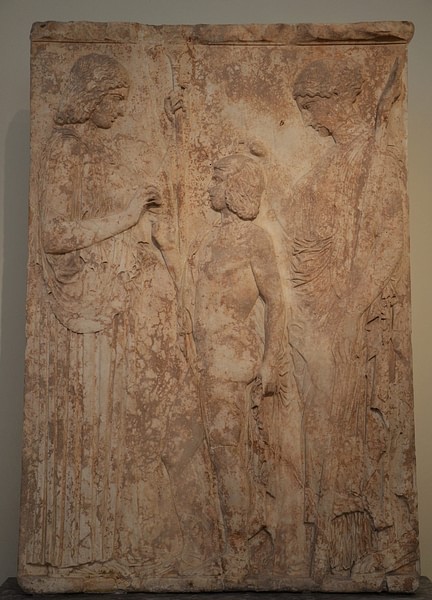 Eleusinian votive relief Carole Raddato (CC BY-SA) ](https://www.worldhistory.org/image/3511/eleusinian-votive-relief/ "Eleusinian votive relief")Another interpretation of the Persephone myth may be that it represents when the Greeks stored their grain underground for part of the year in order to protect it from summer heat. In favour of this argument is that in [Greece](https://www.worldhistory.org/greece/)'s climate seeds are sown in the autumn and quickly germinate to grow throughout the winter time. Therefore, Persephone's time in Hades would not equate with winter in the agricultural season but, rather, with summer. Whatever the exact significance, the association between Persephone and agriculture is firmly established in rituals, literature, and ancient art. Finally, the myth of Hades' abduction may also reference the Greek practice of girls marrying in their early teens, a loss to their mothers as Persephone was to Demeter.
### Other Cults of Persephone
The cult of Persephone in the [Greek religion](https://www.worldhistory.org/Greek_Religion/) was especially strong in Sicily and southern [Italy](https://www.worldhistory.org/italy/), and besides the Eleusinian Mysteries at Eleusis there were sanctuaries to the goddess across the Greek world, most notably at Locri Epizephyrii, Mantinea, Megalopolis, and [Sparta](https://www.worldhistory.org/sparta/). Here annual festivities celebrated Persephone's marriage and her picking of flowers. The Thesmophoria was a Greek-wide celebration of the goddess and her mother. Exclusive to [women](https://www.worldhistory.org/disambiguation/women/), it was held annually before the sowing period when sacrifices were made and putrefied pig's remains were mixed with the seeds. Persephone, in her guise as Queen of the Underworld, was often appealed to in curse tablets and on the inscribed [gold](https://www.worldhistory.org/gold/) leaves buried with the dead followers of Orphism which gave instructions on how to conduct themselves in the after-life.
[  Persephone Mosaic, Amphipolis Not Specified (Public Domain) ](https://www.worldhistory.org/image/3269/persephone-mosaic-amphipolis/ "Persephone Mosaic, Amphipolis")### How is Persephone Represented in Art?
Persephone rarely appears in art before the 6th century BCE, and then she is usually shown with Demeter; often both wear crowns and hold a torch, sceptre, or stalks of grain. A famous relief slab from Eleusis depicts Demeter and Persephone (holding a torch) either side of Triptolemos; it dates to the 5th century BCE. It is on permanent display in the National Archaeological Museum in [Athens](https://www.worldhistory.org/Athens/). On Attic [red-figure pottery](https://www.worldhistory.org/Red-Figure_Pottery/) throughout the Classical period, Persephone is often shown seated on her throne in Hades.
Frescoes in the 4th-century BCE royal [tomb](https://www.worldhistory.org/tomb/) at Aegae (Vergina) in Pieria, [Macedon](https://www.worldhistory.org/macedon/) show Hades abducting the goddess and explain the popular 'Tomb of Persephone' label. A recent spectacular find is the large pebble [mosaic](https://www.worldhistory.org/Mosaic/), measuring 4.5 by 3 metres from the [Hellenistic](https://www.worldhistory.org/Hellenic_World/) tomb at [Amphipolis](https://www.worldhistory.org/Amphipolis/), which again depicts the god Hades abducting Persephone in a chariot led by Hermes. Persephone's abduction by Hades was a popular subject in [Roman sculpture](https://www.worldhistory.org/Roman_Sculpture/) too, especially on sarcophagi, and continued to be so for 18th and 19th-century oil painters.
#### Editorial Review
This human-authored definition has been reviewed by our editorial team before publication to ensure accuracy, reliability and adherence to academic standards in accordance with our [editorial policy](https://www.worldhistory.org/static/editorial-policy/).
## Bibliography
- Bagnall, R. et al. *The Encyclopedia of Ancient History.* Wiley-Blackwell, 2012
- [Boardman, J. *Greek Sculpture.* Thames & Hudson, 1985.](https://www.worldhistory.org/books/0500201986/)
- [Carabatea, M. *Greek Mythology.* Adam Editions, 1997.](https://www.worldhistory.org/books/9605001020/)
- [Carpenter, T.H. *Art and Myth in Ancient Greece.* Thames & Hudson, 1991.](https://www.worldhistory.org/books/0500202362/)
- [Graziosi, B. *The Gods of Olympus.* Picador, 2015.](https://www.worldhistory.org/books/1250062349/)
- [Hornblower, S. *The Oxford Classical Dictionary.* Oxford University Press, 2012.](https://www.worldhistory.org/books/0199545561/)
## About the Author
Mark is WHE’s Publishing Director and has an MA in Political Philosophy (University of York). He is a full-time researcher, writer, historian and editor. Special interests include art, architecture and discovering the ideas that all civilizations share.
## Timeline
- **c. 1500 BCE**: First [temple](https://www.worldhistory.org/temple/) to [Demeter](https://www.worldhistory.org/demeter/) & [Persephone](https://www.worldhistory.org/persephone/) is built at [Eleusis](https://www.worldhistory.org/Eleusis/).
- **c. 700 BCE**: [Greek](https://www.worldhistory.org/disambiguation/greek/) poet [Hesiod](https://www.worldhistory.org/hesiod/) writes his *[Theogony](https://www.worldhistory.org/Theogony/)* and *[Works and Days](https://www.worldhistory.org/Works_and_Days/)*.
- **c. 600 BCE**: The Eleusinian Mysteries become part of the official Athenian religious calendar.
## Questions & Answers
### What was Persephone known for?
Persephone is known for being the Greek goddess of agriculture, grain, and vegetation. She was infamously abducted by the god Hades and made to live a part of the year in the Underworld.
### What is the significance of the Persephone myth?
The significance of the Persephone myth is perhaps the changing seasons and the perennial change from life to death, to life once more, in particular, the change from summer to winter and the return of life in spring.
### Is Persephone in love with Hades?
Persephone was not in love with Hades but was taken by force to the Underworld where the god rules.
## Cite This Work
### APA
Cartwright, M. (2016, March 24). Persephone. *World History Encyclopedia*.
### Chicago
Cartwright, Mark. "Persephone." *World History Encyclopedia*, March 24, 2016. .
### MLA
Cartwright, Mark. "Persephone." *World History Encyclopedia*, 24 Mar 2016, .
## License & Copyright
Submitted by [Mark Cartwright](https://www.worldhistory.org/user/markzcartwright/ "User Page: Mark Cartwright"), published on 24 March 2016. The copyright holder has published this content under the following license: [Creative Commons Attribution-NonCommercial-ShareAlike](https://creativecommons.org/licenses/by-nc-sa/4.0/deed.en). This license lets others remix, tweak, and build upon this content non-commercially, as long as they credit the author and license their new creations under the identical terms. When republishing on the web a hyperlink back to the original content source URL must be included. Please note that content linked from this page may have different licensing terms.