---
title: Mythology
author: Joshua J. Mark
source: https://www.worldhistory.org/mythology/
format: machine-readable-alternate
license: Creative Commons Attribution-NonCommercial-ShareAlike (https://creativecommons.org/licenses/by-nc-sa/4.0/)
updated: 2023-04-02
---
# Mythology
_Authored by [Joshua J. Mark](https://www.worldhistory.org/user/JPryst/)_
Myths are a part of every [culture](https://www.worldhistory.org/disambiguation/culture/) in the world and are used to explain natural phenomena, where a people came from and how their [civilization](https://www.worldhistory.org/civilization/) developed, and why things happen as they do. At their most basic level, myths comfort by giving a sense of order and meaning to what can sometimes seem a chaotic world.
Mythology (from the [Greek](https://www.worldhistory.org/disambiguation/greek/) *mythos* for story-of-the-people, and *logos* for word or speech, so the spoken story of a people) is the study and interpretation of often sacred tales or fables of a culture known as myths or the collection of such stories which deal with various aspects of the human condition: good and evil; the meaning of suffering; human origins; the origin of place-names, animals, cultural values, and traditions; the meaning of life and [death](https://www.worldhistory.org/disambiguation/Death/); the afterlife; and celestial stories of the gods or a [god](https://www.worldhistory.org/God/). Myths express the beliefs and values about these subjects held by a certain culture.
Myths tell the stories of ancestors and the origin of humans and the world, the gods, supernatural beings (satyrs, nymphs, mermaids) and heroes with super-human, usually god-given, powers (as in the case of the Greek myth of Heracles or [Perseus](https://www.worldhistory.org/Perseus/)). Myths also describe origins or nuances of long-held customs or explain natural events such as the sunrise and sunset, the cycle of the moon and the [seasons](https://www.worldhistory.org/Horae/), or thunder and lightning storms. Scholars Maria Leach and Jerome Fried define mythology along these lines:
> \[A myth is\] a story, presented as having actually occurred in a previous age, explaining the cosmological and supernatural traditions of a people, their gods, heroes, cultural traits, religious beliefs, etc. The purpose of myth is to explain, and, as Sir G.L. Gomme said, myths explain matters in “the [science](https://www.worldhistory.org/science/) of a pre-scientific age.” Thus myths tell of the creation of man, of animals, of landmarks; they tell why a certain animal has its characteristics (e.g. why the bat is blind or flies only at night), why or how certain natural phenomena came to be (e.g. why the rainbow appears or how the constellation [Orion](https://www.worldhistory.org/Orion/) got into the sky), how and why rituals and ceremonies began and why they continue. (778)
Mythology has played an integral part in every civilization throughout the world. Pre-historic cave paintings, etchings in stone, tombs, and monuments all suggest that, long before human beings set down their myths in words, they had already developed a belief structure corresponding to the definition of `myth' provided by Leach and Fried. According to twentieth century psychiatrist Carl Jung, myth is a necessary aspect of the human psyche which needs to find meaning and order in a world which often presents itself as chaotic and meaningless. Jung writes:
> The psyche, as a reflection of the world and man, is a thing of such infinite complexity that it can be observed and studied from a great many sides. It faces us with the same problem that the world does: because a systematic study of the world is beyond our powers, we have to content ourselves with mere rules of thumb and with aspects that particularly interest us. Everyone makes for himself his own segment of world and constructs his own private system, often with air-tight compartments, so that after a time it seems to him that he has grasped the meaning and structure of the whole. But the finite will never be able to grasp the infinite. (23-24)
The infinite Jung references is the numinous quality of the mysterious, holy, and powerful which provides the underlying allure of mythological tales and themes because it gives a final meaning to human existence. The concept of something greater and more powerful than one's self gives one the hope of direction and protection in an uncertain world. According to Leach and Fried, the mysterious, holy, and powerful is “a concept of the human mind from earliest times: the basic psychological reaction to the universe and environment which underlies all [religion](https://www.worldhistory.org/religion/)” (777).
[ 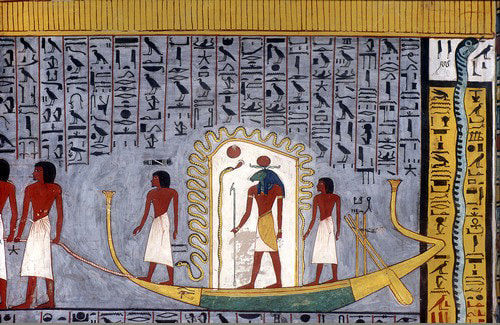 Ra Travelling Through the Underworld Unknown Artist (Public Domain) ](https://www.worldhistory.org/image/4543/ra-travelling-through-the-underworld/ "Ra Travelling Through the Underworld")What one calls “mythology” in the present day, it should be remembered, was the religion of the ancient past. The stories which make up the corpus of ancient mythology served the same purpose for the people of the time as the stories from accepted scripture do for people today: they explained, comforted, and directed an audience and, further, provided a sense of unity, cohesion, and protection to a community of like-minded believers.
### Types of Myth
Scholar Joseph Campbell, who famously advocated for the study of myths, notes how mythology is the underlying form of every civilization and the underpinning of each individual's consciousness. In his seminal work, *The Hero with a Thousand Faces*, he discusses what he calls the “monomyth”, the similarities in theme, characters, purpose, and narrative progression of myths from different cultures, at different times, around the world and throughout history. Campbell writes:
> What is the secret of the timeless vision? From what profundity of the mind does it derive? Why is mythology everywhere the same, beneath its varieties of costume? And what does it teach? (4)
Campbell's answer, ultimately, is that myths teach meaning. Mythology explains, empowers, stabilizes, and elevates the life of a believer from a mundane existence to one imbued with eternal meaning. On the most basic level, a myth explains a phenomenon, tradition, place-name, or geological formation but it can also elevate a past event to epic and even supernatural significance and, most importantly, provide a role model for one's individual journey through life.
There are many different types of myth but, essentially, they can be grouped into three:
- Etiological Myths
- Historical Myths
- Psychological Myths
Etiological myths (from the Greek *aetion* meaning `reason') explain why a certain thing is the way it is or how it came to be. This type of myth is usually defined as an origin story. For example, in [Egyptian mythology](https://www.worldhistory.org/Egyptian_Mythology/) the sycamore tree looks the way it does because it is home to the goddess [Hathor](https://www.worldhistory.org/Hathor/), the Lady of the Sycamore. In [Norse mythology](https://www.worldhistory.org/Norse_Mythology/), thunder is recognized as [Thor](https://www.worldhistory.org/Thor/)'s [chariot](https://www.worldhistory.org/chariot/) racing across the heavens. Etiological myths can offer explanations for why the world is the way it is – as in the story from [Greek mythology](https://www.worldhistory.org/Greek_Mythology/) of [Pandora](https://www.worldhistory.org/Pandora/)'s Box which explains how evil and suffering was released into the world – or how a certain institution came to be – as in the Chinese myth of the goddess Nuwa who kept creating human beings over and over and over until she grew tired and instituted the practice of marriage so humans could reproduce themselves. Characters in myths always serve a definite purpose whether they are explaining marriage or an epic mission or decisive [battle](https://www.worldhistory.org/disambiguation/battle/).
[  Pandora About to Open Her Box Lawrence Alma-Tadema (Public Domain) ](https://www.worldhistory.org/image/4010/pandora-about-to-open-her-box/ "Pandora About to Open Her Box")Historical myths retell an event from the past but elevate it with greater meaning than the actual event (if it even happened). One example of this is the story of the Battle of Kurukshetra as described in the Indian epic *[Mahabharata](https://www.worldhistory.org/Mahabharata/)* in which the Pandava brothers symbolize different values and provide role models, even if they are occasionally flawed. Kurukshetra is then presented in microcosm in the *[Bhagavad Gita](https://www.worldhistory.org/Bhagavad_Gita/)* where one of the [Pandavas](https://www.worldhistory.org/Pandavas/), [Arjuna](https://www.worldhistory.org/Arjuna/), is visited on the battlefield by the god [Krishna](https://www.worldhistory.org/Krishna/), avatar of [Vishnu](https://www.worldhistory.org/Vishnu/), to explain one's purpose in life. Whether the Battle of Kurukshetra ever took place is immaterial to the power of these two stories on a mythological level. The same can be said for the religious myths of the Abrahamic narratives of the [Bible](https://www.worldhistory.org/bible/) or the Siege of [Troy](https://www.worldhistory.org/troy/) and its fall as described in [Homer](https://www.worldhistory.org/homer/)'s *[Iliad](https://www.worldhistory.org/iliad/)* or [Odysseus](https://www.worldhistory.org/odysseus/)' journey home in the *[Odyssey](https://www.worldhistory.org/Odyssey/)* or [Aeneas](https://www.worldhistory.org/Aeneas/)' adventures in the work of [Virgil](https://www.worldhistory.org/virgil/).
Psychological myths present one with a journey from the known to the unknown which, according to both Jung and Campbell, represents a psychological need to balance the external world with one's internal consciousness of it. However that may be, the story of the myth itself usually involves a hero or heroine on a journey in which they discover their true identity or fate and, in so doing, resolve a crisis while also providing an audience with some important cultural value.
Probably the best-known classical myth of this type is that of [Oedipus](https://www.worldhistory.org/Oedipus_the_King/) the prince who, seeking to avoid the prediction that he would grow up to kill his father, leaves his life behind to travel to another region where he unknowingly winds up killing the man who was his actual father who had abandoned him at birth in an attempt to circumvent that same prediction.
[  Oedipus & the Sphinx of Thebes Carole Raddato (CC BY-SA) ](https://www.worldhistory.org/image/6240/oedipus--the-sphinx-of-thebes/ "Oedipus & the Sphinx of Thebes")The Oedipus tale would have impressed on an ancient Greek audience the futility in trying to escape or change one's fate as decreed by the gods and would have inspired fear and awe of those gods in the people, thus instilling a desirable cultural value. On a personal level, the story could also encourage a hearer to accept whatever trials he or she was enduring at the time since even a royal personage like Oedipus suffered and, further, whatever one was dealing with was probably not as bad as killing one's father and inadvertently marrying one's mother.
### Famous Myths of These Types
One of the best-known etiological myths comes from [Greece](https://www.worldhistory.org/greece/) in the form of the tale of [Demeter](https://www.worldhistory.org/demeter/), goddess of grain and the harvest, and her daughter [Persephone](https://www.worldhistory.org/persephone/) who became Queen of the Dead. In this story, Persephone is kidnapped by [Hades](https://www.worldhistory.org/Hades/), god of the underworld, and brought down to his dark realm. Demeter searches desperately everywhere for the maiden but cannot find her. During this time of Demeter's sorrow, the crops fail and people starve and the gods are not given their due. [Zeus](https://www.worldhistory.org/zeus/), king of the gods, orders Hades to restore Persephone to her mother and Hades obliges but, because Persephone has eaten a certain number of pomegranate seeds while in the underworld, she has to spend half the year below the earth but could enjoy the other half with her mother in the world above.
This story explained the changes of the seasons in Greece. When it was warm and the fields were bountiful, Persephone was with her mother and Demeter was happy and causes the world to bloom; in the cold and rainy season, when Persephone was below the earth with Hades as his queen, Demeter mourned and the land was barren. Since, in the course of the tale, Demeter teaches the people of [Eleusis](https://www.worldhistory.org/Eleusis/) the secrets of [agriculture](https://www.worldhistory.org/disambiguation/Agriculture/), the myth would also serve to explain how people first learned to cultivate the earth and, further, as she also teaches them the correct way of recognizing and worshiping her, proper veneration of the gods.
The most famous historical myth in the west is Homer's epic 8th century BCE tale of the *Iliad* which tells the story of the siege and fall of the [city](https://www.worldhistory.org/city/) of Troy. [Helen](https://www.worldhistory.org/disambiguation/Helen/), the wife of the Achaean king [Menelaus](https://www.worldhistory.org/Menelaus/), runs off with the Trojan prince [Paris](https://www.worldhistory.org/disambiguation/paris/) and Menelaus, swearing to bring her back home, enlists the aid of his brother [Agamemnon](https://www.worldhistory.org/disambiguation/Agamemnon/) who then calls on the kings and princes of the various city-states for aid and they sail off to attack Troy. The great Achaean hero [Achilles](https://www.worldhistory.org/achilles/), who is invincible in battle, feels insulted by Agamemnon and refuses to fight any longer resulting in the death of his beloved [Patroclus](https://www.worldhistory.org/Patroclus/) and many others of the Achaean host. Although there are many different stories told in the *Iliad*, this central theme of the dangers of pride is emphasized as a cultural value. A certain amount of pride in one's self was considered a virtue but too much brought disaster.
In [China](https://www.worldhistory.org/china/), this theme was explored in another way through the tale of Fuxi (foo-shee), the god of fire. As a god, Fuxi had many responsibilities but when his friend, the goddess Nuwa, asked for his help, he did not refuse. Nuwa had created human beings but found they did not know how to do anything and she did not have the patience to teach them. Fuxi brought humans fire, taught them to control it, and how to use it to cook food and warm themselves. He then taught them how to weave fishing nets and draw food from the sea and, afterwards, gave them the arts of divination, [music](https://www.worldhistory.org/disambiguation/Music/), and [writing](https://www.worldhistory.org/writing/). Fuxi is thought to be based on an actual historical king who lived c.2953-2736 BCE and possibly provided the order necessary for the rise of the [Xia Dynasty](https://www.worldhistory.org/Xia_Dynasty/) (c. 2070-1600 BCE), the first historical dynasty in China. In this story, Fuxi sets aside his pride as a god and humbles himself to the service of his friend Nuwa and humanity.
The oldest myth in the world is, not surprisingly, a psychological myth relating to the inevitability of death and the individual's attempt to find meaning in life. *The Epic of [Gilgamesh](https://www.worldhistory.org/gilgamesh/)* (written c. 2150-c.1400 BCE) developed in [Mesopotamia](https://www.worldhistory.org/Mesopotamia/) from [Sumerian](https://www.worldhistory.org/Sumerians/) poems relating to the historical Gilgamesh, king of [Uruk](https://www.worldhistory.org/uruk/), who was later elevated to the status of a demi-god. In the story, Gilgamesh is a proud king who is so haughty that the gods feel he needs a lesson in humility. They groom the wild man Enkidu as a worthy opponent to the king and the two fight but, when neither can get the best of the other, they become best friends. Enkidu is later killed by the gods for affronting them and Gilgamesh, grief-stricken, embarks on a quest for the meaning of life embodied in the concept of immortality. Although he fails to win eternal life, his journey enriches him and he returns to his kingdom a wiser and better man and king.
[  Flood Tablet of the Epic of Gilgamesh Osama Shukir Muhammed Amin (Copyright) ](https://www.worldhistory.org/image/4821/flood-tablet-of-the-epic-of-gilgamesh/ "Flood Tablet of the Epic of Gilgamesh")Joseph Campbell has famously called the best-known psychological myth type “the Hero's Journey” in which the story begins with a hero or heroine, usually of royal birth, separated from their true identity and living in a chaotic world or kingdom. The hero goes through various stages in the story, which usually takes the form of a journey, until they find out who they really are and are able to right some great wrong which re-establishes order. This narrative progression is best known in the modern-day as the plot of *Star Wars* and the overwhelming success of that film franchise attests to the enduring power of mythological themes and symbols.
### Conclusion
Every culture in the world has had, and still has, some type of mythology. The classical mythology of the ancient Greeks and Romans is the most familiar to people in the west but the motifs found in those stories are echoed in others around the world. The Greek tale of [Prometheus](https://www.worldhistory.org/Prometheus/) the fire-bringer and teacher of humanity is echoed in the Chinese tale of Fuxi. The story of Nuwa and her creation of human beings in China resonates with another from the other side of the world: the story of creation from the *Popol-Vuh* of the [Maya](https://www.worldhistory.org/disambiguation/Maya/) in which humans are created who can do nothing and prove useless but, in the Maya story, are destroyed and the gods then try again. This same motif appears in the mythology of Mesopotamia where the gods struggle in creating humans who keep coming out poorly.
The same types of stories, and often the very same story, can be found in myths from different parts of the world. African myth, [Native American](https://www.worldhistory.org/Native_Peoples_of_North_America/) myth, Chinese, or European all serve the same function of explaining, comforting, and providing meaning. The creation story as related in the biblical [Book of Genesis](https://www.worldhistory.org/Book_of_Genesis/), for example, where a great god speaks existence into creation is quite similar to creation stories from ancient [Sumeria](https://www.worldhistory.org/Sumerians/), [Egypt](https://www.worldhistory.org/egypt/), [Phoenicia](https://www.worldhistory.org/phoenicia/) and China.
The story of the Great Flood can be found in the mythology of virtually every culture on earth but takes its biblical form from the Atrahasis myth of Mesopotamia. The figure of the Dying and Reviving God (a deity who dies for the good of, or to redeem the sins of, his people, goes down into the earth, and rises again to life) can be traced back to ancient Sumeria in the tales of Gilgamesh, the poem *The Descent of [Inanna](https://www.worldhistory.org/Inanna/)* and others and to the [Egyptian](https://www.worldhistory.org/disambiguation/Egyptian/) myth of [Osiris](https://www.worldhistory.org/osiris/), the Greek stories of [Dionysus](https://www.worldhistory.org/Dionysos/), of [Adonis](https://www.worldhistory.org/Adonis/), and of Persephone, the Phoenician *[Baal](https://www.worldhistory.org/baal/) Cycle*, and the [Hindu](https://www.worldhistory.org/hinduism/) Krishna (among many others) down to the most famous of these figures, [Jesus Christ](https://www.worldhistory.org/Jesus_Christ/). The biblical Book of Ecclesiastes 1:9 claims that “there is no new thing under the sun” and this is as true of religious-mythological systems, symbols, and characters as of anything else. Joseph Campbell notes:
> Throughout the inhabited world, in all times and under every circumstance, the myths of men have flourished; and they have been the living inspiration of whatever else may have appeared out of the activities of the human body and mind. It would not be too much to say that myth is the secret opening through which the inexhaustible energies of the cosmos pour into human cultural manifestation. Religions, philosophies, arts, the social forms of primitive and historic man, prime discoveries in science and technology, the very dreams that blister sleep, boil up from the basic, magic ring of myth. (3)
Mythology tries to answer the most difficult and the most basic questions of human existence: Who am I? Where did I come from? Why am I here? Where am I going? To the ancients, the meaning of the story was most important, not the literal truth of the details of a certain version of a tale. There are many variations on the birth and life of the goddess Hathor of Egypt, for example, and no ancient Egyptian would have rejected one of these as 'false' and chosen another as 'true'. The message of the myth contained the truth, not the specific details of the story, which is evident in the genre known as [Mesopotamian Naru Literature](https://www.worldhistory.org/Mesopotamian_Naru_Literature/) in which historical figures are featured out of their historical context.
It was understood in the ancient world that the purpose of a myth was to provide the hearer with a truth which the audience then interpreted for themselves within the value system of their culture. Apprehension of reality was left up to the interpretation of the individual encountering the values expressed in the myths instead of having that reality interpreted for them by an authority figure.
This remains the essential difference between a sermon and an individual experience with religious mythology; within one's cultural belief system a sermon can only encourage or reinforce common belief while a myth, though it might do the same, has the potential to elevate and transform individual understanding through the potency of symbolic landscape, character, image, and theme. The ancient myths still resonate with a modern audience precisely because the ancient writers crafted them toward individual interpretation, leaving each person who heard the story to recognize the meaning in the tale for themselves and respond to it accordingly.
#### Editorial Review
This human-authored definition has been reviewed by our editorial team before publication to ensure accuracy, reliability and adherence to academic standards in accordance with our [editorial policy](https://www.worldhistory.org/static/editorial-policy/).
## Bibliography
- [Bulfinch, T. *Bulfinch's Mythology.* Vintage Books, 2009.](https://www.worldhistory.org/books/B002RKT4NA/)
- [Campbell, J. *The Hero with a Thousand Faces.* New World Library, 2008.](https://www.worldhistory.org/books/1577315936/)
- [Coogan, M. D. & Smith, M. S. *Stories from Ancient Canaan.* Westminster John Knox Press, 2012.](https://www.worldhistory.org/books/0664241840/)
- [Dalley, S. *Myths from Mesopotamia; Creation, The Flood, Gilgamesh, and Others.* Oxford University Press, 2012.](https://www.worldhistory.org/books/B004R41SUQ/)
- [David, R. *Religion and Magic in Ancient Egypt.* Penguin Books, 2003.](https://www.worldhistory.org/books/0140262520/)
- [Easwaran, E. *The Bhagavad Gita.* Nilgiri Press, 2007.](https://www.worldhistory.org/books/1586380192/)
- [Ebrey, P. B. *The Cambridge Illustrated History of China.* Cambridge University Press, 2010.](https://www.worldhistory.org/books/0521124336/)
- [Hamilton, E. *Mythology.* Scribner's Publishing, 1998.](https://www.worldhistory.org/books/0316341517/)
- [Homer (Robert Fagles Translation). *The Iliad.* Penguin Classics, 1998.](https://www.worldhistory.org/books/0140275363/)
- [Jacobsen, T. *The Treasures of Darkness.* Yale University Press, 1978.](https://www.worldhistory.org/books/0300022913/)
- [Jung, C. G. (edited by Joseph Campbell). *The Portable Jung.* Penguin Classics, 1992.](https://www.worldhistory.org/books/0140150706/)
- [Kramer, S. N. *The Sumerians: Their History, Culture, and Character.* University of Chicago Press, 1971.](https://www.worldhistory.org/books/0226452387/)
- [Kriwaczek, P. *Babylon: Mesopotamia and the Birth of Civilization.* St. Martin's Griffin, 2012.](https://www.worldhistory.org/books/1250054168/)
- [Leach, M. & Fried, J. *Funk & Wagnall's Standard Dictionary of Folklore, Mythology, and Legend.* Harper & Row Publishers, 1984.](https://www.worldhistory.org/books/0062505114/)
- [Lindow, J. *Norse Mythology.* Oxford University Press, 2002.](https://www.worldhistory.org/books/0195153820/)
- [Narayan, R. K. *The Mahabharata.* University of Chicago Press, 2016.](https://www.worldhistory.org/books/022605165X/)
- [Pinch, G. *Egyptian Mythology: A Guide to the Gods, Goddesses, and Traditions of Ancient Egypt.* Oxford University Press, 2004.](https://www.worldhistory.org/books/0195170245/)
- [Sanders, N. K. *The Epic of Gilgamesh.* Penguin Classics, 1960.](https://www.worldhistory.org/books/014044100X/)
- [Wolkstein, D. & Kramer, S. N. *Inanna: Queen of Heaven and Earth.* Harper Perennial, 1983.](https://www.worldhistory.org/books/0060908548/)
## About the Author
Joshua J. Mark is World History Encyclopedia's co-founder and Content Director. He was previously a professor at Marist College (NY) where he taught history, philosophy, literature, and writing. He has traveled extensively and lived in Greece and Germany.
- [Linkedin Profile](https://www.linkedin.com/pub/joshua-j-mark/38/614/339)
## Timeline
- **c. 4000 BCE**: Earliest [Egyptian](https://www.worldhistory.org/disambiguation/Egyptian/) Myths Recorded.
- **c. 3000 BCE**: [Hathor](https://www.worldhistory.org/Hathor/), known as Mistress of Dendera, cult center flourishes in the [city](https://www.worldhistory.org/city/) of Dendera.
- **c. 2500 BCE**: [Osiris](https://www.worldhistory.org/osiris/) as Dying and Reviving [God](https://www.worldhistory.org/God/) and God of the Dead appears in [Pyramid](https://www.worldhistory.org/pyramid/) Texts.
- **c. 2300 BCE**: Life of [Enheduanna](https://www.worldhistory.org/Enheduanna/), daughter of [Sargon of Akkad](https://www.worldhistory.org/Sargon_of_Akkad/), and world's first author known by name.
- **c. 2150 BCE - c. 1400 BCE**: The tales of [Gilgamesh](https://www.worldhistory.org/gilgamesh/) written which inform the Epic of Gilgamesh.
- **c. 1640 BCE - c. 1700 BCE**: Written form of the Atrahasis myth of the Great Flood.
- **c. 1300 BCE**: The [Myth of Adapa](https://www.worldhistory.org/article/216/the-myth-of-adapa/) appears in written form.
- **c. 1120 BCE**: Extant copy of the [Sumerian](https://www.worldhistory.org/Sumerians/) Enuma Elish (creation story) is made from much older text.
- **c. 826 BCE - c. 823 BCE**: [Mahabharata](https://www.worldhistory.org/Mahabharata/) likely composed.
- **c. 800 BCE - c. 700 BCE**: [Homer](https://www.worldhistory.org/homer/) of [Greece](https://www.worldhistory.org/greece/) writes his *[Iliad](https://www.worldhistory.org/iliad/)* and *[Odyssey](https://www.worldhistory.org/Odyssey/)*.
- **753 BCE**: The legendary founding date of [Rome](https://www.worldhistory.org/Rome/).
- **c. 700 BCE**: [Greek](https://www.worldhistory.org/disambiguation/greek/) poet [Hesiod](https://www.worldhistory.org/hesiod/) writes his *[Theogony](https://www.worldhistory.org/Theogony/)* and *[Works and Days](https://www.worldhistory.org/Works_and_Days/)*.
- **c. 515 BCE - 70 CE**: Biblical [Book of Genesis](https://www.worldhistory.org/Book_of_Genesis/) revised, along with other Hebrew scripture, during the Second [Temple](https://www.worldhistory.org/temple/) Period.
- **c. 400 BCE**: [Roman](https://www.worldhistory.org/disambiguation/Roman/) tale of mythical twins [Romulus and Remus](https://www.worldhistory.org/Romulus_and_Remus/) first recorded.
- **c. 400 BCE - c. 200 CE**: [Bhagavad Gita](https://www.worldhistory.org/Bhagavad_Gita/) likely written down from earlier oral tradition.
- **c. 30 BCE - c. 19 BCE**: [Roman](https://www.worldhistory.org/disambiguation/Roman/) poet [Virgil](https://www.worldhistory.org/virgil/) writes his [Aeneid](https://www.worldhistory.org/The_Aeneid/).
- **c. 65 CE - c. 100 CE**: The tales of the life and work of [Jesus](https://www.worldhistory.org/Jesus_Christ/) ([gospels](https://www.worldhistory.org/The_Gospels/)) composed.
- **712 CE**: The [Kojiki](https://www.worldhistory.org/Kojiki/) is written, a collection of oral myths forming the basis of the [Shinto religion](https://www.worldhistory.org/collection/43/the-shinto-religion/).
- **720 CE**: The [Nihon Shoki](https://www.worldhistory.org/Nihon_Shoki/) is written, a collection of oral myths forming the basis of the [Shinto religion](https://www.worldhistory.org/collection/43/the-shinto-religion/).
- **c. 807 CE**: Imibe-no-Hironari writes the Kogoshui, a collection of oral myths forming the basis of the [Shinto religion](https://www.worldhistory.org/collection/43/the-shinto-religion/).
## External Links
- [Mythology & Folklore Stack Exchange](http://www.mythology.stackexchange.com)
- [THE ABORIGINAL CREATION MYTH](https://ed.ted.com/on/nHXnlyEZ)
- [THE NAVAJO CREATION MYTH](https://ed.ted.com/on/kZYMcqdu)
- [THE ZULU CREATION MYTH](https://ed.ted.com/on/Ikh0G3mW)
- [THE INCA CREATION MYTH](https://ed.ted.com/on/0Kk7hLcE)
- [Mythological Gods: 6 Of The Craziest And Most Terrifying Of All Time](https://allthatsinteresting.com/mythological-gods)
- [Gods & Myths - Ancient Greek Society 03](https://ed.ted.com/on/hYFXUVmS)
- [33 Captivating Mythological Creatures From Folklore](https://allthatsinteresting.com/mythological-creatures)
- [The myth of Pandora's box - Iseult Gillespie](https://ed.ted.com/lessons/the-myth-of-pandora-s-box-iseult-gillespie)
- [THEOI GREEK MYTHOLOGY](https://www.theoi.com/)
- [M. R. Wright, A Dictionary of Classical Mythology](http://mythreligion.philology.upatras.gr/pages/en/dictionary.html)
- [Monsters and mythical creatures invade Rome (photos)](https://followinghadrian.com/2014/03/05/monsters-and-mythical-creatures-invade-rome-photos/)
- [The Taino myth of the cursed creator - Bill Keegan](https://ed.ted.com/lessons/the-taino-myth-of-the-cursed-creator-bill-keegan)
## Cite This Work
### APA
Mark, J. J. (2018, October 31). Mythology. *World History Encyclopedia*.
### Chicago
Mark, Joshua J.. "Mythology." *World History Encyclopedia*, October 31, 2018. .
### MLA
Mark, Joshua J.. "Mythology." *World History Encyclopedia*, 31 Oct 2018, .
## License & Copyright
Submitted by [Joshua J. Mark](https://www.worldhistory.org/user/JPryst/ "User Page: Joshua J. Mark"), published on 31 October 2018. The copyright holder has published this content under the following license: [Creative Commons Attribution-NonCommercial-ShareAlike](https://creativecommons.org/licenses/by-nc-sa/4.0/deed.en). This license lets others remix, tweak, and build upon this content non-commercially, as long as they credit the author and license their new creations under the identical terms. When republishing on the web a hyperlink back to the original content source URL must be included. Please note that content linked from this page may have different licensing terms.