---
title: Mycenae
author: Mark Cartwright
source: https://www.worldhistory.org/mycenae/
format: machine-readable-alternate
license: Creative Commons Attribution-NonCommercial-ShareAlike (https://creativecommons.org/licenses/by-nc-sa/4.0/)
updated: 2022-07-22
---
# Mycenae
_Authored by [Mark Cartwright](https://www.worldhistory.org/user/markzcartwright/)_
Mycenae was a fortified late [Bronze Age](https://www.worldhistory.org/disambiguation/Bronze_Age/) [city](https://www.worldhistory.org/city/) located between two hills on the Argolid plain of the [Peloponnese](https://www.worldhistory.org/Peloponnese/), [Greece](https://www.worldhistory.org/greece/). The [acropolis](https://www.worldhistory.org/Acropolis/) today dates from between the 14th and 13th century BCE when the [Mycenaean civilization](https://www.worldhistory.org/Mycenaean_Civilization/) was at its peak of power, influence and artistic expression. The archaeological sites of Mycenae and nearby [Tiryns](https://www.worldhistory.org/tiryns/) are listed by UNESCO as a World Heritage Site.
### In [Mythology](https://www.worldhistory.org/mythology/)
In [Greek mythology](https://www.worldhistory.org/Greek_Mythology/), the city was founded by [Perseus](https://www.worldhistory.org/Perseus/), who gave the site its name either after his sword scabbard (*mykes*) fell to the ground and was regarded as a good omen or as he found a water spring near a mushroom (*mykes*). Perseus was the first king of the Perseid dynasty which ended with Eurytheus (instigator of [Hercules](https://www.worldhistory.org/hercules/)' famous twelve labours). The succeeding dynasty was the Atreids, whose first king, [Atreus](https://www.worldhistory.org/Atreus/), is traditionally believed to have reigned around 1250 BCE. Atreus' son [Agamemnon](https://www.worldhistory.org/disambiguation/Agamemnon/) is believed to have been not only king of Mycenae but of all of the Achaean [Bronze](https://www.worldhistory.org/disambiguation/bronze/) Age Greeks and leader of their expedition to [Troy](https://www.worldhistory.org/troy/) to recapture [Helen](https://www.worldhistory.org/disambiguation/Helen/). In [Homer](https://www.worldhistory.org/homer/)'s account of the [Trojan War](https://www.worldhistory.org/Trojan_War/) in the *[Iliad](https://www.worldhistory.org/iliad/)*, Mycenae (or Mykene) is described as a 'well-founded citadel', as 'wide-wayed' and as 'golden Mycenae', the latter supported by the recovery of over 15 kilograms of [gold](https://www.worldhistory.org/gold/) objects recovered from the shaft graves in the acropolis.
### Historical Overview
Situated on a rocky hill (40-50 m high) commanding the surrounding plain as far as the sea 15 km away, the site of Mycenae covered 30,000 square metres and has always been known throughout history, although the surprising lack of literary references to the site suggest it may have been at least partially covered. First excavations were begun by the Archaeological Society of [Athens](https://www.worldhistory.org/Athens/) in 1841 CE and then famously continued by Heinrich Schliemann in 1876 CE who discovered the magnificent treasures of [Grave](https://www.worldhistory.org/burial/) Circle A. The archaeological excavations have shown that the city has a much older history than the [Greek](https://www.worldhistory.org/disambiguation/greek/) literary tradition described.
[ 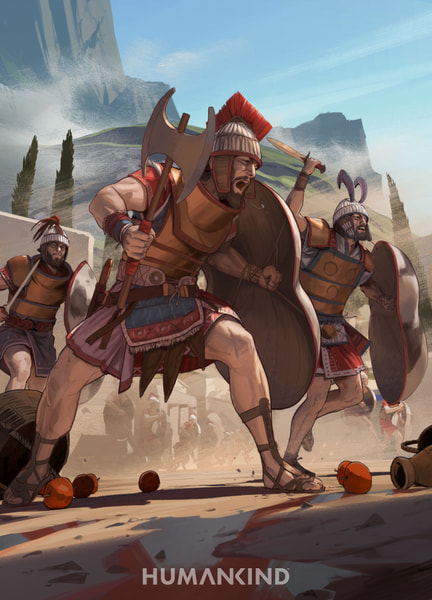 Artist's Impression of Mycenaean Warriors Amplitude Studios (Copyright) ](https://www.worldhistory.org/image/16183/artists-impression-of-mycenaean-warriors/ "Artist's Impression of Mycenaean Warriors")Inhabited since [Neolithic](https://www.worldhistory.org/Neolithic/) times, it is not until c. 2100 BCE that the first walls, [pottery](https://www.worldhistory.org/pottery/) finds (including imports from the Cycladic islands) and pit and shaft graves with higher quality grave goods appear. These, taken collectively, suggest a greater importance and prosperity in the settlement and Mycenae's role as an important city of an early Greek [civilization](https://www.worldhistory.org/civilization/).
From c. 1600 BCE there is evidence of an elite presence on the acropolis: high-quality pottery, [wall](https://www.worldhistory.org/wall/) paintings, shaft graves and an increase in the surrounding settlement with the construction of large tholos tombs. From the 14th century BCE and the [Mycenaean period](https://www.worldhistory.org/Mycenaean_Civilization/), the first large-scale [palace](https://www.worldhistory.org/disambiguation/palace/) complex is built (on three artificial terraces), as is the celebrated tholos [tomb](https://www.worldhistory.org/tomb/), the Treasury of Atreus, a monumental circular building with corbelled roof reaching a height of 13.5 m and 14.6 m in diameter and approached by a long walled and unroofed corridor 36 m long and 6m wide. Fortification walls, of large, roughly worked stone blocks, surrounding the acropolis (of which the north wall is still visible today), flood management structures such as dams, roads, [Linear B](https://www.worldhistory.org/Linear_B_Script/) tablets and an increase in pottery imports (fitting well with theories of contemporary [Mycenaean](https://www.worldhistory.org/Mycenaean_Civilization/) expansion in the [Aegean](https://www.worldhistory.org/aegean/)) illustrate the [culture](https://www.worldhistory.org/disambiguation/culture/) was at its zenith.
[  Lion's Gate at Mycenae Andreas Trepte, www.photo-natur.de (CC BY-SA) ](https://www.worldhistory.org/image/337/lions-gate-at-mycenae/ "Lion's Gate at Mycenae")### [Architecture](https://www.worldhistory.org/disambiguation/architecture/)
The large palace structure built around a central hall or *Megaron* is typical of Mycenaean palaces. Other features included a secondary hall, many private rooms and a workshop complex. Decorated stonework and frescoes, city walls and a monumental entrance, the Lion Gate (a 3 m x 3 m square doorway with an 18-ton lintel topped by two 3 m high heraldic lions and a [column](https://www.worldhistory.org/column/) altar), added to the overall splendour of the complex. The relationship between the palace and the surrounding settlement and between Mycenae and other towns in the Peloponnese is much discussed by scholars. Concrete archaeological evidence is lacking but it seems likely that the palace was a centre of political, religious and commercial power. Certainly, high-value grave goods, administrative tablets, pottery imports and the presence of precious materials deposits such as bronze, gold and ivory would suggest that the palace was, at the very least, the hub of a thriving [trade](https://www.worldhistory.org/disambiguation/trade/) network.
The first palace was destroyed in the late 13th century BCE, probably by an [earthquake](https://www.worldhistory.org/disambiguation/earthquake/) and then (rather poorly) repaired. A monumental staircase, the North Gate, and a ramp were added to the acropolis and the walls were extended to include the Perseia spring within the fortifications. The spring was named after the city's mythological founder and was reached by an impressive corbelled tunnel (or *syrinx*) with 86 steps leading down 18m to the water source. It is argued by some scholars that these architectural additions are evidence for a preoccupation with security and possible invasion. This second palace was itself destroyed, this time with signs of fire. Some rebuilding did occur and pottery finds suggest a degree of prosperity returned briefly before another fire ended occupation of the site until a brief revival in [Hellenistic](https://www.worldhistory.org/Hellenic_World/) times. With the decline of Mycenae, [Argos](https://www.worldhistory.org/argos/) became the dominant power in the region. Reasons for the demise of Mycenae from the 12th century BCE and the Mycenaean civilization in general are much debated with suggestions including natural disaster, over-population, internal social and political unrest or invasion from foreign tribes.
[  Death Mask of Agamemnon Xuan Che (CC BY) ](https://www.worldhistory.org/image/1235/death-mask-of-agamemnon/ "Death Mask of Agamemnon")### Artefacts
Celebrated artefacts from Mycenae, one of Greece's great archaeological sites, include five magnificent beaten gold [burial](https://www.worldhistory.org/burial/) masks (one being incorrectly attributed to Agamemnon by Schliemann), gold diadems, carved rings, cups and a lion head rhyton. A magnificent bronze and gold rhyton in the form of a bull's head, large bronze swords and daggers with richly inlaid scenes on their blades, ivory [sculpture](https://www.worldhistory.org/disambiguation/Sculpture/) and fragments of [fresco](https://www.worldhistory.org/disambiguation/Fresco/) also give testimony to the quality of craftsmanship and wealth of 'golden Mycenae'.
#### Editorial Review
This human-authored definition has been reviewed by our editorial team before publication to ensure accuracy, reliability and adherence to academic standards in accordance with our [editorial policy](https://www.worldhistory.org/static/editorial-policy/).
## Bibliography
- [Cline, E.H. *The Oxford Handbook of the Bronze Age Aegean.* Oxford University Press, USA, 2012.](https://www.worldhistory.org/books/0199873607/)
- [Higgins, R. *Minoan and Mycenaean Art.* Thames & Hudson, 1997.](https://www.worldhistory.org/books/0500203032/)
- [Iakovidis, S.E. *Mycenae-Epidaurus Argos-Tiryns-Nauplion A complete guide to the museums and archaeological..* Ekdotike Athenon S.A., 1996.](https://www.worldhistory.org/books/B000VVZTWM/)
- Spathari, E. *Mycenae.* Hesperos, Athens, 2001
## About the Author
Mark is WHE’s Publishing Director and has an MA in Political Philosophy (University of York). He is a full-time researcher, writer, historian and editor. Special interests include art, architecture and discovering the ideas that all civilizations share.
## Timeline
- **3000 BCE - 2000 BCE**: First inhabitation of [Mycenae](https://www.worldhistory.org/mycenae/) area.
- **c. 2100 BCE**: First evidence of building structures at [Mycenae](https://www.worldhistory.org/mycenae/).
- **c. 1700 BCE - c. 1600 BCE**: First shaft graves constructed at [Mycenae](https://www.worldhistory.org/mycenae/).
- **1700 BCE - 1100 BCE**: The [Mycenaean civilization](https://www.worldhistory.org/Mycenaean_Civilization/) dominates [Greece](https://www.worldhistory.org/greece/).
- **c. 1600 BCE**: First evidence of elite buildings at [Mycenae](https://www.worldhistory.org/mycenae/).
- **c. 1550 BCE**: [Gold](https://www.worldhistory.org/gold/) [death](https://www.worldhistory.org/disambiguation/Death/) masks (including that of '[Agamemnon](https://www.worldhistory.org/disambiguation/Agamemnon/)') made at [Mycenae](https://www.worldhistory.org/mycenae/).
- **c. 1500 BCE**: First tholos tombs built at [Mycenae](https://www.worldhistory.org/mycenae/).
- **c. 1500 BCE - c. 1400 BCE**: First [palace](https://www.worldhistory.org/disambiguation/palace/) structure and Treasury of [Atreus](https://www.worldhistory.org/Atreus/) [tomb](https://www.worldhistory.org/tomb/) built at [Mycenae](https://www.worldhistory.org/mycenae/).
- **c. 1500 BCE - 1200 BCE**: [Mycenae](https://www.worldhistory.org/mycenae/) at its peak of influence.
- **c. 1500 BCE - c. 1200 BCE**: The [Linear B script](https://www.worldhistory.org/Linear_B_Script/) of the [Mycenaean civilization](https://www.worldhistory.org/Mycenaean_Civilization/) is in use.
- **c. 1450 BCE**: Mycenaen influence extended to [Knossos](https://www.worldhistory.org/knossos/), [Crete](https://www.worldhistory.org/crete/).
- **c. 1300 BCE**: First [palace](https://www.worldhistory.org/disambiguation/palace/) destroyed at [Mycenae](https://www.worldhistory.org/mycenae/) and repaired, Lion Gate added and fortifications extended.
- **c. 1300 BCE - c. 1250 BCE**: Cyclopean stone bridge built near [Mycenae](https://www.worldhistory.org/mycenae/).
- **c. 1200 BCE**: Second [palace](https://www.worldhistory.org/disambiguation/palace/) destroyed at [Mycenae](https://www.worldhistory.org/mycenae/), [city](https://www.worldhistory.org/city/) begins to decline.
- **1200 BCE - 1100 BCE**: [Argos](https://www.worldhistory.org/argos/) takes over from [Mycenae](https://www.worldhistory.org/mycenae/) as most important regional power in the Argolid.
- **468 BCE**: Argeians destroy citadel of [Mycenae](https://www.worldhistory.org/mycenae/).
## External Links
- [Mycenaean Civilization | Essay | The Metropolitan Museum of Art | Heilbrunn Timeline of Art History](https://www.metmuseum.org/toah/hd/myce/hd_myce.htm)
## Cite This Work
### APA
Cartwright, M. (2009, September 02). Mycenae. *World History Encyclopedia*.
### Chicago
Cartwright, Mark. "Mycenae." *World History Encyclopedia*, September 02, 2009. .
### MLA
Cartwright, Mark. "Mycenae." *World History Encyclopedia*, 02 Sep 2009, .
## License & Copyright
Submitted by [Mark Cartwright](https://www.worldhistory.org/user/markzcartwright/ "User Page: Mark Cartwright"), published on 02 September 2009. The copyright holder has published this content under the following license: [Creative Commons Attribution-NonCommercial-ShareAlike](https://creativecommons.org/licenses/by-nc-sa/4.0/deed.en). This license lets others remix, tweak, and build upon this content non-commercially, as long as they credit the author and license their new creations under the identical terms. When republishing on the web a hyperlink back to the original content source URL must be included. Please note that content linked from this page may have different licensing terms.