---
title: Lydia
author: Mark Cartwright
source: https://www.worldhistory.org/lydia/
format: machine-readable-alternate
license: Creative Commons Attribution-NonCommercial-ShareAlike (https://creativecommons.org/licenses/by-nc-sa/4.0/)
updated: 1970-01-01
---
# Lydia
_Authored by [Mark Cartwright](https://www.worldhistory.org/user/markzcartwright/)_
Lydia was a region of western [Asia Minor](https://www.worldhistory.org/Asia_Minor/) which prospered due to its natural resources and position on trading routes between the [Mediterranean](https://www.worldhistory.org/disambiguation/mediterranean/) and Asia. The Kingdom of Lydia flourished in the 7th and 6th centuries BCE and expanded to its greatest extent during the reign of [Croesus](https://www.worldhistory.org/croesus/), famed for his great wealth. Lydia then became a Persian satrapy with its capital at [Sardis](https://www.worldhistory.org/sardis/). Conquered by [Alexander the Great](https://www.worldhistory.org/Alexander_the_Great/), Lydia was absorbed into the [Seleucid Empire](https://www.worldhistory.org/Seleucid_Empire/) in the [Hellenistic Period](https://www.worldhistory.org/Hellenistic_Period/). Part of the [Roman](https://www.worldhistory.org/disambiguation/Roman/) province of Asia, Lydia was made a separate province in the 3rd century CE.
### Geography & Resources
Lydia, a name derived from its first King Lydus according to [Herodotus](https://www.worldhistory.org/herodotus/) but also known as Maeonia, occupied the western region of Asia Minor ([Anatolia](https://www.worldhistory.org/Asia_Minor/)) in the Hermus and Cayster Valleys. Its neighbours were Caria (south), [Phrygia](https://www.worldhistory.org/phrygia/) (east), and Mysia (north). The [cities](https://www.worldhistory.org/city/) located on the coast such as Smyrna and [Ephesus](https://www.worldhistory.org/ephesos/) were intermittently under the control of Lydia. As a meeting point between East and West Lydia became an important trading area which further enriched the kingdom already blessed with fertile land and natural resources, especially [silver](https://www.worldhistory.org/Silver/) and [gold](https://www.worldhistory.org/gold/) from the Pactolus River. Lydia was also noted for its production of fine textiles and leather goods.
Lydia had its own language, of [Indo-European](https://www.worldhistory.org/Indo-European_Languages/) origin and with an [alphabet](https://www.worldhistory.org/alphabet/) similar to [Greek](https://www.worldhistory.org/disambiguation/greek/), which was in use until the 1st century BCE. The limited number of surviving inscriptions have resulted in only a partial decipherment of Lydian. Lydia's art, [culture](https://www.worldhistory.org/disambiguation/culture/), and [religion](https://www.worldhistory.org/religion/) also reflected its geographic location and displayed both eastern and Greek influences.
[ 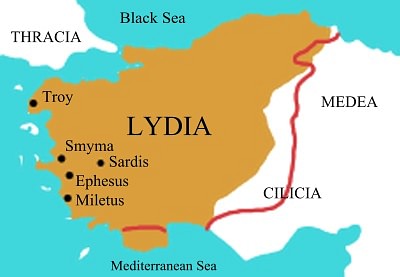 Map of Lydia Roke (CC BY-SA) ](https://www.worldhistory.org/image/155/map-of-lydia/ "Map of Lydia")### The Mermnad Dynasty
Lydia, with its capital at Sardis, rose to its greatest prominence under the reign of the Mermnad dynasty (c. 700 - 546 BCE). The first king of the dynasty was Gyges (r. c. 680 – 645 BCE) who can claim the fame of being the first named tyrant in Greek records. The fourth king was Alyattes (610 - 560 BCE) who, like Gyges, fought the neighbouring Cimmerians but with more success and acquired parts of [Ionia](https://www.worldhistory.org/ionia/). Both Gyges and Alyattes' impressive tombs were laid at Bin Tepe and gained fame for their size in antiquity.
### Croesus
Lydia thrived even more under the last Mermnad king, Croesus (r. 560 - 546 BCE), who conquered the Greek cities on the coast and expanded the [empire](https://www.worldhistory.org/empire/) to control all of the Anatolian plateau up to the river Halys (modern Kizilirmak) and thus border the [Persian empire](https://www.worldhistory.org/disambiguation/Persian_Empire/). Croesus maintained friendly diplomatic relations with the Greeks and he even gave financial aid to the rebuilding of the [Temple of Artemis at Ephesus](https://www.worldhistory.org/Temple_of_Artemis_at_Ephesus/) and made dedications at [Delphi](https://www.worldhistory.org/delphi/) (where he famously misinterpreted the oracle's proclamation that an empire would fall, alas, it was to be Lydia and not, as Croesus thought, [Persia](https://www.worldhistory.org/Persia/)).
[  Lydian Gold Stater Mark Cartwright (CC BY-NC-SA) ](https://www.worldhistory.org/image/816/lydian-gold-stater/ "Lydian Gold Stater")The Greeks told of the legendary wealth of Croesus, probably based on the fact that Lydia was one of the first states to mint [coinage](https://www.worldhistory.org/coinage/), perhaps in the reign of Croesus' father Alyattes. These roughly made coins were small lumps of electrum (an alloy of gold and silver) or pure silver and gold which were stamped with a design of a lion and an ox. Croesus' expansion of Lydia came to an abrupt end when the Persian king [Cyrus II](https://www.worldhistory.org/Cyrus_the_Great/) defeated him in 546 BCE in a [battle](https://www.worldhistory.org/disambiguation/battle/) at Halys. Croesus was thrown on a funeral pyre with legend claiming the king was saved by [Apollo](https://www.worldhistory.org/apollo/) and taken to the mythical land of the Hyperboreans while Sardis was taken and Lydia became, thereafter, a Persian satrapy. During the 5th-century BCE [Persian Wars](https://www.worldhistory.org/Persian_Wars/), Sardis was sacked by the Ionians in 498 BCE and used as a base by [Xerxes](https://www.worldhistory.org/Xerxes_I/) prior to his invasion of mainland [Greece](https://www.worldhistory.org/greece/) in 480 BCE.
### [Hellenistic](https://www.worldhistory.org/Hellenic_World/) & Roman Period
Lydia was conquered by [Alexander](https://www.worldhistory.org/disambiguation/Alexander/) the Great in the 4th century BCE. In the Successor Wars, it first came under the control of [Antigonus I](https://www.worldhistory.org/Antigonus_I/) and then became a part of the [Seleucid](https://www.worldhistory.org/Seleucid_Empire/) Empire in c. 280 BCE. Sardis continued its role as an important regional capital and benefitted from a re-building programme which included a [temple](https://www.worldhistory.org/temple/) to [Artemis](https://www.worldhistory.org/artemis/), a [theatre](https://www.worldhistory.org/disambiguation/theatre/), and [gymnasium](https://www.worldhistory.org/Gymnasium/). In 189 BCE at the Battle of Magnesia between Antiochus III of [Syria](https://www.worldhistory.org/syria/) and [Rome](https://www.worldhistory.org/Rome/), the latter, with the help of Eumenes II of [Pergamon](https://www.worldhistory.org/pergamon/), won a decisive victory. A part of the Roman province of Asia from 133 BCE, Lydia was made a separate province by [Diocletian](https://www.worldhistory.org/Diocletian/) in the 3rd century CE and Sardis was given the honorary title of metropolis.
Life in Roman Lydia was blighted by unrest, the imposition of an administrative Roman ruling class, heavy taxation, and, in 17 CE, a devastating [earthquake](https://www.worldhistory.org/disambiguation/earthquake/) which destroyed 12 cities. The prosperity of the region improved again in the 2nd and 3rd centuries CE as indicated by an increase in the minting of coinage and imperial visits from emperors [Hadrian](https://www.worldhistory.org/hadrian/) (124 CE) and [Caracalla](https://www.worldhistory.org/Caracalla/) (215 CE).
#### Editorial Review
This human-authored definition has been reviewed by our editorial team before publication to ensure accuracy, reliability and adherence to academic standards in accordance with our [editorial policy](https://www.worldhistory.org/static/editorial-policy/).
## Bibliography
- Bagnall, R. et al. *The Encyclopedia of Ancient History.* Wiley-Blackwell, 2012
- [Hornblower, S. *The Oxford Classical Dictionary.* Oxford University Press, 2012.](https://www.worldhistory.org/books/0199545561/)
- [Strassler, R.B. *The Landmark Herodotus.* Anchor Books, 2009.](https://www.worldhistory.org/books/1400031141/)
## About the Author
Mark is WHE’s Publishing Director and has an MA in Political Philosophy (University of York). He is a full-time researcher, writer, historian and editor. Special interests include art, architecture and discovering the ideas that all civilizations share.
## Timeline
- **1200 BCE**: [Lydia](https://www.worldhistory.org/lydia/) arises as a Neo-[Hittite](https://www.worldhistory.org/hittite/) kingdom.
- **1185 BCE - 687 BCE**: Heraclid dynasty rules [Lydia](https://www.worldhistory.org/lydia/).
- **c. 700 BCE - 546 BCE**: The Mermnad dynasty rules [Lydia](https://www.worldhistory.org/lydia/).
- **687 BCE - 652 BCE**: King Gyges rules [Lydia](https://www.worldhistory.org/lydia/) and expands its borders. [Sardis](https://www.worldhistory.org/sardis/) becomes Lydian capital.
- **c. 685 BCE - 546 BCE**: Mermnad Dynasty rules [Lydia](https://www.worldhistory.org/lydia/).
- **c. 635 BCE - 585 BCE**: Reign of Alyattes of [Lydia](https://www.worldhistory.org/lydia/). Minting of first coins made from electrum.
- **c. 625 BCE**: [Lydia](https://www.worldhistory.org/lydia/) drives back the Cimmerians and conquers [Phrygia](https://www.worldhistory.org/phrygia/).
- **c. 600 BCE**: [Gordium](https://www.worldhistory.org/Gordium/) becomes part of [Lydia](https://www.worldhistory.org/lydia/).
- **28 May 585 BCE**: A [battle](https://www.worldhistory.org/disambiguation/battle/) between [Media](https://www.worldhistory.org/disambiguation/media/) and [Lydia](https://www.worldhistory.org/lydia/) broke off immediately as a result of a total eclipse of the sun and the two armies made peace. The eclipse was successfully predicted by [Thales of Miletus](https://www.worldhistory.org/Thales_of_Miletus/).
- **560 BCE**: The oracles of [Delphi](https://www.worldhistory.org/delphi/) and [Thebes](https://www.worldhistory.org/disambiguation/Thebes/) both tell King [Croesus](https://www.worldhistory.org/croesus/) of [Lydia](https://www.worldhistory.org/lydia/) that if he attacks the [Medes](https://www.worldhistory.org/Medes/), he will destroy a great [empire](https://www.worldhistory.org/empire/). Seeing this as a good omen, he goes to [war](https://www.worldhistory.org/disambiguation/War/), loses, and the Lydian Empire is destroyed.
- **560 BCE - 546 BCE**: Reign of [Croesus](https://www.worldhistory.org/croesus/) of [Lydia](https://www.worldhistory.org/lydia/).
- **c. 550 BCE - c. 430 BCE**: Construction of the [Temple of Artemis at Ephesus](https://www.worldhistory.org/Temple_of_Artemis_at_Ephesus/), one of [the Seven Wonders](https://www.worldhistory.org/The_Seven_Wonders/) of the Ancient World.
- **c. 498 BCE**: Ionians and [Greek](https://www.worldhistory.org/disambiguation/greek/) allies invade and burn [Sardis](https://www.worldhistory.org/sardis/) (capital of [Lydia](https://www.worldhistory.org/lydia/)).
- **334 BCE**: [Sardis](https://www.worldhistory.org/sardis/) surrenders to [Alexander the Great](https://www.worldhistory.org/Alexander_the_Great/).
- **280 BCE**: [Lydia](https://www.worldhistory.org/lydia/) becomes a part of the [Seleucid Empire](https://www.worldhistory.org/Seleucid_Empire/).
- **133 BCE**: [Lydia](https://www.worldhistory.org/lydia/) and its captial [Sardis](https://www.worldhistory.org/sardis/) comes under [Roman](https://www.worldhistory.org/disambiguation/Roman/) rule.
- **17 BCE**: An [earthquake](https://www.worldhistory.org/disambiguation/earthquake/) destroys 12 [cities](https://www.worldhistory.org/city/) in [Lydia](https://www.worldhistory.org/lydia/), including [Sardis](https://www.worldhistory.org/sardis/).
- **124 CE**: [Roman emperor](https://www.worldhistory.org/Roman_Emperor/) [Hadrian](https://www.worldhistory.org/hadrian/) visits [Lydia](https://www.worldhistory.org/lydia/).
- **215 CE**: [Roman emperor](https://www.worldhistory.org/Roman_Emperor/) [Caracalla](https://www.worldhistory.org/Caracalla/) visits [Lydia](https://www.worldhistory.org/lydia/).
- **615 CE**: [Sardis](https://www.worldhistory.org/sardis/) is sacked by [Sassanian](https://www.worldhistory.org/Sasanian_Empire/) Persians; damage is never repaired
## External Links
- [Lydia and Phrygia | Essay | The Metropolitan Museum of Art | Heilbrunn Timeline of Art History](https://www.metmuseum.org/toah/hd/lygo/hd_lygo.htm)
## Cite This Work
### APA
Cartwright, M. (2016, April 03). Lydia. *World History Encyclopedia*.
### Chicago
Cartwright, Mark. "Lydia." *World History Encyclopedia*, April 03, 2016. .
### MLA
Cartwright, Mark. "Lydia." *World History Encyclopedia*, 03 Apr 2016, .
## License & Copyright
Submitted by [Mark Cartwright](https://www.worldhistory.org/user/markzcartwright/ "User Page: Mark Cartwright"), published on 03 April 2016. The copyright holder has published this content under the following license: [Creative Commons Attribution-NonCommercial-ShareAlike](https://creativecommons.org/licenses/by-nc-sa/4.0/deed.en). This license lets others remix, tweak, and build upon this content non-commercially, as long as they credit the author and license their new creations under the identical terms. When republishing on the web a hyperlink back to the original content source URL must be included. Please note that content linked from this page may have different licensing terms.