---
title: Lesbos
author: Mark Cartwright
source: https://www.worldhistory.org/lesbos/
format: machine-readable-alternate
license: Creative Commons Attribution-NonCommercial-ShareAlike (https://creativecommons.org/licenses/by-nc-sa/4.0/)
updated: 1970-01-01
---
# Lesbos
_Authored by [Mark Cartwright](https://www.worldhistory.org/user/markzcartwright/)_
Lesbos, a [Greek](https://www.worldhistory.org/disambiguation/greek/) island located in the eastern [Aegean](https://www.worldhistory.org/aegean/), had several prosperous [city](https://www.worldhistory.org/city/)-states which thrived from the [Bronze Age](https://www.worldhistory.org/disambiguation/Bronze_Age/) to the [Byzantine](https://www.worldhistory.org/disambiguation/Byzantine/) era. Switching many times between independence, Persian and Greek control, Lesbos was often a victim of its geographical location on the edge of the Greek world. The island was famous in antiquity for its wine and its [culture](https://www.worldhistory.org/disambiguation/culture/), producing many famous names over the centuries, notably the poetess [Sappho](https://www.worldhistory.org/Sappho_of_Lesbos/), the statesman Pittakos, and the philosopher Theophrastus.
### In [Mythology](https://www.worldhistory.org/mythology/)
According to [Greek mythology](https://www.worldhistory.org/Greek_Mythology/), the island was the birthplace of the hero Lesbos. The island features in the [Trojan War](https://www.worldhistory.org/Trojan_War/) story of [Homer](https://www.worldhistory.org/homer/)'s *[Iliad](https://www.worldhistory.org/iliad/)*, notably when [Agamemnon](https://www.worldhistory.org/disambiguation/Agamemnon/) offers [Achilles](https://www.worldhistory.org/achilles/), amongst other things, seven [women](https://www.worldhistory.org/disambiguation/women/) from Lesbos skilled in handicrafts, in order to persuade the hero to rejoin the conflict. Agamemnon must have known of the great warrior's admiration of the women of Lesbos because Achilles had brought one as his partner for the duration of the [war](https://www.worldhistory.org/disambiguation/War/), Diomede, daughter of Phorbas. The king also mentions in passing that Achilles had captured the island, presumably on their way to [Troy](https://www.worldhistory.org/troy/), and that it had then been part of the Trojan [Empire](https://www.worldhistory.org/empire/) of King Priam.
The island is a brief stopping point for [Odysseus](https://www.worldhistory.org/odysseus/) in Homer's *[Odyssey](https://www.worldhistory.org/Odyssey/)* and the hero's son Telemachus recounts (twice in fact) how his father successfully wrestled Philomeleides, the king of Lesbos who loved to challenge all comers for a bit of rough and tumble, with [death](https://www.worldhistory.org/disambiguation/Death/) the loser's stark reward.
Finally, in some accounts the head of [Orpheus](https://www.worldhistory.org/Orpheus/), that great [lyre](https://www.worldhistory.org/Lyre/) player, washed up on the shores of Lesbos after the poor youth had been ripped to pieces by a group of frenzied Maenads. There, the [Muses](https://www.worldhistory.org/muse/) buried it and built a shrine where birds would sing in such a fashion as to recall his fabulous lost talent. Orpheus' lyre, also smashed by the Maenads, is said to have washed up on the island, too, where it was discovered by a fisherman and given to the famed 7th-century BCE musician and poet Terpander.
[ 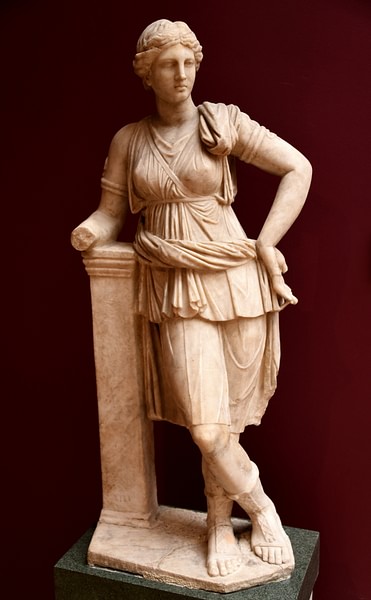 Statue of Artemis from Mytilene Osama Shukir Muhammed Amin (Copyright) ](https://www.worldhistory.org/image/8700/statue-of-artemis-from-mytilene/ "Statue of Artemis from Mytilene")### Historical Overview
**[Bronze](https://www.worldhistory.org/disambiguation/bronze/) Age Lesbos**
The island of Lesbos is located in the northeastern Aegean, off the west coast of [Turkey](https://www.worldhistory.org/Asia_Minor/), and it is the third-largest Greek island measuring some 1,630 sq. km (629 sq. mi). Inhabited since the [Neolithic period](https://www.worldhistory.org/Neolithic/), the island prospered in the Bronze Age but was, being only 10 km (6 miles) from the Turkish coast, closer in culture to [Anatolia](https://www.worldhistory.org/Asia_Minor/) than the [Mycenaean civilization](https://www.worldhistory.org/Mycenaean_Civilization/) on mainland [Greece](https://www.worldhistory.org/greece/). At this time the most important settlement was Thermi on the coast, named after its hot springs. In the late Bronze Age (10th century BCE) there was perhaps a significant wave of immigration to Lesbos from mainland Greece, most likely the [Thessaly](https://www.worldhistory.org/disambiguation/Thessaly/) region, and the Aiolic dialect was widely spoken on the island thereafter. There remained a distinctive culture which mixed Greek, Anatolian, and indigenous cultural practices. Unique elements included the production of grey [bucchero](https://www.worldhistory.org/Bucchero/) [pottery](https://www.worldhistory.org/pottery/). The island prospered largely thanks to its production and export of olives, olive oil, and wine, as evidenced by finds of Lesbian [amphorae](https://www.worldhistory.org/Amphora/) across the Greek world.
**Greek Lesbos**
In the [Archaic period](https://www.worldhistory.org/Archaic_Period/), the Penthelid dynasty dominated the island as tyrants, but according to [Aristotle](https://www.worldhistory.org/aristotle/) (384-322 BCE), they were kicked out by a group of aristocrats c. 630 BCE. The island was able to support a naval force which allowed it to control areas in Anatolia ([Asia Minor](https://www.worldhistory.org/Asia_Minor/)) to the east and Thrace to the north. Major city-states dotted across the island included Antissa, Eresus, Methymna, Pyrrha, and the most powerful polis of all, Mytilene, which was similar in size to Athens in its heyday. The ruins of fortifications and rural watchtowers - perhaps to protect mineral mines - would suggest that there were sometimes military clashes between the [cities](https://www.worldhistory.org/city/), while the presence of artificial harbour moles in several towns illustrates the naval and commercial strength of the island. Important religious temples were built at Klopedi in the countryside (dedicated to [Apollo](https://www.worldhistory.org/apollo/)) and at Mesa. Mytilene had a [temple](https://www.worldhistory.org/temple/) dedicated to [Demeter](https://www.worldhistory.org/demeter/) and Kore while there was a sanctuary to [Dionysos](https://www.worldhistory.org/Dionysos/) at Methymna, perhaps no coincidence given the town's reputation for its fine wine. [Cybele](https://www.worldhistory.org/Cybele/), the mother goddess, was worshipped in several towns, another link with Anatolian culture.
Some of the Lesbian cities continued to suffer internally from the rivalries of tyrants and aristocratic clans, Mytilene famously had Pittakos (aka Pittacus, c. 650-570 BCE) as its elected tyrant (*aisymnetes*), who was considered one of the seven sages of ancient Greece. Pittakos, again according to Aristotle, was responsible for instigating a new [law](https://www.worldhistory.org/disambiguation/law/) code, with the sage declaring that laws were the best protection a city could have. One of the most famous of Pittakos' laws was that the punishment for any crime should be doubled if the guilty party were drunk at the time of the crime.
[ 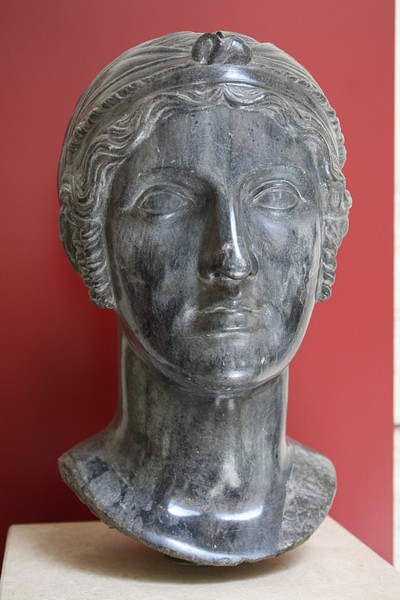 Sappho of Lesbos, Palazzo Massimo Mark Cartwright (CC BY-NC-SA) ](https://www.worldhistory.org/image/2123/sappho-of-lesbos-palazzo-massimo/ "Sappho of Lesbos, Palazzo Massimo")Another famous figure from Lesbos was the poetess Sappho (c. 620-570 BCE) whose skills earned her the title of 'the tenth [muse](https://www.worldhistory.org/muse/).' The fact that many of [Sappho of Lesbos](https://www.worldhistory.org/Sappho_of_Lesbos/)' surviving poems seem to deal with love between women or girls led to, in post-Classical times, the term 'lesbian' being used to refer to female homosexuals. However, the Greeks themselves never used such a term with that meaning and, in any case, lesbianism was far from being unique to the island even if it is a rare subject in Greek art and met the disapproval of such later thinkers as [Plato](https://www.worldhistory.org/plato/) (c. 428 - c. 347 BCE).
During the mid-6th century BCE, the Persians took control of Lesbos, but following the early 5th century BCE [Persian Wars](https://www.worldhistory.org/Persian_Wars/), the island was once more an independent Greek island and became a founding member of the [Delian League](https://www.worldhistory.org/Delian_League/). The League was formed as an association for mutual assistance should any Greek state be attacked again by the Persians, but it eventually degenerated into the Athenian Empire after Athens, its most powerful member state, took over the League's treasury and compelled members to pay their dues (in money or ships). Mytilene revolted against this in 428 BCE, but the island was brutally dealt with by Athens and made into a colony or cleruchy (except Methymna which had remained loyal). A famous figure from 5th-century BCE Lesbos was the historian Hellanicus of Mytilene (c. 480-395 BCE), a prolific compiler of myths, ethnologies, and local history, but, sadly, only fragments of his work survive.
[ 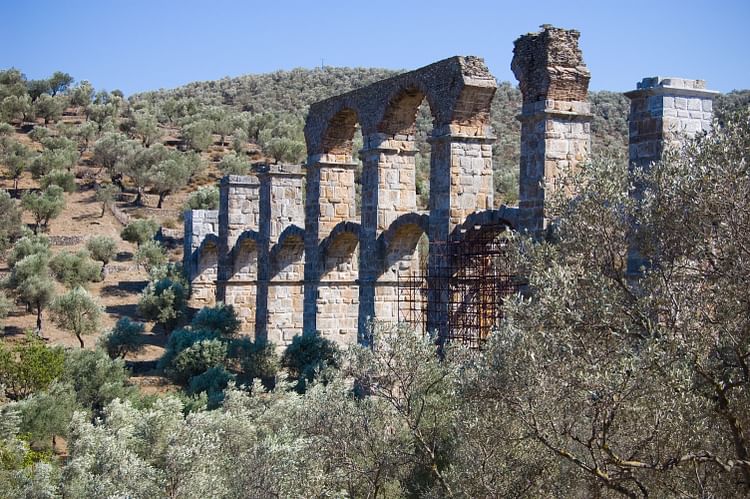 Roman Aqueduct, Lesbos Jonathan Lundqvist (CC BY) ](https://www.worldhistory.org/image/11121/roman-aqueduct-lesbos/ "Roman Aqueduct, Lesbos")In the mid-4th century BCE, [Persia](https://www.worldhistory.org/Persia/) was once again in control of the island with tyrannies established at Mytilene, Methymna, and Eresos. In the next century, the Greek world grabbed the island back thanks to the arrival of [Alexander the Great](https://www.worldhistory.org/Alexander_the_Great/) (356-323 BCE). After a period when the cities on the island were ruled by Macedonian tyrants, many [poleis](https://www.worldhistory.org/Polis/) developed a form of democracy as Lesbos became part of the Ptolemaic part of [Alexander](https://www.worldhistory.org/disambiguation/Alexander/)'s once-great empire. A celebrated islander from this period was the philosopher and botanist Theophrastus (c. 371 - c. 287 BCE), the successor to Aristotle as the head of the Lyceum in Athens. Around 231 BCE Pyrrha was destroyed by an [earthquake](https://www.worldhistory.org/disambiguation/earthquake/).
**[Roman](https://www.worldhistory.org/disambiguation/Roman/) Lesbos**
In 168 BCE the Romans made their [mark](https://www.worldhistory.org/disambiguation/Mark/) on the island by destroying Antissa and, in 84 BCE, the Roman general and politician Lucullus (118 - c. 57 BCE) captured the whole island. Mytilene was sacked in 79 BCE after the city supported [Mithridates VI](https://www.worldhistory.org/Mithridates_VI/) (120-63 BCE), the king of Pontus, against [Rome](https://www.worldhistory.org/Rome/). Better treatment was given by [Pompey the Great](https://www.worldhistory.org/pompey/) (106-48 BCE) who made the island independent again, perhaps because of his friendship with the famed historian Theophanes of Mytilene.
Settling down as an unobtrusive part of the [Roman Empire](https://www.worldhistory.org/Roman_Empire/) when it attracted many rich Roman holiday-makers, Lesbos next came to wider prominence as a centre of [early Christianity](https://www.worldhistory.org/article/1205/early-christianity/). By the Byzantine period, Lesbos had many large Christian basilicas and two prominent bishops at Mytilene and Methymna, including the famed historian and bishop Zacharias of Mytilene (b. c. 465 CE). Lesbos, despite a few brief political wrangles, remained a quiet corner of the [Byzantine Empire](https://www.worldhistory.org/Byzantine_Empire/) until it fell to the Ottomans in 1462 CE.
Today, there are few substantial remains to remind of the island's importance in antiquity save a few temple and sanctuary foundations, a 2nd/3rd-century CE [aqueduct](https://www.worldhistory.org/aqueduct/) near Mytilene and, dotted here and there, ruins of Roman buildings such as theatres, basilicas, and private villas. One outstanding artwork which has survived from the island's heyday is a full standing figure of [Artemis](https://www.worldhistory.org/artemis/). Rendered in marble by a Roman 3rd-century CE sculptor copying a [Hellenistic](https://www.worldhistory.org/Hellenic_World/) original, the statue now resides in the Archaeological Museum of Istanbul.
#### Editorial Review
This human-authored definition has been reviewed by our editorial team before publication to ensure accuracy, reliability and adherence to academic standards in accordance with our [editorial policy](https://www.worldhistory.org/static/editorial-policy/).
## Bibliography
- Bagnall, R. (ed). *The Encyclopedia of Ancient History.* Wiley-Blackwell, 2012
- [Graziosi, B. (ed). *The Oxford Handbook of Hellenic Studies.* Oxford University Press, 2009.](https://www.worldhistory.org/books/0199286140/)
- [Homer. *The Iliad.* Penguin Classics, 1998.](https://www.worldhistory.org/books/0140275363/)
- [Homer. *The Odyssey.* Penguin Classics, 1999.](https://www.worldhistory.org/books/0140268863/)
- [Hope Moncrieff, R. *Classical Mythology.* Senate, 1994.](https://www.worldhistory.org/books/1859580092/)
- [Hornblower, S. *The Oxford Classical Dictionary.* Oxford University Press, 2012.](https://www.worldhistory.org/books/0199545561/)
- [Kinzl, K.H. (ed). *A Companion to the Classical Greek World.* Wiley-Blackwell, 2010.](https://www.worldhistory.org/books/1444334123/)
- [Rosser, J.H. *Historical Dictionary of Byzantium.* Scarecrow Press, 2001.](https://www.worldhistory.org/books/0810839792/)
## About the Author
Mark is WHE’s Publishing Director and has an MA in Political Philosophy (University of York). He is a full-time researcher, writer, historian and editor. Special interests include art, architecture and discovering the ideas that all civilizations share.
## Timeline
- **1000 BCE - 900 BCE**: Settlers from [Thessaly](https://www.worldhistory.org/disambiguation/Thessaly/) arrive on [Lesbos](https://www.worldhistory.org/lesbos/).
- **c. 650 BCE - 570 BCE**: Life of Pittakos, elected tyrant of Mytilene on [Lesbos](https://www.worldhistory.org/lesbos/).
- **c. 630 BCE**: Aristocrats remove the ruling Penthelid clan from power on [Lesbos](https://www.worldhistory.org/lesbos/).
- **c. 620 BCE - c. 570 BCE**: Life of [Sappho of Lesbos](https://www.worldhistory.org/Sappho_of_Lesbos/).
- **c. 480 BCE - 395 BCE**: Life of the historian Hellanicus of Mytilene.
- **428 BCE**: Mytilene on [Lesbos](https://www.worldhistory.org/lesbos/) unsuccessfully revolts against the Athenian domination of the [Delian League](https://www.worldhistory.org/Delian_League/).
- **231 BCE**: Pyrrha on [Lesbos](https://www.worldhistory.org/lesbos/) is destroyed by an [earthquake](https://www.worldhistory.org/disambiguation/earthquake/).
- **168 BCE**: The Romans destroy Antissa on [Lesbos](https://www.worldhistory.org/lesbos/).
- **84 BCE**: The [Roman](https://www.worldhistory.org/disambiguation/Roman/) general and politician Lucullus captures [Lesbos](https://www.worldhistory.org/lesbos/).
- **79 BCE**: Mytilene on [Lesbos](https://www.worldhistory.org/lesbos/) is sacked by the Romans after the [city](https://www.worldhistory.org/city/) supported [Mithridates VI](https://www.worldhistory.org/Mithridates_VI/).
## Cite This Work
### APA
Cartwright, M. (2019, August 28). Lesbos. *World History Encyclopedia*.
### Chicago
Cartwright, Mark. "Lesbos." *World History Encyclopedia*, August 28, 2019. .
### MLA
Cartwright, Mark. "Lesbos." *World History Encyclopedia*, 28 Aug 2019, .
## License & Copyright
Submitted by [Mark Cartwright](https://www.worldhistory.org/user/markzcartwright/ "User Page: Mark Cartwright"), published on 28 August 2019. The copyright holder has published this content under the following license: [Creative Commons Attribution-NonCommercial-ShareAlike](https://creativecommons.org/licenses/by-nc-sa/4.0/deed.en). This license lets others remix, tweak, and build upon this content non-commercially, as long as they credit the author and license their new creations under the identical terms. When republishing on the web a hyperlink back to the original content source URL must be included. Please note that content linked from this page may have different licensing terms.