---
title: Jupiter
author: Donald L. Wasson
source: https://www.worldhistory.org/jupiter/
format: machine-readable-alternate
license: Creative Commons Attribution-NonCommercial-ShareAlike (https://creativecommons.org/licenses/by-nc-sa/4.0/)
updated: 2022-12-04
---
# Jupiter
_Authored by [Donald L. Wasson](https://www.worldhistory.org/user/DWasson/)_
Among the many gods of the Romans, Jupiter, the son of [Saturn](https://www.worldhistory.org/Saturn/), was the supreme [god](https://www.worldhistory.org/God/), associated with thunder, lightning, and storms. The first citizens of what would become [Rome](https://www.worldhistory.org/Rome/) believed they were watched over by the spirits of their ancestors, and they added a triad of gods to these spirits. These new gods included [Mars](https://www.worldhistory.org/Mars/), the god of [war](https://www.worldhistory.org/disambiguation/War/); Quirinus, the deified [Romulus](https://www.worldhistory.org/Romulus_and_Remus/) who watched over the people of Rome; and lastly, Jupiter, the supreme god. He was Jupiter Elicius - one who brings forth. By the rise of the Republic, Jupiter's identity as the greatest of all the gods was firmly established, but two members of the old triad were replaced with [Juno](https://www.worldhistory.org/Juno/) (his sister and wife) and [Minerva](https://www.worldhistory.org/Minerva/) (his daughter). Jupiter's most important title was Jupiter Optimus Maximus, meaning the Best and Greatest and signifying his role as father of the gods.
Jupiter, the old, personalized deity of the [Etruscan](https://www.worldhistory.org/Etruscan_Civilization/) kings, found a new home in the Republic. He was a god of light, a protector during defeat, and the giver of victory. He was Jupiter Imperator, the supreme general; Jupiter Invictus, the unconquered; and lastly, Jupiter Triumphator. He protected Rome in time of war and maintained the welfare of the people during peace. He was most often portrayed with a long, white beard, and his symbol was the eagle atop a scepter which he carried as he sat upon his majestic throne. As with [Zeus](https://www.worldhistory.org/zeus/), his reputation for violence often caused men to tremble in fear for he could easily punish them with one of his thunderbolts. Of course, he would give them a fair warning before the final, destructive bolt, and punishment was usually carried out only with the consent of the other gods.
### Jupiter in [Roman Religion](https://www.worldhistory.org/Roman_Religion/)
[Religion](https://www.worldhistory.org/religion/) has always been a significant element of almost every society, modern or ancient. It explained everything, including the [seasons](https://www.worldhistory.org/Horae/), the rise of the sun in the morning and the moon at night. The gods protected people from their enemies, the forces of nature, and fought alongside them during times of war. The gods were ever-present in their folklore and temples were built to honor them. Sacrifices were made to win the gods' blessing. Prior to the rise of the monotheism of the Judeo-Christians, most cultures worshipped a multitude of gods. There was a god of war, a god of the harvest, and even a goddess of fertility. The [Roman Empire](https://www.worldhistory.org/Roman_Empire/) was no different.
To the early Romans religion and faith, especially during the early years of the Republic, offered reassurance and protection to the people. It was a major component in every aspect of life; few decisions were made without appealing to the gods. [Roman](https://www.worldhistory.org/disambiguation/Roman/) religion, however, was not individualistic as [Christianity](https://www.worldhistory.org/christianity/), for example; it was communal. There was no holy text or creed; there was only the *pax* *deorum* or peace of the gods. Through rituals and prayer, the Romans curried favor with the gods and thereby evaded his or her wrath. And, while the Romans were often tolerant of the religion of those they conquered (often absorbing an occasional new god or two), they remained protective of the official state religion and were suspicious of anything that might undermine their power structure. This suspicion was the underlying cause of the persecution of both the Jews and Christians during the reigns of [Nero](https://www.worldhistory.org/Nero/) and subsequent emperors. This protection would enable Jupiter and his fellow Olympians to survive from the [Etruscans](https://www.worldhistory.org/Etruscan_Civilization/), through both the Republican and Imperial Eras, and up to the rise of Christianity.
### [Temple](https://www.worldhistory.org/temple/) in Rome
Around 509 BCE a magnificent temple, shared with Juno and Minerva, was erected on Capitoline Hill in Rome, a place where people could gather and make sacrifices. Aside from a large [sculpture](https://www.worldhistory.org/disambiguation/Sculpture/) of Jupiter, the temple, the grandest of all in Rome, housed the Sibylline books which were the oracles of Rome and were only consulted during moments of crisis. Jupiter was worshipped by many titles: Invictus, Imperator, and Triumphator - titles that represented his supreme importance to Rome in all matters of state life, both in peace and war. After returning from [battle](https://www.worldhistory.org/disambiguation/battle/), victorious generals would lead a procession called a [triumph](https://www.worldhistory.org/Roman_Triumph/) through the streets of Rome to Jupiter's temple. The general would be dressed in a long, purple robe, carrying a scepter in his right hand, riding in a [chariot](https://www.worldhistory.org/chariot/) drawn by four white horses; he was followed by a large mass of citizens, his army, and prisoners of war, the latter of course, in chains. After arriving at the temple, he would make a sacrifice, being sure to donate a portion of his booty to Jupiter, thanking Jupiter for his victory in battle.
To these generals Jupiter represented the fearlessness of the [Roman army](https://www.worldhistory.org/Roman_Army/). However, while he was worshipped by the military, often being viewed as a patron of violence, he was also a political god, conferring legitimacy to both the popular assembly and the Senate. The Senate would not allow a declaration of war without the blessing of Jupiter. He was the patron of oaths and treaties and the punisher of perjurers. No political action was begun or completed without his judgment. The chief games celebrated in September, the *Ludi [Romani](https://www.worldhistory.org/Romani/)*, were observed in his honor.
[ 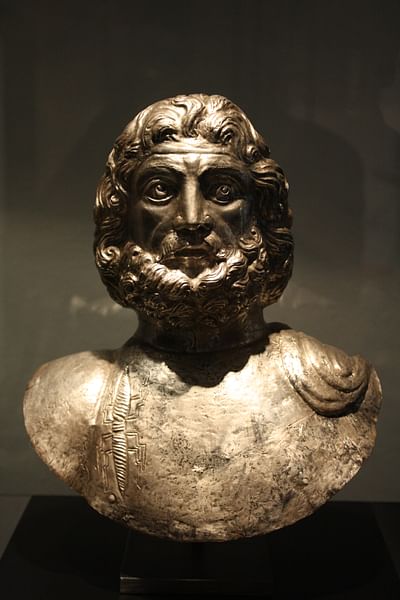 Bust of Jupiter Graius Mark Cartwright (CC BY-NC-SA) ](https://www.worldhistory.org/image/2150/bust-of-jupiter-graius/ "Bust of Jupiter Graius")### The Decline of Jupiter
Jupiter, however, had his detractors and challenges. After the [death](https://www.worldhistory.org/disambiguation/Death/) of [Julius Caesar](https://www.worldhistory.org/Julius_Caesar/), who at one time served as a *flamen* *dialis* or Jupiter's personal priestly officer, Emperor [Augustus](https://www.worldhistory.org/augustus/)' followers initiated an imperial cult: the worship of the emperor as a god. While Augustus rejected the idea of being a god, those emperors who followed often relished the idea, often conferring deification of a predecessor; Emperor [Caligula](https://www.worldhistory.org/Caligula/) even claimed himself to be a living god. And like [Alexander the Great](https://www.worldhistory.org/Alexander_the_Great/), who believed he was the son of Zeus, Emperor [Galba](https://www.worldhistory.org/Galba/) believed he was descended from Jupiter. Emperor [Elagabalus](https://www.worldhistory.org/Elagabalus/) temporarily replaced Jupiter with Elagabal, a Syrian god. He even had a large, black conical-shaped stone - a cult symbol of his religion - brought from [Syria](https://www.worldhistory.org/syria/) and installed on the Palatine Hill. A new temple, the Elagabalium, was built to honor Elagabal. Luckily, his successor, [Alexander Severus](https://www.worldhistory.org/Alexander_Severus/) wanted to curry favor with the people of Rome and returned Jupiter to his proper place as supreme god: he sent the stone back to Syria. Later, in the third century, Jupiter was replaced, this time it was the cult of *Sol* *Invictus*, the Unconquered Sun, a patron of soldiers. Again, Jupiter was saved by Emperor [Diocletian](https://www.worldhistory.org/Diocletian/). Lastly, St. [Augustine](https://www.worldhistory.org/disambiguation/Augustine/), author of *[City](https://www.worldhistory.org/city/) of God*, condemned both Roman society and its religion. He wrote that not only had the Roman gods failed to protect the Romans from disaster, but Jupiter was singled out as being an adulterer.
With the rise of Christianity and the fall of the [Empire](https://www.worldhistory.org/empire/) in the 5th century CE, Jupiter and his fellow gods became the stuff of [mythology](https://www.worldhistory.org/mythology/). Their names now live on through the planets: Jupiter, [Neptune](https://www.worldhistory.org/Neptune/), Mars, Mercury, and [Venus](https://www.worldhistory.org/venus/). Unfortunately, Jupiter's memory has also been overshadowed by his [Greek](https://www.worldhistory.org/disambiguation/greek/) counterpart Zeus. He did, however, play a crucial role in Roman [culture](https://www.worldhistory.org/disambiguation/culture/) throughout most of its history. He protected Romans from the wrath of their enemies, during peace and in war. Despite the successes and failures of the emperors, Jupiter was, then, an ever-present feature of [Roman daily life](https://www.worldhistory.org/article/637/roman-daily-life/).
#### Editorial Review
This human-authored definition has been reviewed by our editorial team before publication to ensure accuracy, reliability and adherence to academic standards in accordance with our [editorial policy](https://www.worldhistory.org/static/editorial-policy/).
## Bibliography
- [Freeman, P. *Julius Caesar.* Simon & Schuster, 2009.](https://www.worldhistory.org/books/0743289544/)
- [Gwynn, D.M. *The Roman Republic.* Oxford University Press, 2012.](https://www.worldhistory.org/books/0199595119/)
- [Hornblower, S. *The Oxford Classical Dictionary.* Oxford University Press, 2012.](https://www.worldhistory.org/books/0199545561/)
- Rodgers, N. *Roman Empire.* Metro Books, 2008
- [Scarre, C. *Chronicle of the Roman Emperors.* Thames & Hudson, 1995.](https://www.worldhistory.org/books/B004PG03S4/)
- [Stapleton, M. *A Dictionary of Greek and Roman Mythology.* Outlet, 1979.](https://www.worldhistory.org/books/0517262819/)
## About the Author
Donald has taught Ancient, Medieval and U.S. History at Lincoln College (Normal, Illinois)and has always been and will always be a student of history, ever since learning about Alexander the Great. He is eager to pass knowledge on to his students.
## Timeline
- **146 BCE**: First [Roman](https://www.worldhistory.org/disambiguation/Roman/) all-marble building is constructed, the [temple](https://www.worldhistory.org/temple/) of [Jupiter](https://www.worldhistory.org/jupiter/) Stater in [Rome](https://www.worldhistory.org/Rome/).
- **c. 1 CE - c. 100 CE**: Construction of the [temple](https://www.worldhistory.org/temple/) of [Jupiter](https://www.worldhistory.org/jupiter/) [Baal](https://www.worldhistory.org/baal/) by the Romans at [Baalbek](https://www.worldhistory.org/Baalbek/).
## Cite This Work
### APA
Wasson, D. L. (2014, May 06). Jupiter. *World History Encyclopedia*.
### Chicago
Wasson, Donald L.. "Jupiter." *World History Encyclopedia*, May 06, 2014. .
### MLA
Wasson, Donald L.. "Jupiter." *World History Encyclopedia*, 06 May 2014, .
## License & Copyright
Submitted by [Donald L. Wasson](https://www.worldhistory.org/user/DWasson/ "User Page: Donald L. Wasson"), published on 06 May 2014. The copyright holder has published this content under the following license: [Creative Commons Attribution-NonCommercial-ShareAlike](https://creativecommons.org/licenses/by-nc-sa/4.0/deed.en). This license lets others remix, tweak, and build upon this content non-commercially, as long as they credit the author and license their new creations under the identical terms. When republishing on the web a hyperlink back to the original content source URL must be included. Please note that content linked from this page may have different licensing terms.