---
title: Ishtar
author: Louise Pryke
source: https://www.worldhistory.org/ishtar/
format: machine-readable-alternate
license: Creative Commons Attribution-NonCommercial-ShareAlike (https://creativecommons.org/licenses/by-nc-sa/4.0/)
updated: 1970-01-01
---
# Ishtar
_Authored by [Louise Pryke](https://www.worldhistory.org/user/louise.pryke/)_
Ishtar ([Inanna](https://www.worldhistory.org/Inanna/) in [Sumerian](https://www.worldhistory.org/Sumerians/) sources) is a primary Mesopotamian goddess closely associated with love and [war](https://www.worldhistory.org/disambiguation/War/). This powerful Mesopotamian goddess is the first known deity for which we have written evidence. While largely unknown in the modern day, this powerful ancient deity had a complex and influential role in the religions and cultures of the Ancient [Near East](https://www.worldhistory.org/Near_East/).
In the ancient world, it is difficult to overstate the importance of Inanna/Ishtar. As the most famous Mesopotamian goddess, her substantial influence was embedded in many aspects of her worshippers' lives, and she was revered across the broad geographical reach of the Ancient Near East for a period of history spanning thousands of years. Ishtar comes from a very early time in the history of complex civilisations, with her cult attested at [Uruk](https://www.worldhistory.org/uruk/) as early as the late 4th millennium BCE.
### Importance
Evidence for Ishtar comes from [Mesopotamia](https://www.worldhistory.org/Mesopotamia/), an area of the Ancient Near East generally considered to be placed geographically between the Tigris and Euphrates rivers. Although there is much debate about Mesopotamia's exact territorial extent, it is considered to roughly correspond with modern-day Iraq, Kuwait and parts of [Syria](https://www.worldhistory.org/syria/), Iran, and [Turkey](https://www.worldhistory.org/Asia_Minor/). Mesopotamia was home to many of the world's first great empires, including the [Akkadian](https://www.worldhistory.org/disambiguation/akkadian/), Babylonian and Assyrian Empires.
#### Author Promotion
[](https://www.worldhistory.org/books/1138860735/ "Ishtar by Louise Pryke")### Ishtar
by Louise M. Pryke The author of this article has just published a book on the subject. [Ishtar](https://www.worldhistory.org/books/1138860735/) is the first book dedicated to providing an accessible analysis of the mythology and image of this complex goddess. Louise M. Pryke is a Lecturer for the Languages and Literature of Ancient Israel at Macquarie University, Australia, and holds a PhD in Ancient Near Eastern History from the University of Sydney. [Learn More](https://www.worldhistory.org/books/1138860735/)
.sponsor.book img.key_art {
box-shadow: none !important;
}
.button_container {
margin-top: 1em;
}
.sponsor.book h3 {
text-transform: none;
margin-top: 0px;
margin-bottom: 15px;
font-family: "Libre Baskerville", "Palatino Linotype", "Book Antiqua", Palatino, serif;
}
.sponsor_message {
margin-left: 190px;
font-family: Karla, Arial, Helvetica, sans-serif;
line-height: 140%;
min-height: 200px;
}
.sponsor.book {
padding: 20px;
margin: 25px 0px;
background-color: #f3f3f3;
}
.sponsor.book .key_art {
margin-top: 0px;
margin-bottom: 10px;
float: left;
}
.sponsor h4 {
font-weight: bold;
text-transform: uppercase;
color: #000;
margin-bottom: 10px;
margin-top: 0px;
font-family: Karla,Arial,Helvetica,sans-serif;
font-size: 13px;
padding: 0;
}
.sponsor_book_author {
color: #999;
margin: -10px 0px 20px;
}
@media (max-width: 1199px) {
.sponsor.book .key_art {
float: none;
width: 100%;
}
.sponsor.book .sponsor_message {
margin-left: 0px;
}
.sponsor.book h3 {
margin-top: 20px;
margin-bottom: 10px;
}
}
@media (max-width: 767px) {
}
Ishtar had a significant impact on the images and cults of many later goddesses, including the famous [Greek](https://www.worldhistory.org/disambiguation/greek/) goddess of love, [Aphrodite](https://www.worldhistory.org/Aphrodite/), and other well-known goddesses such as [Astarte](https://www.worldhistory.org/astarte/). Many goddesses from the Classical period, such as Aphrodite, [Artemis](https://www.worldhistory.org/artemis/), and [Athena](https://www.worldhistory.org/athena/), have continued to function as important cultural symbols. Ishtar, comparatively, has not enjoyed similar longevity to her image. From being among the most commonly attested of ancient Mesopotamian deities, she has fallen into almost complete obscurity.
Ishtar's slide into modern-day anonymity likely resulted from a variety of causes but can be most plausibly connected to the disappearance of the [cuneiform](https://www.worldhistory.org/cuneiform/) [writing](https://www.worldhistory.org/writing/) system. For over 3,000 years, cuneiform was the primary means of communication throughout the Ancient Near East and into parts of the [Mediterranean](https://www.worldhistory.org/disambiguation/mediterranean/). It fell from use by around 400 CE, although the processes involved in this change remain enigmatic. Ishtar's influence in the ancient world subsided alongside the script used to record her myths and prophecies.
### Sources
Inanna/Ishtar is frequently presented anthropomorphically in myths. In Sumerian love poetry, she is depicted as a young woman who lives at home with her mother, Ningal, and her father, [Nanna](https://www.worldhistory.org/Nanna/) (the Mesopotamian moon [god](https://www.worldhistory.org/God/), Sin). Her twin brother is Utu (Semitic [Shamash](https://www.worldhistory.org/Utu-Shamash/)), the solar deity, who is connected to the concept of justice. Ishtar herself is also associated with a celestial body: [Venus](https://www.worldhistory.org/venus/), the morning and evening star. The goddess's courting partner is Dumuzi (Semitic Tammuz), who appears in myths as a shepherd king. Dumuzi's mother is the goddess Duttur, and his sister is Geshtinanna.
[  Ishtar Clay Mould Osama Shukir Muhammed Amin (Copyright) ](https://www.worldhistory.org/image/8095/ishtar-clay-mould/ "Ishtar Clay Mould")The ancient sources for Ishtar, while extensive, are fragmentary, incomplete, and difficult to contextualise. The problematic nature of the evidence for Ishtar is surprising when considered in light of the goddess' elevated status, and her enduring influence in the ancient world. The difficulties with the evidence can be considered largely (although not exclusively) the result of the goddess' antiquity. Among the ancient literary sources, the goddess is best known for her appearance in two of the most famous myths from Mesopotamia: the *Epic of [Gilgamesh](https://www.worldhistory.org/gilgamesh/)*, and *Ishtar's Descent to the Netherworld*.
### The *Epic of Gilgamesh*
The *Epic of Gilgamesh* is one of the world's earliest known works of epic [literature](https://www.worldhistory.org/literature/), surviving in numerous versions. The story tells of the journey of the young hero Gilgamesh, semi-divine king of the [city](https://www.worldhistory.org/city/) of Uruk. In the Standard Babylonian Version of the *Epic of Gilgamesh*, Ishtar appears most prominently in Tablet VI. Here, Gilgamesh is described bathing and cleaning his weapons after doing [battle](https://www.worldhistory.org/disambiguation/battle/) with the Forest Guardian, Humbaba, at an earlier point in the narrative. Ishtar sees the young king's beauty and looks at him covetously. She proposes marriage and offers some nice inducements to sweeten the deal. Gilgamesh, it seems, does not want to marry Ishtar, and he makes the questionable choice of rejecting her in harshly unflattering terms.
[ 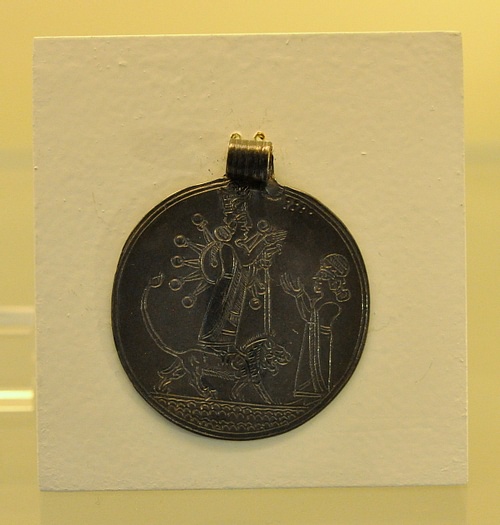 Pendant of Ishtar Osama Shukir Muhammed Amin (Copyright) ](https://www.worldhistory.org/image/7179/pendant-of-ishtar/ "Pendant of Ishtar")In his refusal of Ishtar's proposal, Gilgamesh compares the goddess to a drafty back door, a faulty battering ram, and a shoe which bites the feet of its owner. This last insult may be viewed as ominous, as in ancient divination, an abrasion from an ill-fitting sandal was considered to be a portent with potentially fatal consequences.
Ishtar is shown as greatly distressed by Gilgamesh's cruel rejection. She travels to the heavens to visit the sky deity, [Anu](https://www.worldhistory.org/Anu/). Through the use of threats and emotional blackmail, the goddess persuades the elder god to loan her the Bull of Heaven. Her plan is to use the mighty bovine warrior to seek revenge on Gilgamesh. When Anu eventually agrees, Ishtar leads the Bull back to earth. The cosmic Bull (associated with the constellation, Taurus) battles against Gilgamesh and his companion, Enkidu. The two heroes are able to kill the great beast, and Ishtar mourns over its body with the [women](https://www.worldhistory.org/disambiguation/women/) of the city.
### *Ishtar's Descent to the Netherworld*
Ishtar and her shepherd husband, Tammuz (Sumerian Inanna and Dumuzi), are the divine protagonists of one of the world's oldest known love stories. Despite having an intimate and loving relationship in Sumerian poetry, the romance does not end in lasting happiness for the pair. Once Ishtar and Tammuz have united, they are soon separated by disloyalty, [death](https://www.worldhistory.org/disambiguation/Death/), and some underworld demons.
The myth of *Ishtar's Descent to the Netherworld* tells the story of the goddess's journey to the underworld, the home of her sister, [Ereshkigal](https://www.worldhistory.org/Ereshkigal/). While numerous reasons have been suggested for Ishtar's journey, it seems most likely that she is motivated by the ambitious desire to increase her own powers. The goddess travels through the seven gates of the underworld, removing an item of clothing at each gate. Ishtar finally arrives naked before her sister, Ereshkigal, who is the Queen of the Netherworld, and is killed.
[  Goddess Ishtar descent to the underworld tablet Osama Shukir Muhammed Amin (Copyright) ](https://www.worldhistory.org/image/2464/goddess-ishtar-descent-to-the-underworld-tablet/ "Goddess Ishtar descent to the underworld tablet")The death of the goddess of love leaves her trapped in the underworld and requiring rescue. With the assistance of her faithful companion, Ninshubur, Ishtar is revived through the clever plotting of the god of wisdom, Ea (Sumerian [Enki](https://www.worldhistory.org/Enki/)). Ishtar's place in the underworld cannot be left empty, and the deity rises along with a group of demons to search for a replacement. Following a long search, her consort, Tammuz, is sent to the underworld in her place.
### Other Myths
Beyond the *Descent* myth and *Gilgamesh* lies a wealth of further textual evidence for the deity. Inanna/Ishtar appears in royal hymns, several myths, prophetic texts, magic spells, and even proverbs. The earliest poems to Inanna/Ishtar were written by [Enheduanna](https://www.worldhistory.org/Enheduanna/), the world's first known author to be individually identified. Enheduanna (circa 2300 BCE) is generally considered to have been a historical figure living in [Ur](https://www.worldhistory.org/ur/), one of the world's oldest urban centres. She was a priestess of the moon god and the daughter of [Sargon of Akkad](https://www.worldhistory.org/Sargon_of_Akkad/) (“Sargon the Great”, 2334-2279 BCE). Many of the lesser known myths involving Inanna have only been published in the last 50 years or so. It was only as recently as 1983 CE, with the publication of *Inanna, Queen of Heaven and Earth*, that the goddess began to become more widely known outside of scholarly circles.
### Representation in Art
In artistic works, the imagery of the goddess is a dominant motif of [grave](https://www.worldhistory.org/burial/) goods, and she appears alongside kings in royal iconography. Barrett has convincingly argued that the famous Burney Relief, with its depiction of the nude, winged goddess, represents an “underworld form” of Ishtar. Several features of the Relief indicate that the goddess is being presented in the context of her visit to the underworld. The deity holds the rod and ring of leadership, a turban and a necklace, and is possibly wearing a wig. The double row of oval-like shapes at the base of the Relief represent mountains, which have associations with death, as do the owls. While not a part of the myth, the positioning of the figure on the back of two lions strengthens the connection to Ishtar, as does the figure's frontal presentation. The goddess' nudity suggests the stage in the myth of the Descent where she is close to death—perhaps on her way back from the realm of the dead. The talons and wings of the figure may show the goddess returning from the Netherworld in pursuit of vengeance—leading to the death of her lover, Tammuz. In many myths, the goddess is closely associated with vengeance, justice, and the maintenance of cosmic order.
[  Queen of the Night or Burney's Relief, Mesopotamia Osama Shukir Muhammed Amin (Copyright) ](https://www.worldhistory.org/image/2460/queen-of-the-night-or-burneys-relief-mesopotamia/ "Queen of the Night or Burney's Relief, Mesopotamia")Ishtar in portraiture may be accompanied by her emblematic animal, the lion, and she often carries weapons. Sumerian Inanna, in particular, is often represented with a lion or standing on top of a lion. She also appears in iconography in her celestial aspect, as an eight-pointed star, and is associated in visual sources with rosettes. Ishtar's star is often depicted alongside a sun-disk and a crescent-shaped moon symbol, representing her brother, the solar deity Shamash (Sumerian Utu), and her father, the moon deity Sin (Sumerian Nanna). Ishtar's association with the astral emblem of an eight-pointed star is found on cylinder seals from the [Early Dynastic](https://www.worldhistory.org/disambiguation/Early_Dynastic/) Period (2900-2300 BCE) and remains closely linked to the deity through thousands of years of Mesopotamian history, up to the Neo-Babylonian period.
The goddess is at times presented alongside scorpion imagery, such as on Babylonian cylinder seals. This artistic connection to scorpions can also be seen in literary sources, where Inanna battles a [giant](https://www.worldhistory.org/Giants/) scorpion in a Sumerian myth depicting her usurpation of the god of heaven, An (Semitic Anu). Ishtar may be pictured alongside the Mesopotamian king, and she is shown taking part in religious rituals or ceremonies. This type of scene is famously presented on the Warka Vase, a carved alabaster vessel discovered in Inanna's [temple](https://www.worldhistory.org/temple/) complex in Uruk. The vase shows the goddess standing at the doorway of the temple, receiving a procession, and is one of the oldest known examples of narrative relief [sculpture](https://www.worldhistory.org/disambiguation/Sculpture/), dating around 3000 BCE.
### Kingship & Legacy
Ishtar had a special relationship with the human rulers of Mesopotamia. In her association with Mesopotamian kings, Ishtar/Inanna is represented as spouse, lover, sister, and mother—sometimes all within a single composition. Although her role shows flexibility, the textual evidence is thematically linked through an emphasis on the goddess' physicality, especially her feminine form. The affections of the goddess held a legitimising function for kings, with the concept of “king by love of Inanna” able to be traced back to the earliest origins of political hierarchy.
Ishtar is not well-known in the modern day, and what remains of her image has been frequently obscured by historiographical biases. The controversy around Ishtar's modern image can be most overtly seen in the distorted fixation on the goddess's sexuality found in much 20th-century CE scholarship. While Ishtar's sexuality is a vital aspect of her image, the emphasis on her erotic side has overshadowed many of the other important elements of the deity's image, such as her connection to [warfare](https://www.worldhistory.org/warfare/) and the dispensing of justice, her association with [music](https://www.worldhistory.org/disambiguation/Music/), joy, and abundance, and her religious ties to death and vengeance.
The obscurity of the goddess' myths in the present day has, generally speaking, resulted in her image being found primarily in works with particularly strong mythical input, particularly the genres of [science](https://www.worldhistory.org/science/) fiction and fantasy. Glimpses of the ancient deity may be found in television series such as Stargate, SG-1, [Hercules](https://www.worldhistory.org/hercules/), the Legendary Journeys, and Buffy the Vampire Slayer. Myths of Ishtar also appear in the written works of Neil Gaiman, Richard Adams, and Robert A. Heinlein.
In the present day, one of the world's most ancient known deities has been reimagined as a character in modern comics. Inanna appeared in comics for the first time in Marvel's 1974 CE comic, *Conan the Barbarian* #40, “The Fiend from the Forgotten City.” In the comic, the barbarian hero Conan is assisted by the goddess while fighting against looters in an ancient “forgotten city.” Marvel's Inanna holds similar powers to her mythical counterpart, including the ability to heal. Ishtar has also appeared in DC Comics, along with her husband, Tammuz. In *Madame [Xanadu](https://www.worldhistory.org/Xanadu/) Special* #1.1 (1981 CE), the ancient lovers are resurrected—but only temporarily.
### Love & Social Connections
Ishtar, the world's first known goddess of love, is connected to many forms of emotional intimacy. While this association certainly includes sexual love, it encompasses a variety of other types of loving bonds. The goddess has caring relationships with her divine family, and her maidservant, Ninshubur. Love connected the goddess to the historical Mesopotamian king, in a unique bond that blended the roles of mother, wife, and sister. The goddess' affections were deemed to protect those she cared for, binding together families, communities, and empires in powerful ties that persevered even beyond death.
In myths, Ishtar uses her status as the goddess of love and her extraordinary skills for social networking to enhance her power. While not generally listed among the most dominant of great [Mesopotamian gods](https://www.worldhistory.org/collection/196/mesopotamian-gods/) (at different times, these would be more likely [Enlil](https://www.worldhistory.org/Enlil/), Ea, [Marduk](https://www.worldhistory.org/Marduk/), [Assur](https://www.worldhistory.org/assur/), or Anu), Ishtar's competence in using social connections in the service of her ambitions gave her a distinctive role in the [pantheon](https://www.worldhistory.org/Pantheon/). Indeed, the deity's remarkable capacity for social networking is one of the most constant aspects of her image. Ishtar's identity as a powerful female deity, alongside her mastery of social networking, makes the appreciation of this ancient goddess particularly topical for modern day audiences.
#### Editorial Review
This human-authored definition has been reviewed by our editorial team before publication to ensure accuracy, reliability and adherence to academic standards in accordance with our [editorial policy](https://www.worldhistory.org/static/editorial-policy/).
## Bibliography
- [Asher-Greve, J. *Goddesses in Context.* Vandenhoeck & Ruprecht, 2013.](https://www.worldhistory.org/books/3525543824/)
- [Bahrani, Z. *Women of Babylon.* Routledge, 2011.](https://www.worldhistory.org/books/0415619386/)
- Barrett, C. "Was Dust Their Food and Clay Their Bread? Grave Goods, the Mesopotamian Afterlife, and the Liminal Role of Inana/Ishtar." *Journal of Ancient Near Eastern Religions*, 07/2007, pp. 7-65.
- Goodnick Westenholz, J. "King by Love of Inanna—An Image of Female Empowerment?." *NIN*, 01/2000, pp. 75-89.
- Harris, R. B. "Inanna-Ishtar as Paradox and a Coincidence of Opposites." *History of Religions*, 30/1991, pp. 261-78.
- [Hrusa, I. *Ancient Mesopotamian Religion.* Ugarit Verlag, 2015.](https://www.worldhistory.org/books/3868351183/)
- [Leick, G. *Sex & Eroticism in Mesopotamian Literature.* Routledge, 2003.](https://www.worldhistory.org/books/0415311616/)
- [Pryke, L. M. *Ishtar.* Routledge, 2017.](https://www.worldhistory.org/books/1138860735/)
- [Wolkstein, D. *Inanna, Queen of Heaven and Earth.* Harper Perennial, 1983.](https://www.worldhistory.org/books/0060908548/)
- [Zgoll, A. *Die Kunst Des Betens.* Ugarit Verlag, 2004.](https://www.worldhistory.org/books/3934628451/)
## About the Author
Dr. Louise Pryke is an Honorary Research Associate and Lecturer at the University of Sydney. She is the author of Scorpion (2016), Ishtar (2017) and Gilgamesh (2019).
- [X/Twitter Profile](https://twitter.com/louloveshistory)
## Timeline
- **c. 3000 BCE - c. 2000 BCE**: [Nineveh](https://www.worldhistory.org/nineveh/) is a major religious center for the worship of the goddess [Ishtar](https://www.worldhistory.org/ishtar/).
- **c. 2300 BCE**: Life of [Enheduanna](https://www.worldhistory.org/Enheduanna/), daughter of [Sargon of Akkad](https://www.worldhistory.org/Sargon_of_Akkad/), and world's first author known by name.
- **c. 2100 BCE - c. 1400 BCE**: The tales of [Gilgamesh](https://www.worldhistory.org/gilgamesh/) written which inform the Epic of Gilgamesh.
- **c. 1900 BCE - c. 1600 BCE**: The poem "Descent of [Inanna](https://www.worldhistory.org/Inanna/)" is written.
## External Links
- [Cognitive Science and the Ancient Near Eastern Religious Imagination](https://www.asor.org/anetoday/2021/08/cognitive-science-religious-imagination/)
## Cite This Work
### APA
Pryke, L. (2019, May 10). Ishtar. *World History Encyclopedia*.
### Chicago
Pryke, Louise. "Ishtar." *World History Encyclopedia*, May 10, 2019. .
### MLA
Pryke, Louise. "Ishtar." *World History Encyclopedia*, 10 May 2019, .
## License & Copyright
Submitted by [Louise Pryke](https://www.worldhistory.org/user/louise.pryke/ "User Page: Louise Pryke"), published on 10 May 2019. The copyright holder has published this content under the following license: [Creative Commons Attribution-NonCommercial-ShareAlike](https://creativecommons.org/licenses/by-nc-sa/4.0/deed.en). This license lets others remix, tweak, and build upon this content non-commercially, as long as they credit the author and license their new creations under the identical terms. When republishing on the web a hyperlink back to the original content source URL must be included. Please note that content linked from this page may have different licensing terms.