---
title: The Classical Orders of Architecture: From Greece to Rome, the Five Pillars of Architectural Design
author: Simeon Netchev
source: https://www.worldhistory.org/image/948/the-classical-orders-of-architecture/
format: machine-readable-alternate
license: Creative Commons Attribution-NonCommercial-NoDerivs (https://creativecommons.org/licenses/by-nc/4.0)
updated: 2026-01-20
---
# The Classical Orders of Architecture: From Greece to Rome, the Five Pillars of Architectural Design
_Authored by [Simeon Netchev](https://www.worldhistory.org/user/simeonnetchev/)_
## Image File
[](https://www.worldhistory.org/uploads/images/948.png)
## Image Caption
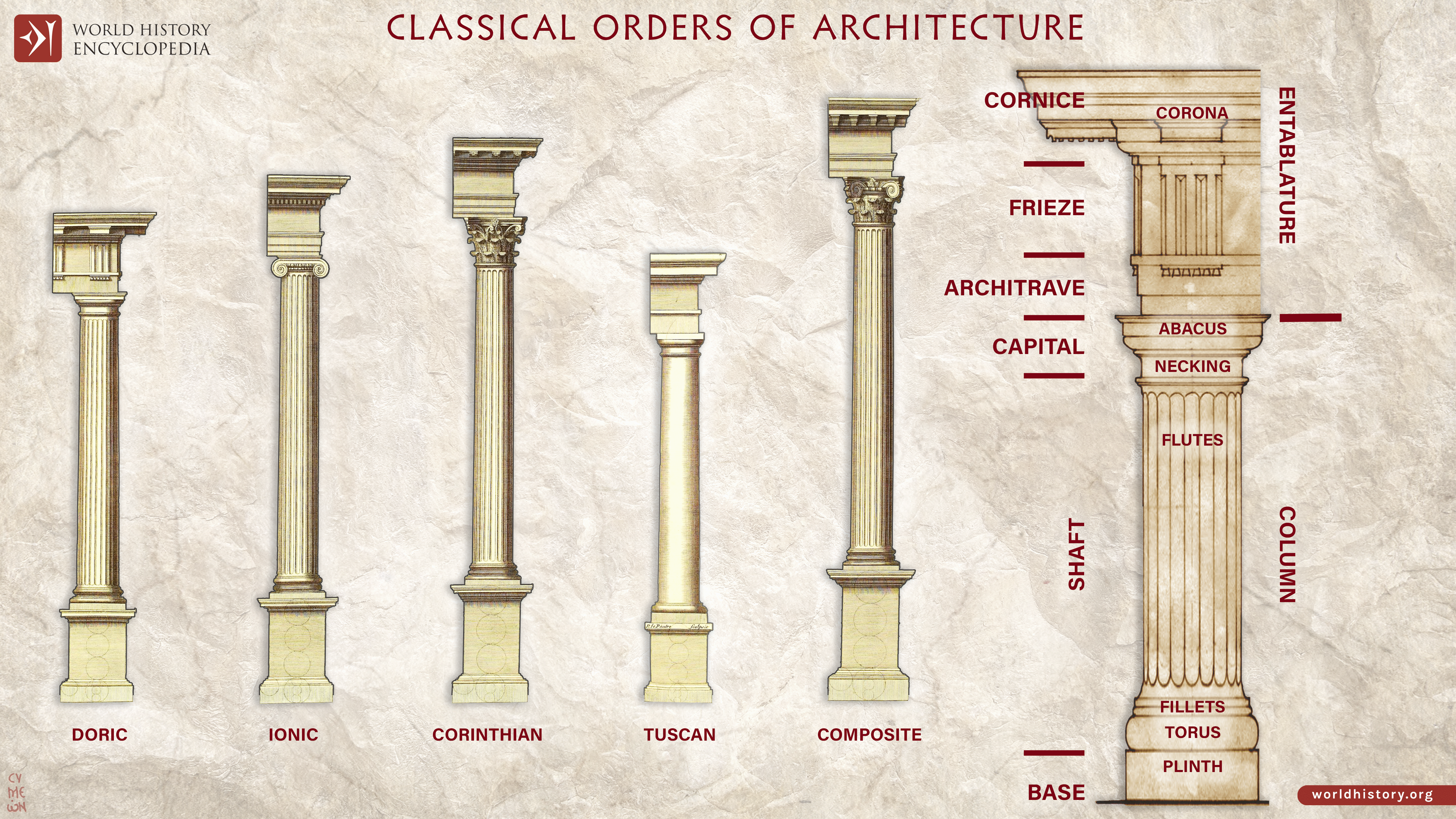
The five classical orders of [architecture](https://www.worldhistory.org/disambiguation/architecture/): Doric, Ionic, Corinthian, Tuscan, and Composite, form a codified system of proportion, decoration, and structural logic that emerged in the [Greek](https://www.worldhistory.org/disambiguation/greek/) world (c. 7th–4th centuries BCE) and was later adapted and formalized by [Roman](https://www.worldhistory.org/disambiguation/Roman/) architects (c. 1st century BCE–2nd century CE). Originally developed to standardize the design of temples and civic buildings, the orders expressed cultural values such as restraint, balance, refinement, and imperial authority. Their principles were preserved through Roman architectural treatises, most notably V*itruvius* ([writing](https://www.worldhistory.org/writing/) c. 30–20 BCE), ensuring their transmission into later architectural traditions.
The Doric order (c. 7th century BCE) is the earliest and most austere, characterized by heavy proportions and minimal ornament, reflecting ideals of strength and discipline. The Ionic order (c. 6th century BCE) introduced slimmer columns and distinctive volutes, associated with elegance and intellectual refinement, while the Corinthian order (developed c. 5th–4th centuries BCE) emphasized elaborate acanthus decoration and visual richness. Roman architects expanded this system by introducing the Tuscan order, a simplified and more utilitarian variant of Doric, and the Composite order (c. 1st century CE), which fused Ionic volutes with Corinthian foliage into a distinctly Roman expression of grandeur. Together, these orders established a visual language rooted in harmony and proportion, shaping architecture from imperial [Rome](https://www.worldhistory.org/Rome/) through the Renaissance and into modern Neoclassicism.
#### Editorial Review
This human-authored image has been reviewed by our editorial team before publication to ensure accuracy, reliability and adherence to academic standards in accordance with our [editorial policy](https://www.worldhistory.org/static/editorial-policy/).
## About the Author
Simeon is a freelance visual designer and history educator, passionate about the human stories that shape the past.
- [Linkedin Profile](https://www.linkedin.com/in/simeon-netchev/)
## Cite This Work
### APA
Netchev, S. (2026, January 20). The Classical Orders of Architecture: From Greece to Rome, the Five Pillars of Architectural Design. *World History Encyclopedia*.
### Chicago
Netchev, Simeon. "The Classical Orders of Architecture: From Greece to Rome, the Five Pillars of Architectural Design." *World History Encyclopedia*, January 20, 2026. .
### MLA
Netchev, Simeon. "The Classical Orders of Architecture: From Greece to Rome, the Five Pillars of Architectural Design." *World History Encyclopedia*, 20 Jan 2026, .
## License & Copyright
Submitted by [Simeon Netchev](https://www.worldhistory.org/user/simeonnetchev/ "User Page: Simeon Netchev"), published on 20 January 2026. The copyright holder has published this content under the following license: [Creative Commons Attribution-NonCommercial-NoDerivs](https://creativecommons.org/licenses/by-nc/4.0deed.en). This licence only allows others to download this content and share it with others as long as the author is credited, but they can't change the content in any way or use it commercially. When republishing on the web a hyperlink back to the original content source URL must be included. Please note that content linked from this page may have different licensing terms.