---
title: Maya Spouted Jar
author: Metropolitan Museum of Art
source: https://www.worldhistory.org/image/8621/maya-spouted-jar/
format: machine-readable-alternate
updated: 1970-01-01
---
# Maya Spouted Jar
_Authored by Metropolitan Museum of Art_
## Image File
[](https://www.worldhistory.org/uploads/images/8621.jpg)
## Image Caption
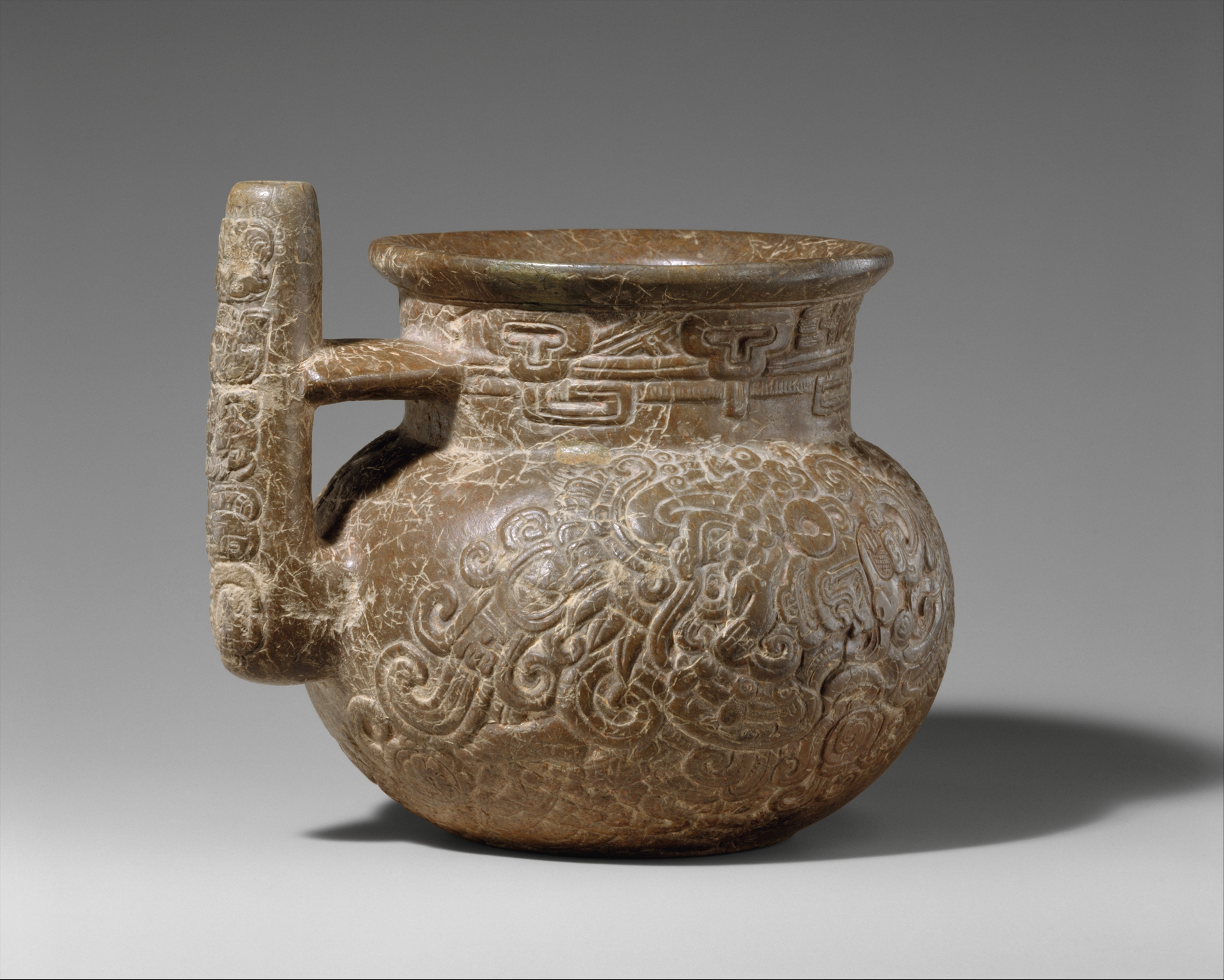
This spouted vessel is one of the most elegantly sculpted stone containers in the corpus of [Maya](https://www.worldhistory.org/disambiguation/Maya/) art. Its form with the vertical spout parallel to the central axis of the main chamber is known from the late 1st millennium B.C. and is especially related to [chocolate](https://www.worldhistory.org/disambiguation/Chocolate/) consumption. The ancient Maya would inject air into the spout so that the bubbling effect would produce a frothy spume on the surface of the savory chocolate drink. Carved from indurated (compacted) limestone, the vessel is a rare example of such a spouted container in stone. The neck of the vessel contains a “sky-band,” a motif in Maya art indicating a celestial location, that has t-shaped hieroglyphs deciphered as IK, “wind” separated by diagonal lines. The globular body of the vessel is perfectly symmetrical and the bottom of the chamber is leveled off for ease of storage. On either side of the spout on the body of the vessel are ornate deities floating in smoky volutes. The specificity of these figures contrasts with the repetitive abstraction of the sky band rim decoration. The first supernatural, to the proper right of the spout, has avian characteristics including wings, a buccal mask of a protruding beak and downturned mouth, though human-like hands and feet are clearly visible on its twisted limbs. The avian deity faces downward, a common convention for ancestors looking down on living rulers from above in [sculpture](https://www.worldhistory.org/disambiguation/Sculpture/) from the Late Preclassic (ca. 300 B.C.–A.D. 250) and Early Classic Period (ca. A.D. 250–550). A hieroglyphic phrase composed of an open hand holding a sign for k’in “sun” is found directly above the deity’s head, signaling that it is a specific, named individual. The second figure, on the proper left side of the spout, has more human-like characteristics, with symbols associated with the Maya Maize [God](https://www.worldhistory.org/God/), including: the distinguished profile with sloping forehead, the two parallel lines on the cheek, the protruding tooth from the mouth, and jade jewels adoring the wrists, ankles, pectorals, and loin cloth. Another name [hieroglyph](https://www.worldhistory.org/disambiguation/hieroglyph/) appears above the forehead of this Maize Deity as he faces up. A hieroglyphic inscription appears on the spout; while not fully deciphered, it contains a dedication of the vessel. The hieroglyphs, which mention the dedication of the stone bowl (u-K’AL-wa TUUN) and mentions the name of one of the depicted gods, are in a style consistent with Early Classic texts, approximately the 4th century, according to epigrapher Stephen Houston. Houston also identified that the Early Classic artist of this vessel executed the images on the sides of the pot in a style more consistent with earlier, [archaic](https://www.worldhistory.org/disambiguation/Archaic/) images from the Preclassic period. James Doyle, 2016 Metropolitan Museum of Art
## Cite This Work
### APA
Art, M. M. o. (2018, April 16). Maya Spouted Jar. *World History Encyclopedia*.
### Chicago
Art, Metropolitan Museum of. "Maya Spouted Jar." *World History Encyclopedia*, April 16, 2018. .
### MLA
Art, Metropolitan Museum of. "Maya Spouted Jar." *World History Encyclopedia*, 16 Apr 2018, .
## License & Copyright
© [Metropolitan Museum of Art](http://metmuseum.org/), NY. As part of the [Met's Open Access policy](https://www.metmuseum.org/about-the-met/policies-and-documents/open-access), the Metropolitan Museum of Art has waived all copyright and related or neighboring rights to this dataset. [Original image](https://www.metmuseum.org/art/collection/search/318346) by [**Metropolitan Museum of Art**](https://www.metmuseum.org/art/collection/search/318346). Submitted by [Ibolya Horváth](https://www.worldhistory.org/user/horvath.ibolya/ "User Page: Ibolya Horváth"), published on 16 April 2018. The copyright holder has published this content under the following license: [Copyright](http://en.wikipedia.org/wiki/Copyright). You cannot use, copy, distribute, or modify this item without explicit permission from the author. Please note that content linked from this page may have different licensing terms.