---
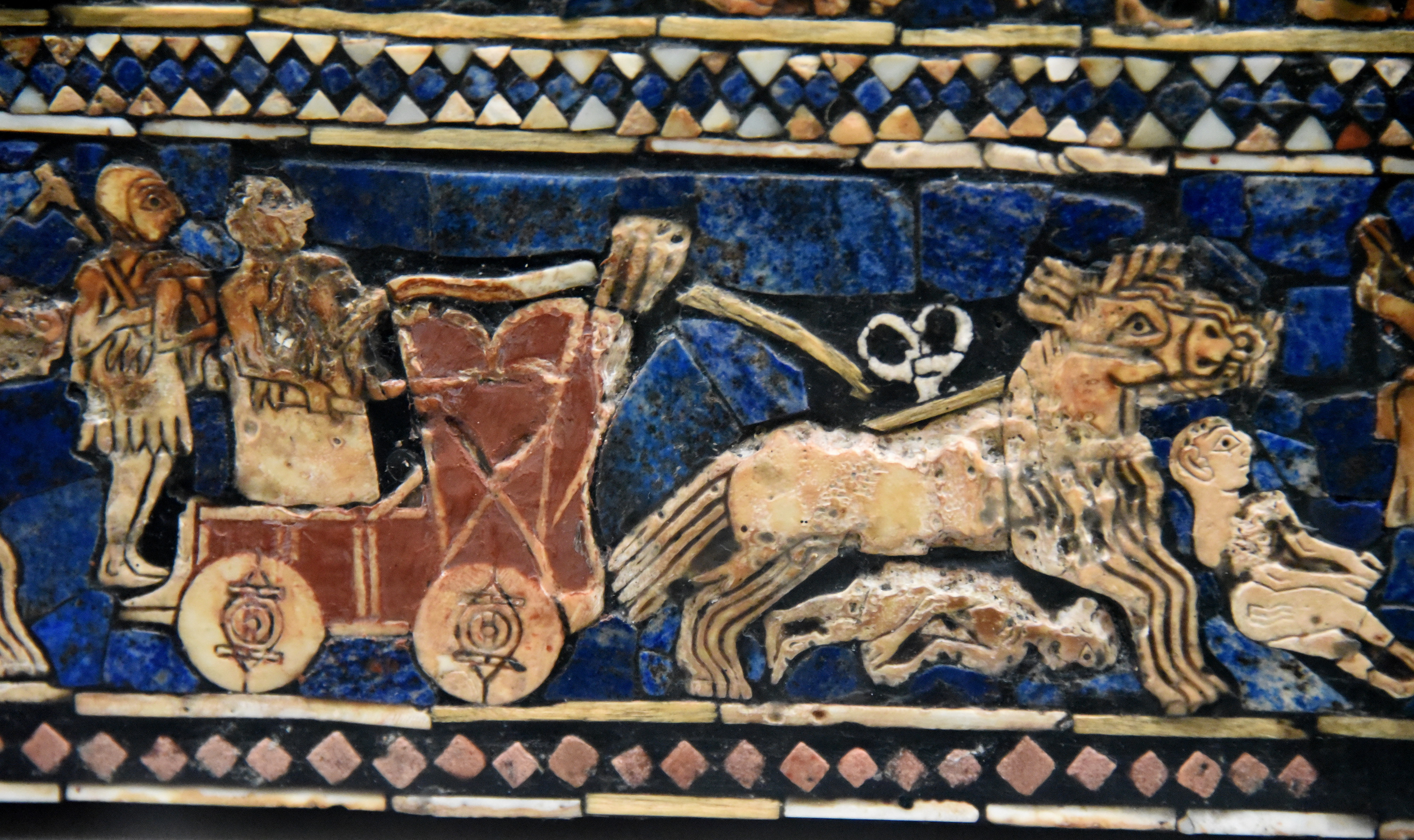
title: Detail of the War Scene of the Standard of Ur Showing a Galloping Chariot
author: Osama Shukir Muhammed Amin
source: https://www.worldhistory.org/image/8427/detail-of-the-war-scene-of-the-standard-of-ur-show/
format: machine-readable-alternate
updated: 1970-01-01
---
# Detail of the War Scene of the Standard of Ur Showing a Galloping Chariot
_Authored by [Osama Shukir Muhammed Amin](https://www.worldhistory.org/user/OsamaSMAmin/)_
## Image File
[](https://www.worldhistory.org/uploads/images/8427.jpg)
## Image Caption
This is a detail of the so-called "[War](https://www.worldhistory.org/disambiguation/War/) Scene" of the Standard of [Ur](https://www.worldhistory.org/ur/) from the right half of the bottom register. Here, a four-wheeled [chariot](https://www.worldhistory.org/chariot/) is drawn by four galloping equids. The wheels of the chariot are solid and not spoked; around 1800 BCE, spoked wheels were invented. A charioteer drives the chariot and holds the reins. Behind him, another soldier accompanies him, holding an axe. At the front of the chariot, a container for spare spears appears. There are no bits (bits were introduced about 1000 years later). There is a rein post with rings on the back of the equids. These animals were probably onagers or asses; during the second millennium BCE, horses came to [Mesopotamia](https://www.worldhistory.org/Mesopotamia/) from Central Asia. This example is a perfect one illustrating how [Sumerians](https://www.worldhistory.org/Sumerians/), 4500 years ago, harnessed equids without bits. There are two trampled and naked enemy soldiers; one below the hooves and one in front of the legs of the equids. The depictions, in [mosaic](https://www.worldhistory.org/Mosaic/), were made using lapis lazuli, red limestone, and shell set in place with bitumen. The Standard of Ur is a (reconstructed) hollow box and its precise purpose is unknown. [Early Dynastic](https://www.worldhistory.org/disambiguation/Early_Dynastic/) Period, circa 2500 BCE. From the Royal Cemetry of Ur, Ur, Sothern Mesopotamia, modern-day Iraq. (The British Museum, London).
#### Editorial Review
This human-authored image has been reviewed by our editorial team before publication to ensure accuracy, reliability and adherence to academic standards in accordance with our [editorial policy](https://www.worldhistory.org/static/editorial-policy/).
## About the Author
Associate Professor of Neurology and lover of the Cradle of Civilization, Mesopotamia. I'm very interested in Mesopotamian history and always try to take photos of archaeological sites and artifacts in museums, both in Iraq and around the world.
- [Facebook Profile](https://www.facebook.com/MRCPian)
- [Linkedin Profile](https://www.linkedin.com/in/osama-shukir-muhammed-amin/)
## Cite This Work
### APA
Amin, O. S. M. (2018, April 06). Detail of the War Scene of the Standard of Ur Showing a Galloping Chariot. *World History Encyclopedia*.
### Chicago
Amin, Osama Shukir Muhammed. "Detail of the War Scene of the Standard of Ur Showing a Galloping Chariot." *World History Encyclopedia*, April 06, 2018. .
### MLA
Amin, Osama Shukir Muhammed. "Detail of the War Scene of the Standard of Ur Showing a Galloping Chariot." *World History Encyclopedia*, 06 Apr 2018, .
## License & Copyright
Submitted by [Osama Shukir Muhammed Amin](https://www.worldhistory.org/user/OsamaSMAmin/ "User Page: Osama Shukir Muhammed Amin"), published on 06 April 2018. The copyright holder has published this content under the following license: [Copyright](http://en.wikipedia.org/wiki/Copyright). You cannot use, copy, distribute, or modify this item without explicit permission from the author. Please note that content linked from this page may have different licensing terms.