---
title: The Lady of Elche
author: James Blake Wiener
source: https://www.worldhistory.org/image/7520/the-lady-of-elche/
format: machine-readable-alternate
license: Creative Commons Attribution-NonCommercial-ShareAlike (https://creativecommons.org/licenses/by-nc-sa/4.0/)
updated: 1970-01-01
---
# The Lady of Elche
_Authored by [James Blake Wiener](https://www.worldhistory.org/user/jbw288/)_
## Image File
[](https://www.worldhistory.org/uploads/images/7520.jpg)
## Image Caption
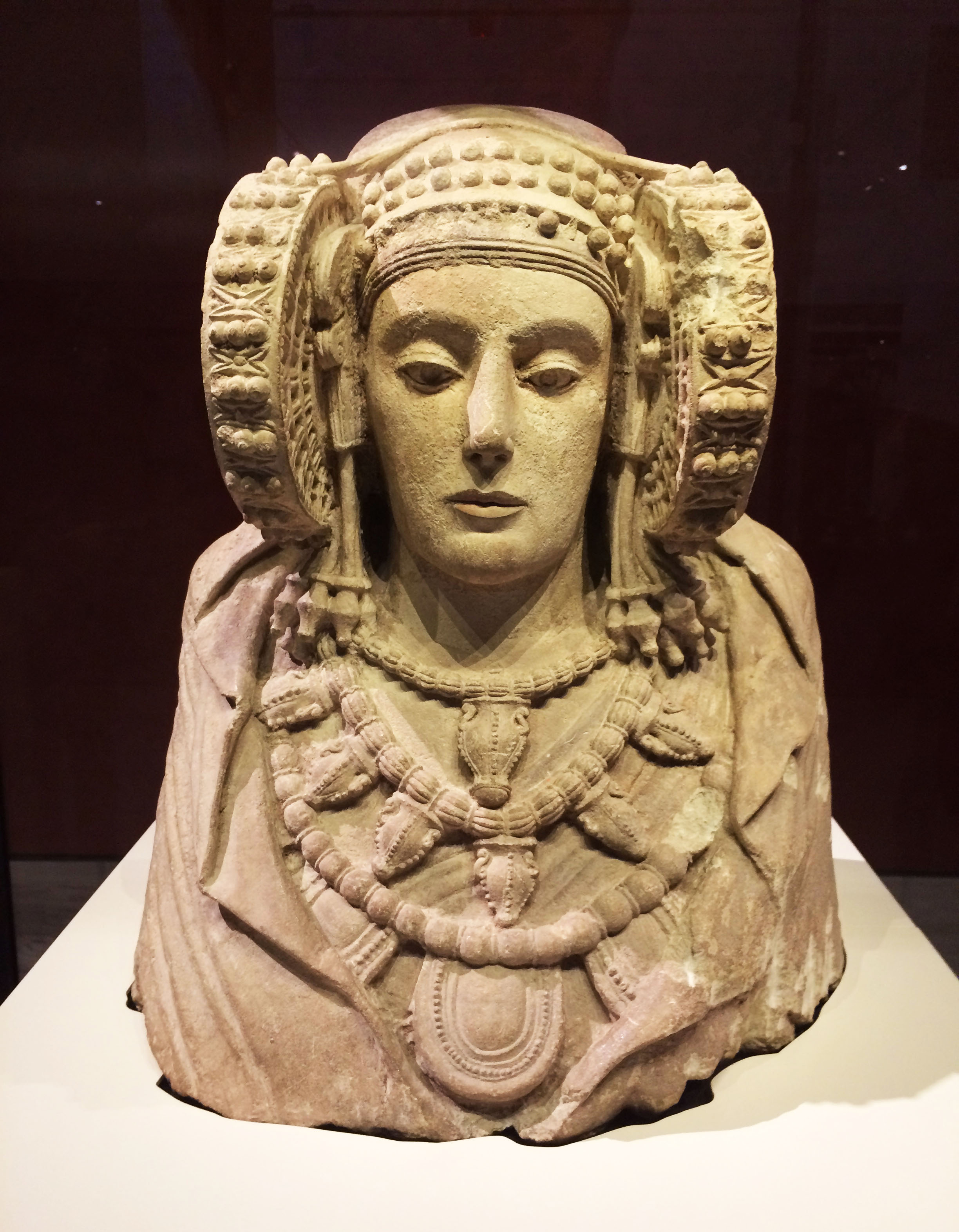
The "Lady of Elche" or "Lady of Elx" is a masterpiece of ancient Iberian [culture](https://www.worldhistory.org/disambiguation/culture/). Carved in the round, the [sculpture](https://www.worldhistory.org/disambiguation/Sculpture/) represents a woman with an idealized face, richly garbed and bejeweled. Made of limestone in the late 5th-early 4th century BCE, the "Lady of Elche" was originally polychromed and the eyes were filled with vitreous paste. Numerous theories of authorship exist, but today most believe that an Iberian commissioned it from a sculptor who was [Greek](https://www.worldhistory.org/disambiguation/greek/) or trained in Greek workshops. The "Lady of Elche" was discovered by chance at the archaeological site of La Alcudia, near the town of Elche, Spain and soon after was sold to the Musée du Louvre in [Paris](https://www.worldhistory.org/disambiguation/paris/). It was displayed there until 1941, when the French and Spanish governments negotiated its return to Spain. The singular nature of this sculpture has made it an icon of Iberian [archaeology](https://www.worldhistory.org/Archaeology/). Numerous hypotehses have been posited about the aperture at the back and its possible fuction: as a slot to accomodate a bracket for atttaching the bust to the [wall](https://www.worldhistory.org/wall/); as a reliquary; and— the most widely accepted—as a possible funerary urn. There are three hypotheses regarding its form: a busy, with similarities to other Iberian sculptures (Baza, Elche); a full-length sculpture, like the "Great Lady Offerant of Cerro de los Santos"; and a seated figure, a time-honored tradition in Iberian statuary. The lady's identity is a mystery but she is attributed both a human and divine nature. Nowadays, the sculpture is interpreted as the portrait of an Iberian aristrocratic woman who was deified by her descendants. (Museo Arqueológico Nacional, Madrid)
#### Editorial Review
This human-authored image has been reviewed by our editorial team before publication to ensure accuracy, reliability and adherence to academic standards in accordance with our [editorial policy](https://www.worldhistory.org/static/editorial-policy/).
## About the Author
James Blake Wiener has a particular interest in cross-cultural exchange and world history. He is a co-founder of World History Encyclopedia and formerly was its Communications Director.
- [Linkedin Profile](https://www.linkedin.com/in/jameswiener)
## Cite This Work
### APA
Wiener, J. B. (2017, November 01). The Lady of Elche. *World History Encyclopedia*.
### Chicago
Wiener, James Blake. "The Lady of Elche." *World History Encyclopedia*, November 01, 2017. .
### MLA
Wiener, James Blake. "The Lady of Elche." *World History Encyclopedia*, 01 Nov 2017, .
## License & Copyright
Submitted by [James Blake Wiener](https://www.worldhistory.org/user/jbw288/ "User Page: James Blake Wiener"), published on 01 November 2017. The copyright holder has published this content under the following license: [Creative Commons Attribution-NonCommercial-ShareAlike](https://creativecommons.org/licenses/by-nc-sa/4.0/deed.en). This license lets others remix, tweak, and build upon this content non-commercially, as long as they credit the author and license their new creations under the identical terms. When republishing on the web a hyperlink back to the original content source URL must be included. Please note that content linked from this page may have different licensing terms.