---
title: Foundation figure of Ur-Nammu
author: Trustees of the British Museum
source: https://www.worldhistory.org/image/578/foundation-figure-of-ur-nammu/
format: machine-readable-alternate
updated: 1970-01-01
---
# Foundation figure of Ur-Nammu
_Authored by Trustees of the British Museum_
## Image File
[](https://www.worldhistory.org/uploads/images/578.jpg)
## Image Caption
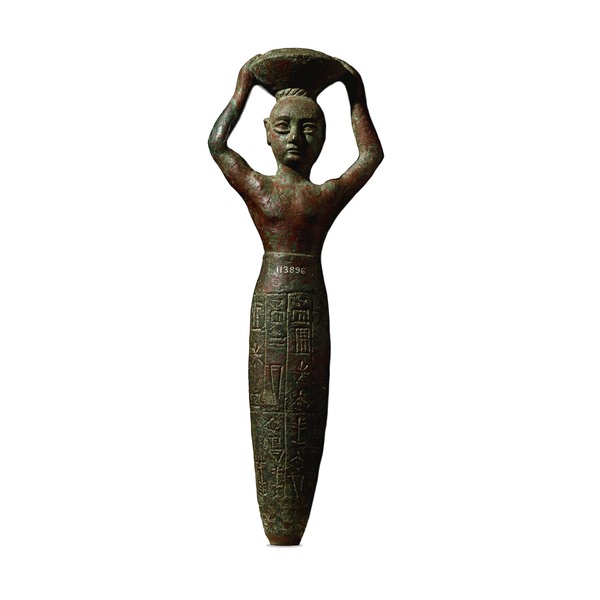
From [Uruk](https://www.worldhistory.org/uruk/), southern Iraq Third Dynasty of [Ur](https://www.worldhistory.org/ur/), about 2100-2000 BC. The king as a [temple](https://www.worldhistory.org/temple/) builder with a basket of earth to make bricks. This [bronze](https://www.worldhistory.org/disambiguation/bronze/) figure represents [Ur-Nammu](https://www.worldhistory.org/Ur-Nammu/), the ruler of Ur (about 2112-2095 BC). It was made for [burial](https://www.worldhistory.org/burial/) in the foundations of a temple of Uruk. It was one of the duties of a Mesopotamian king to care for the gods and restore or rebuild their temples. In the late third millennium BC, rulers in southern [Mesopotamia](https://www.worldhistory.org/Mesopotamia/) depicted themselves carrying out this pious task. Ur-Nammu lifts up a large basket of earth for making bricks. The [copper](https://www.worldhistory.org/copper/) 'peg' acted as a record for posterity and to receive the [god](https://www.worldhistory.org/God/)'s blessing. The [cuneiform](https://www.worldhistory.org/cuneiform/) inscription around and over the king's body states that Ur-Nammu dedicated the figure to Inana ([Ishtar](https://www.worldhistory.org/ishtar/)), the patron deity of Uruk. It also records the restoration of her temple called Eanna 'the house of heaven'. Her name appears to mean 'the lady of heaven'. She was associated with the goddess Ishtar and the planet known to us as [Venus](https://www.worldhistory.org/venus/). Towards the end of the third millennium BC, southern Mesopotamia was united under the control of the [city](https://www.worldhistory.org/city/) of Ur. Ur-Nammu founded the [empire](https://www.worldhistory.org/empire/), which stretched into Iran. He was a prodigious builder. The most impressive monuments of his reign were ziggurats which he constructed at various [cities](https://www.worldhistory.org/city/). Although not unlike the stepped [pyramids](https://www.worldhistory.org/pyramid/) of [Egypt](https://www.worldhistory.org/egypt/) in appearance, ziggurats were made of solid brickwork and did not have tombs inside.
## Bibliography
- E.D. Van Buren. *Foundation Offerings and Figur.* Berlin, H. Schoetz & Co., 1931
- H.W.F. Saggs. *Babylonians.* London, The British Museum Press, 1995
- J.E. Reade. *Mesopotamia.* London, The British Museum Press, 1991
## Cite This Work
### APA
Museum, T. o. t. B. (2012, January 09). Foundation figure of Ur-Nammu. *World History Encyclopedia*.
### Chicago
Museum, Trustees of the British. "Foundation figure of Ur-Nammu." *World History Encyclopedia*, January 09, 2012. .
### MLA
Museum, Trustees of the British. "Foundation figure of Ur-Nammu." *World History Encyclopedia*, 09 Jan 2012, .
## License & Copyright
© Trustees of the [British Museum](http://www.britishmuseum.org/). Republished under the British Museum [Standard Terms of Use](http://www.britishmuseum.org/about_this_site/terms_of_use.aspx) for non-profit educational purposes. [Original image](http://www.britishmuseum.org/explore/highlights/highlight_objects/me/f/foundation_figure_of_ur-nammu.aspx) by [**Trustees of the British Museum**](http://www.britishmuseum.org/explore/highlights/highlight_objects/me/f/foundation_figure_of_ur-nammu.aspx). Submitted by [Jan van der Crabben](https://www.worldhistory.org/user/jvdc/ "User Page: Jan van der Crabben"), published on 09 January 2012. The copyright holder has published this content under the following license: [Copyright](http://en.wikipedia.org/wiki/Copyright). You cannot use, copy, distribute, or modify this item without explicit permission from the author. Please note that content linked from this page may have different licensing terms.