---
title: Spoons & Patera from the Carthage Treasure
author: Osama Shukir Muhammed Amin
source: https://www.worldhistory.org/image/5754/spoons--patera-from-the-carthage-treasure/
format: machine-readable-alternate
updated: 1970-01-01
---
# Spoons & Patera from the Carthage Treasure
_Authored by [Osama Shukir Muhammed Amin](https://www.worldhistory.org/user/OsamaSMAmin/)_
## Image File
[](https://www.worldhistory.org/uploads/images/5754.jpg)
## Image Caption
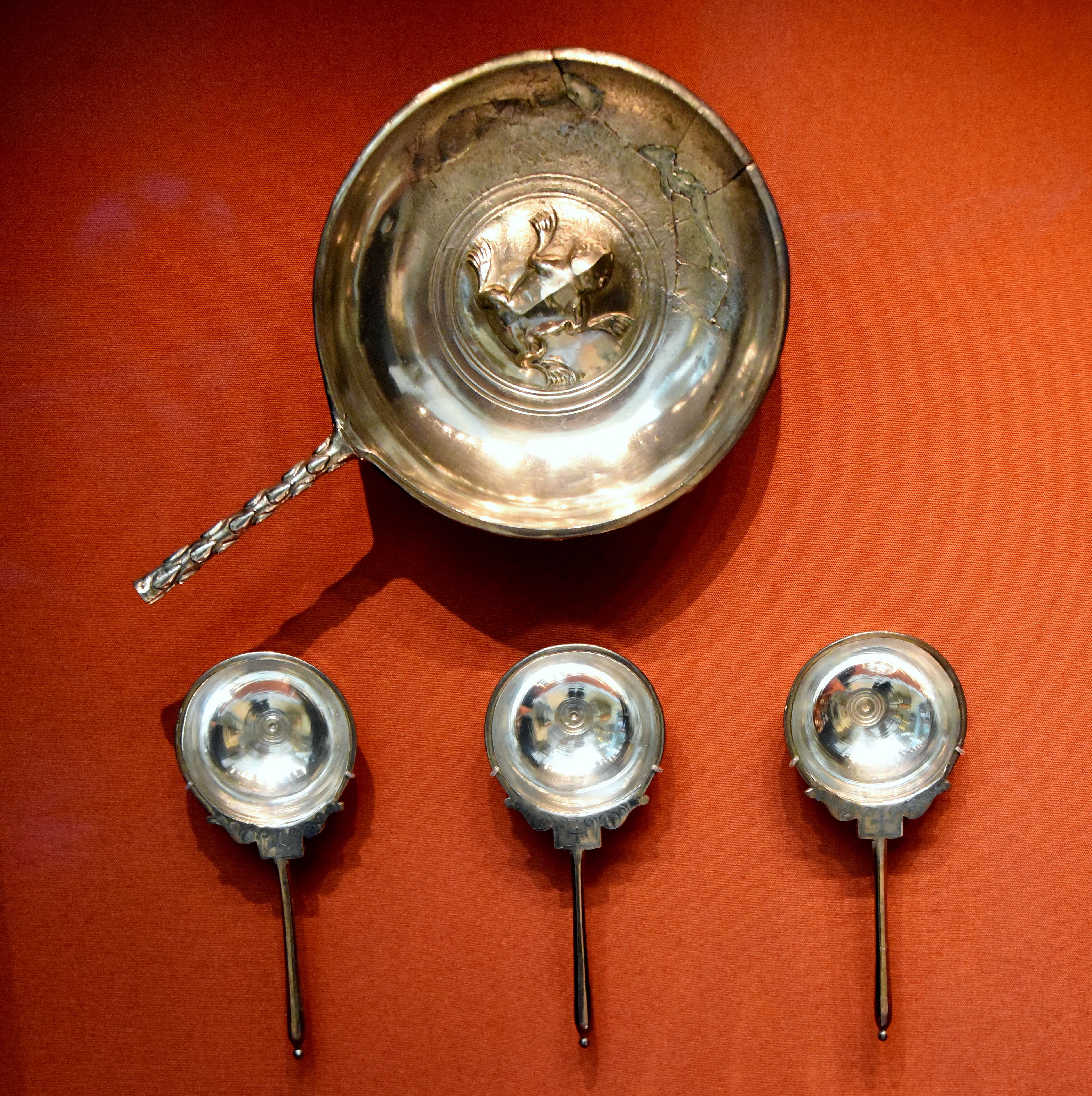
These spoons are an unusual shape for the Late [Roman](https://www.worldhistory.org/disambiguation/Roman/) Period. Their decoration, inlaid with niello (a black [metal](https://www.worldhistory.org/disambiguation/metal/) alloy), demonstrates the fine craftsmanship represented by the [Carthage](https://www.worldhistory.org/carthage/) Treasure. The Cross symbol suggests that the owners were Christians. The frog design on the shallow bowl (patera) may also have had a Christian significance. In pre-Christian [Egypt](https://www.worldhistory.org/egypt/), frogs symbolized the coming of flood and fertility to the earth. For this reason, Christians later associated frogs with resurrection. 300s-400s CE. From the Hill of St. Louis, Tunisia. The Carthage Treasure comprises 31 pieces of jewellery and [silver](https://www.worldhistory.org/Silver/) tableware, dating from around 400 CE. The treasure was found in Carthage, modern-day Tunisia. It is thought to have been buried for safekeeping by the prominent Cresconii family at a time of crisis, possibly when the [city](https://www.worldhistory.org/city/) was attacked by the Germanic [Vandal](https://www.worldhistory.org/Vandals/) King [Gaiseric](https://www.worldhistory.org/Gaiseric/) in 439 CE. Bequeathed by Sir [Augustus](https://www.worldhistory.org/augustus/) Wollaston [Franks](https://www.worldhistory.org/Franks/). (The British Museum, London).
#### Editorial Review
This human-authored image has been reviewed by our editorial team before publication to ensure accuracy, reliability and adherence to academic standards in accordance with our [editorial policy](https://www.worldhistory.org/static/editorial-policy/).
## About the Author
Associate Professor of Neurology and lover of the Cradle of Civilization, Mesopotamia. I'm very interested in Mesopotamian history and always try to take photos of archaeological sites and artifacts in museums, both in Iraq and around the world.
- [Facebook Profile](https://www.facebook.com/MRCPian)
- [Linkedin Profile](https://www.linkedin.com/in/osama-shukir-muhammed-amin/)
## Cite This Work
### APA
Amin, O. S. M. (2016, October 05). Spoons & Patera from the Carthage Treasure. *World History Encyclopedia*.
### Chicago
Amin, Osama Shukir Muhammed. "Spoons & Patera from the Carthage Treasure." *World History Encyclopedia*, October 05, 2016. .
### MLA
Amin, Osama Shukir Muhammed. "Spoons & Patera from the Carthage Treasure." *World History Encyclopedia*, 05 Oct 2016, .
## License & Copyright
Submitted by [Osama Shukir Muhammed Amin](https://www.worldhistory.org/user/OsamaSMAmin/ "User Page: Osama Shukir Muhammed Amin"), published on 05 October 2016. The copyright holder has published this content under the following license: [Copyright](http://en.wikipedia.org/wiki/Copyright). You cannot use, copy, distribute, or modify this item without explicit permission from the author. Please note that content linked from this page may have different licensing terms.