---
title: Statue of King Sobekemsaf I or II
author: Osama Shukir Muhammed Amin
source: https://www.worldhistory.org/image/5382/statue-of-king-sobekemsaf-i-or-ii/
format: machine-readable-alternate
updated: 1970-01-01
---
# Statue of King Sobekemsaf I or II
_Authored by [Osama Shukir Muhammed Amin](https://www.worldhistory.org/user/OsamaSMAmin/)_
## Image File
[](https://www.worldhistory.org/uploads/images/5382.jpg)
## Image Caption
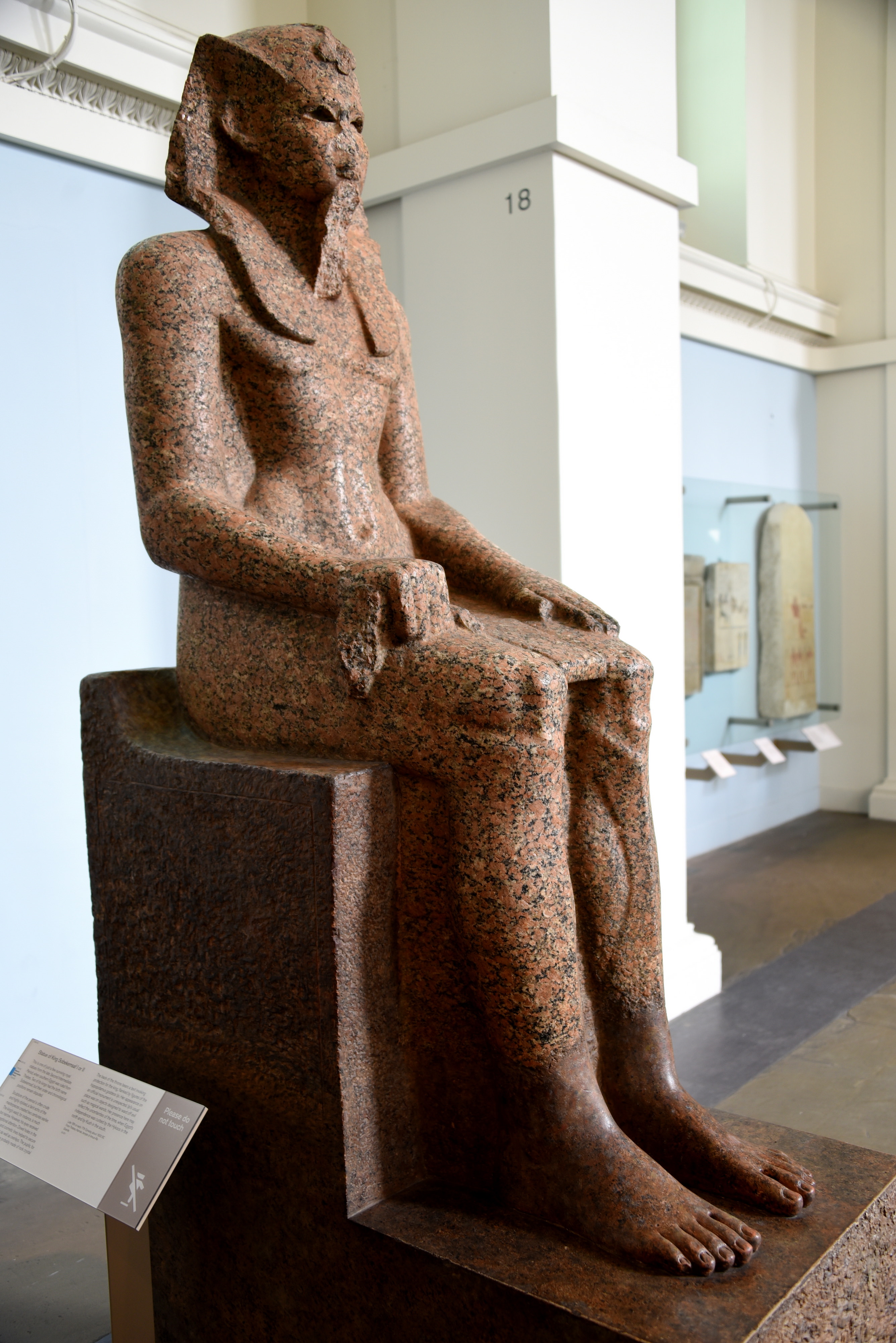
This is one of just a few surviving royal statues from the late [Second Intermediate Period](https://www.worldhistory.org/disambiguation/Second_Intermediate_Period/), when southern [Egypt](https://www.worldhistory.org/egypt/) was ruled from [Thebes](https://www.worldhistory.org/disambiguation/Thebes/). Two of its kings had the birth name of Sobekemsaf, but their order and chronological potions remain disputed. [Sculpture](https://www.worldhistory.org/disambiguation/Sculpture/) from this period is often crude and highly stylized, a faint echo of masterpieces created two centuries earlier. The King's waist, for instance, is much too narrow. However, his eyes received exceptional attention. Dowel holes in the brows and cosmetic lines helped to secure inlaid eyes and as well as overlays. The pupils, for instance, were probably made of rock crystal or obsidian. The back of the throne bears an inscription which invokes protection for the king, flanked by the figures of the hippopotamus goddess Ipi. Her appearance on an official monument is unusual. Ipi's usual place was on objects designed to ward off evil, such as magical wands. Her presence here may reflect the uncertainties of the time, even when Egypt's independence was curbed by the [Hyksos](https://www.worldhistory.org/Hyksos/) in the north and by [Kush](https://www.worldhistory.org/Kush/) in the south. Late 16th or early 17th Dynasties, circa 1600 BCE. From the [temple](https://www.worldhistory.org/temple/) of [Amun](https://www.worldhistory.org/amun/)-Ra at Thebes, [Karnak](https://www.worldhistory.org/Karnak/), Egypt. (The British Museum, London).
#### Editorial Review
This human-authored image has been reviewed by our editorial team before publication to ensure accuracy, reliability and adherence to academic standards in accordance with our [editorial policy](https://www.worldhistory.org/static/editorial-policy/).
## About the Author
Associate Professor of Neurology and lover of the Cradle of Civilization, Mesopotamia. I'm very interested in Mesopotamian history and always try to take photos of archaeological sites and artifacts in museums, both in Iraq and around the world.
- [Facebook Profile](https://www.facebook.com/MRCPian)
- [Linkedin Profile](https://www.linkedin.com/in/osama-shukir-muhammed-amin/)
## Cite This Work
### APA
Amin, O. S. M. (2016, July 21). Statue of King Sobekemsaf I or II. *World History Encyclopedia*.
### Chicago
Amin, Osama Shukir Muhammed. "Statue of King Sobekemsaf I or II." *World History Encyclopedia*, July 21, 2016. .
### MLA
Amin, Osama Shukir Muhammed. "Statue of King Sobekemsaf I or II." *World History Encyclopedia*, 21 Jul 2016, .
## License & Copyright
Submitted by [Osama Shukir Muhammed Amin](https://www.worldhistory.org/user/OsamaSMAmin/ "User Page: Osama Shukir Muhammed Amin"), published on 21 July 2016. The copyright holder has published this content under the following license: [Copyright](http://en.wikipedia.org/wiki/Copyright). You cannot use, copy, distribute, or modify this item without explicit permission from the author. Please note that content linked from this page may have different licensing terms.