---
title: Statue of Ashurnasirpal II
author: Trustees of the British Museum
source: https://www.worldhistory.org/image/528/statue-of-ashurnasirpal-ii/
format: machine-readable-alternate
updated: 2024-09-20
---
# Statue of Ashurnasirpal II
_Authored by Trustees of the British Museum_
## Image File
[](https://www.worldhistory.org/uploads/images/528.jpg)
## Image Caption
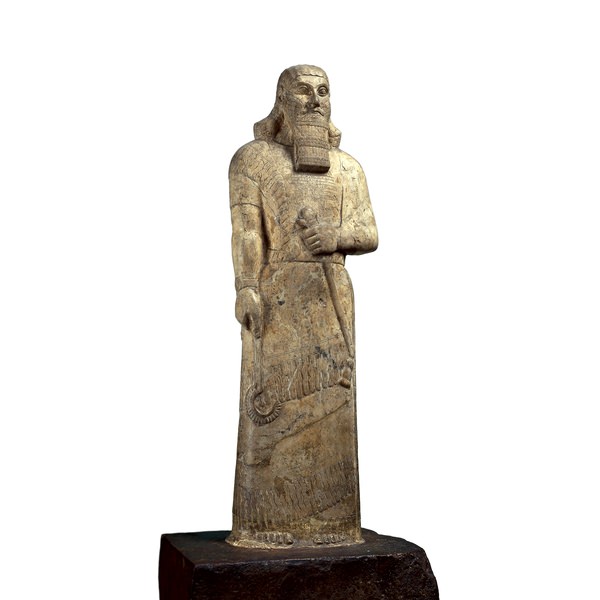
Statue of [Ashurnasirpal II](https://www.worldhistory.org/Ashurnasirpal_II/) from [Nimrud](https://www.worldhistory.org/Kalhu/) (ancient [Kalhu](https://www.worldhistory.org/Kalhu/)), modern-day northern Iraq, [Neo-Assyrian Empire](https://www.worldhistory.org/Neo-Assyrian_Empire/), 883-859 BCE.
This statue of King Ashurnasirpal II (883-859 BCE) was placed in the [Temple](https://www.worldhistory.org/temple/) of [Ishtar](https://www.worldhistory.org/ishtar/) Sharrat-niphi. It was designed to remind the goddess Ishtar of the king's piety. It is made of magnesite and stands on a pedestal of a reddish stone. These unusual stones were probably brought back from a foreign campaign. Kings often boasted of the exotic things they acquired from abroad, not only raw materials and finished goods but also plants and animals.
The king's hair and beard are shown worn long in the fashion of the Assyrian court at this time. It has been suggested that the Assyrians used false hair and beards, as the Egyptians sometimes did, but there is no evidence for this.
Ashurnasirpal holds a sickle in his right hand, of a kind which gods are sometimes depicted using to fight monsters. The mace in his left hand shows his authority as vice-regent of the supreme [god](https://www.worldhistory.org/God/) [Ashur](https://www.worldhistory.org/ashur/). The carved [cuneiform](https://www.worldhistory.org/cuneiform/) inscription across his chest proclaims the king's titles and genealogy, and mentions his expedition westward to the [Mediterranean](https://www.worldhistory.org/disambiguation/mediterranean/) Sea.
The statue was found in the nineteenth century by Henry Layard, the excavator of the temple.
## Bibliography
- [Grayson, A. Kirk & Novotny, Jamie. *The Royal Inscriptions of Sennacherib, King of Assyria (704–681 BC), Part 1.* Eisenbrauns, 2012.](https://www.worldhistory.org/books/1575062410/)
- [John E. Curtis & J.E. Reade. *Art and Empire.* Metropolitan Museum of Art, 1995.](https://www.worldhistory.org/books/0870997386/)
- [Layard, Sir Austen Henry. *Discoveries Among the Ruins of Nineveh and Babylon.* Forgotten Books, 2012.](https://www.worldhistory.org/books/B008PU0BTC/)
- [Reade, Julian. *Assyrian Sculpture.* British Museum, 2012.](https://www.worldhistory.org/books/071412141X/)
## Cite This Work
### APA
Museum, T. o. t. B. (2012, April 26). Statue of Ashurnasirpal II. *World History Encyclopedia*.
### Chicago
Museum, Trustees of the British. "Statue of Ashurnasirpal II." *World History Encyclopedia*, April 26, 2012. .
### MLA
Museum, Trustees of the British. "Statue of Ashurnasirpal II." *World History Encyclopedia*, 26 Apr 2012, .
## License & Copyright
© Trustees of the [British Museum](http://www.britishmuseum.org/). Republished under the British Museum [Standard Terms of Use](http://www.britishmuseum.org/about_this_site/terms_of_use.aspx) for non-profit educational purposes. [Original image](http://www.britishmuseum.org/explore/highlights/highlight_objects/me/s/statue_of_ashurnasirpal_ii.aspx) by [**Trustees of the British Museum**](http://www.britishmuseum.org/explore/highlights/highlight_objects/me/s/statue_of_ashurnasirpal_ii.aspx). Submitted by [Jan van der Crabben](https://www.worldhistory.org/user/jvdc/ "User Page: Jan van der Crabben"), published on 26 April 2012. The copyright holder has published this content under the following license: [Copyright](http://en.wikipedia.org/wiki/Copyright). You cannot use, copy, distribute, or modify this item without explicit permission from the author. Please note that content linked from this page may have different licensing terms.