---
title: Statue of Idrimi
author: Trustees of the British Museum
source: https://www.worldhistory.org/image/509/statue-of-idrimi/
format: machine-readable-alternate
updated: 1970-01-01
---
# Statue of Idrimi
_Authored by Trustees of the British Museum_
## Image File
[](https://www.worldhistory.org/uploads/images/509.jpg)
## Image Caption
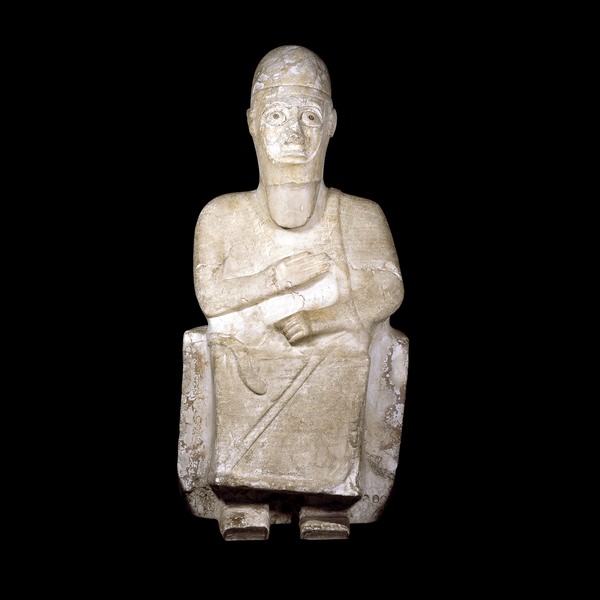
Late [Bronze Age](https://www.worldhistory.org/disambiguation/Bronze_Age/) / Syrian, 16th century BC From Tell Atchana (ancient Alalakh), modern [Turkey](https://www.worldhistory.org/Asia_Minor/)A statue of a king of Alalakh, covered with his biography in [cuneiform](https://www.worldhistory.org/cuneiform/)This extraordinary statue represents Idrimi, a king of Alalakh. It was discovered by the excavator Leonard Woolley in the ruins of a [temple](https://www.worldhistory.org/temple/) at the site of Tell Atchana (ancient Alalakh). The statue had been toppled from its stone throne, presumably at the time of the final destruction of the [city](https://www.worldhistory.org/city/), around 1100 BC. Its head, with inlaid glass eyes, and its feet had broken off. The eyebrows and eyelids had originally been inlaid and the marks of a tubular drill can be seen, probably part of the process of manufacture. The statue is inscribed in faulty [Akkadian](https://www.worldhistory.org/disambiguation/akkadian/), using a poor cuneiform [script](https://www.worldhistory.org/script/), with an autobiography of Idrimi. It is a unique type of text signed by the scribe who wrote it. Idrimi was one of the sons of the royal house of Aleppo, which was subject to the powerful kingdom of [Mitanni](https://www.worldhistory.org/Mitanni/). The territory of Aleppo included the smaller [city state](https://www.worldhistory.org/Polis/) of Alalakh. Following a failed revolt, Idrimi and some of his family fled to Emar (now Meskene) on the Euphrates, which was ruled by his mother's family. From there he went south to live among nomads in [Canaan](https://www.worldhistory.org/canaan/) (the earliest known reference to this land). Here he gathered troops and received popular support and help from his family. In time he made overtures to Parattarna, the king of Mitanni, who recognized his control of Alalakh. The inscription states that he had been ruling for thirty years when he had the statue inscribed, though it has been suggested that the text was actually added to the statue about three [hundred years](https://www.worldhistory.org/disambiguation/Hundred_Years/) after Idrimi. The inscription ends with curses on anyone who would destroy the statue. T.C. Mitchell, The [Bible](https://www.worldhistory.org/bible/) in the British Museu (London, The British Museum Press, 1988) D. Collon, Ancient Near Eastern art (London, The British Museum Press, 1995)
## Cite This Work
### APA
Museum, T. o. t. B. (2012, April 26). Statue of Idrimi. *World History Encyclopedia*.
### Chicago
Museum, Trustees of the British. "Statue of Idrimi." *World History Encyclopedia*, April 26, 2012. .
### MLA
Museum, Trustees of the British. "Statue of Idrimi." *World History Encyclopedia*, 26 Apr 2012, .
## License & Copyright
© Trustees of the [British Museum](http://www.britishmuseum.org/). Republished under the British Museum [Standard Terms of Use](http://www.britishmuseum.org/about_this_site/terms_of_use.aspx) for non-profit educational purposes. [Original image](http://www.britishmuseum.org/explore/highlights/highlight_objects/me/s/statue_of_idrimi.aspx) by [**Trustees of the British Museum**](http://www.britishmuseum.org/explore/highlights/highlight_objects/me/s/statue_of_idrimi.aspx). Submitted by [Jan van der Crabben](https://www.worldhistory.org/user/jvdc/ "User Page: Jan van der Crabben"), published on 26 April 2012. The copyright holder has published this content under the following license: [Copyright](http://en.wikipedia.org/wiki/Copyright). You cannot use, copy, distribute, or modify this item without explicit permission from the author. Please note that content linked from this page may have different licensing terms.