---
title: Ram in a Thicket
author: Trustees of the British Museum
source: https://www.worldhistory.org/image/502/ram-in-a-thicket/
format: machine-readable-alternate
updated: 1970-01-01
---
# Ram in a Thicket
_Authored by Trustees of the British Museum_
## Image File
[](https://www.worldhistory.org/uploads/images/502.jpg)
## Image Caption
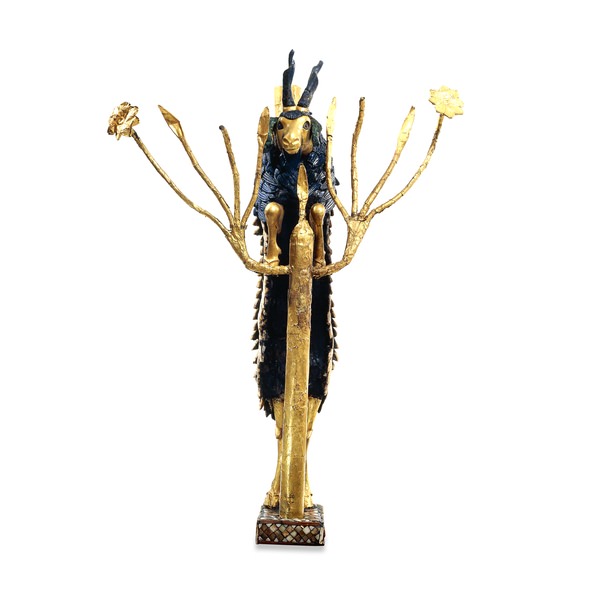
From [Ur](https://www.worldhistory.org/ur/), southern Iraq, about 2600-2400 BC This is one of an almost identical pair discovered by Leonard Woolley in the 'Great [Death](https://www.worldhistory.org/disambiguation/Death/) Pit', one of the graves in the Royal Cemetery at Ur. The other is now in the University of Pennsylvania Museum in Philadelphia. It was named the 'Ram in a Thicket' by the excavator Leonard Woolley, who liked biblical allusions. In Genesis 22:13, [God](https://www.worldhistory.org/God/) ordered [Abraham](https://www.worldhistory.org/Abraham,_the_Patriarch/) to sacrifice his son Isaac, but at the last moment 'Abraham lifted up his eyes, and looked, and behold behind him a ram caught in a thicket by his horns: and Abraham went and took the ram, and offered him up for a burnt offering in the stead of his son'. The 'ram' is more accurately described as a goat, and he reaches up for the tastiest branches in a pose often adopted by goats. Goats and sheep in the [Near East](https://www.worldhistory.org/Near_East/) were among the earliest animals to be domesticated. They were an everyday feature of agricultural life and are regularly depicted by artists in many different ways. The figure had been crushed flat by the weight of the soil and the wooden core had perished. Wax was used to keep the pieces together as it was lifted from the ground, and it was then pressed back into shape. The ram's head and legs are covered in [gold](https://www.worldhistory.org/gold/) leaf, its ears are [copper](https://www.worldhistory.org/copper/) (now green), its twisted horns and the fleece on its shoulders are of lapis lazuli, and its body fleece is made of shell. Its genitals are gold. The tree is covered in gold leaf, with golden flowers, the whole supported on a small rectangular base decorated with a [mosaic](https://www.worldhistory.org/Mosaic/) of shell, red limestone and lapis lazuli. The tube rising from the goat's shoulders suggests it was used to support something, most likely a bowl. C.L. Woolley and P.R.S. Moorey, Ur of the Chaldees, revised edition (Ithaca, New York, Cornell University Press, 1982) H.W.F. Saggs, Babylonians (London, The British Museum Press, 1995) D. Collon, Ancient Near Eastern art (London, The British Museum Press, 1995) C.L. Woolley and others, Ur Excavations, vol. II: The R (London, The British Museum Press, 1934) © Trustees of the British Museum
## Cite This Work
### APA
Museum, T. o. t. B. (2012, April 26). Ram in a Thicket. *World History Encyclopedia*.
### Chicago
Museum, Trustees of the British. "Ram in a Thicket." *World History Encyclopedia*, April 26, 2012. .
### MLA
Museum, Trustees of the British. "Ram in a Thicket." *World History Encyclopedia*, 26 Apr 2012, .
## License & Copyright
© Trustees of the [British Museum](http://www.britishmuseum.org/). Republished under the British Museum [Standard Terms of Use](http://www.britishmuseum.org/about_this_site/terms_of_use.aspx) for non-profit educational purposes. [Original image](http://www.britishmuseum.org/explore/highlights/highlight_objects/me/t/the_ram_in_a_thicket.aspx) by [**Trustees of the British Museum**](http://www.britishmuseum.org/explore/highlights/highlight_objects/me/t/the_ram_in_a_thicket.aspx). Submitted by [Jan van der Crabben](https://www.worldhistory.org/user/jvdc/ "User Page: Jan van der Crabben"), published on 26 April 2012. The copyright holder has published this content under the following license: [Copyright](http://en.wikipedia.org/wiki/Copyright). You cannot use, copy, distribute, or modify this item without explicit permission from the author. Please note that content linked from this page may have different licensing terms.