---
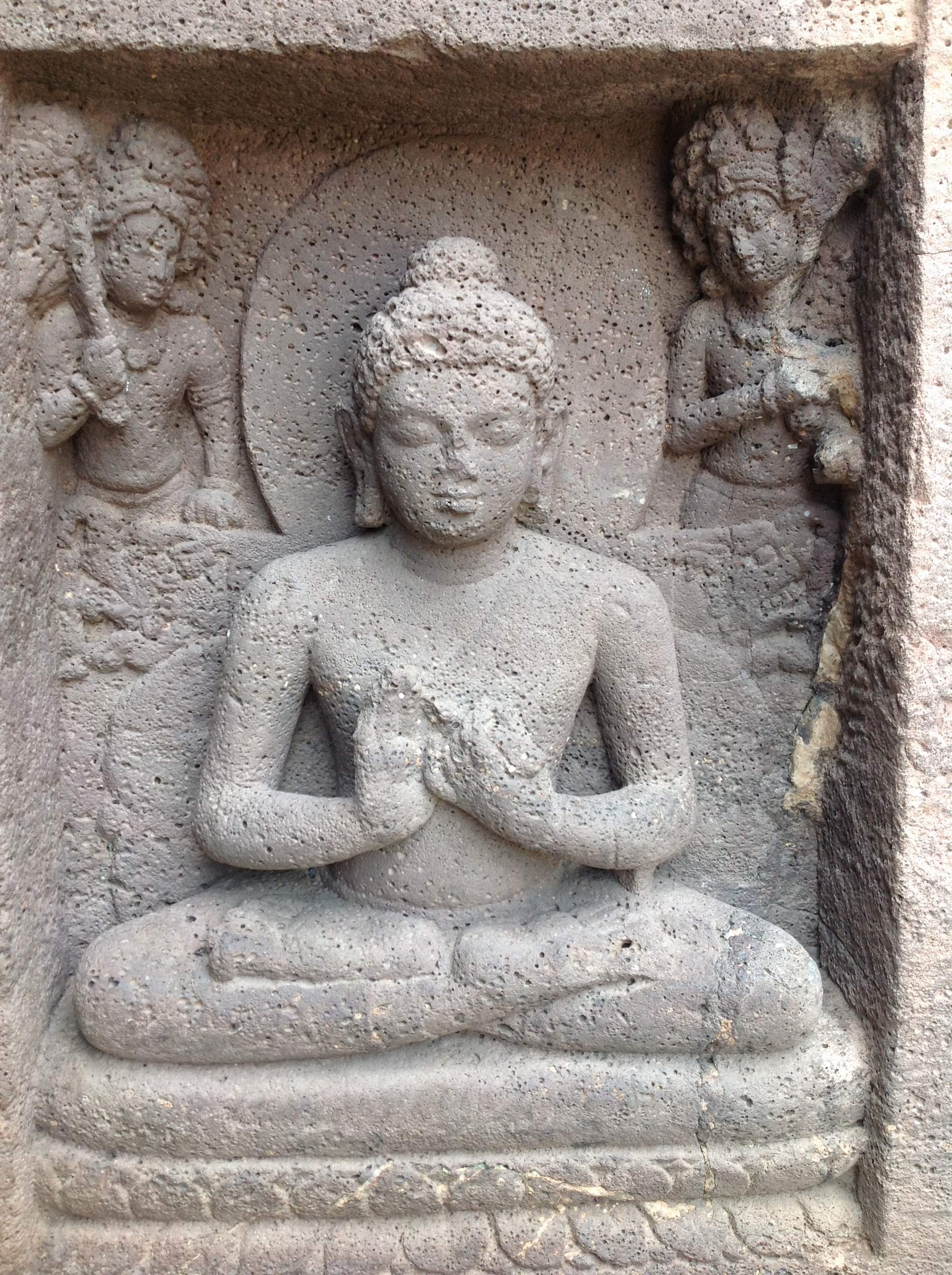
title: Seated Buddha Figure Displaying Dharmachakra Mudra
author: Prashanth Gopalan
source: https://www.worldhistory.org/image/4064/seated-buddha-figure-displaying-dharmachakra-mudra/
format: machine-readable-alternate
license: Creative Commons Attribution-NonCommercial-ShareAlike (https://creativecommons.org/licenses/by-nc-sa/4.0/)
updated: 1970-01-01
---
# Seated Buddha Figure Displaying Dharmachakra Mudra
_Authored by [Prashanth Gopalan](https://www.worldhistory.org/user/prashgopalan/)_
## Image File
[](https://www.worldhistory.org/uploads/images/4064.jpg)
## Image Caption
Here, the figure seated in the lotus position features two important details: first, a halo, indicating that Prince Siddhartha has attained Enlightenment and so has become the "[Buddha](https://www.worldhistory.org/Siddhartha_Gautama/)", or the Enlightened One, and second, the Dharmachakra Mudra, a hand gesture that represents the "Wheel of Dharma", symbolizing an important occasion in the life of the Buddha; the delivery of his first sermon to his followers after his Enlightenment in the Deer Park at Sarnath, in northern [India](https://www.worldhistory.org/india/). By bringing the thumb and index fingers of each hand together to form a circle, the Buddha sets into motion the Dharmachakra Mudra, or Wheel of Dharma, symbolizing the interconnectedness and interdependence of all life, existence and consequence by way of the laws of Dharma. Additionally, each of the extended fingers of each hand represents a [Buddhist](https://www.worldhistory.org/buddhism/) virtue or teaching, and the placement of the Mudra in front of the chest symbolizes that these teachings emanate from the Buddha's heart. This is a detail from one of the outer walls of the [Ajanta](https://www.worldhistory.org/Ajanta/) cave complex, an ancient Buddhist monastery and UNESCO World Heritage Site located in the Aurangabad District of Maharashtra, India. Originally built from the 2nd century BCE, with additional caves added in subsequent centuries, the Ajanta cave complex contains some of the finest surviving examples of ancient Indian and Buddhist religious art and [architecture](https://www.worldhistory.org/disambiguation/architecture/) in the Indian subcontinent.
#### Editorial Review
This human-authored image has been reviewed by our editorial team before publication to ensure accuracy, reliability and adherence to academic standards in accordance with our [editorial policy](https://www.worldhistory.org/static/editorial-policy/).
## Cite This Work
### APA
Gopalan, P. (2015, September 11). Seated Buddha Figure Displaying Dharmachakra Mudra. *World History Encyclopedia*.
### Chicago
Gopalan, Prashanth. "Seated Buddha Figure Displaying Dharmachakra Mudra." *World History Encyclopedia*, September 11, 2015. .
### MLA
Gopalan, Prashanth. "Seated Buddha Figure Displaying Dharmachakra Mudra." *World History Encyclopedia*, 11 Sep 2015, .
## License & Copyright
Submitted by [Prashanth Gopalan](https://www.worldhistory.org/user/prashgopalan/ "User Page: Prashanth Gopalan"), published on 11 September 2015. The copyright holder has published this content under the following license: [Creative Commons Attribution-NonCommercial-ShareAlike](https://creativecommons.org/licenses/by-nc-sa/4.0/deed.en). This license lets others remix, tweak, and build upon this content non-commercially, as long as they credit the author and license their new creations under the identical terms. When republishing on the web a hyperlink back to the original content source URL must be included. Please note that content linked from this page may have different licensing terms.