---
title: Map of the Indus Valley Civilization, c. 3300-1300 BCE: Cities, Trade, and Settlement in the Bronze Age
author: Simeon Netchev
source: https://www.worldhistory.org/image/322/map-of-the-indus-valley-civilization-c-3300-1300-b/
format: machine-readable-alternate
license: Creative Commons Attribution-NonCommercial-NoDerivs (https://creativecommons.org/licenses/by-nc/4.0)
updated: 2026-03-09
---
# Map of the Indus Valley Civilization, c. 3300-1300 BCE: Cities, Trade, and Settlement in the Bronze Age
_Authored by [Simeon Netchev](https://www.worldhistory.org/user/simeonnetchev/)_
## Image File
[](https://www.worldhistory.org/uploads/images/322.png)
## Image Caption
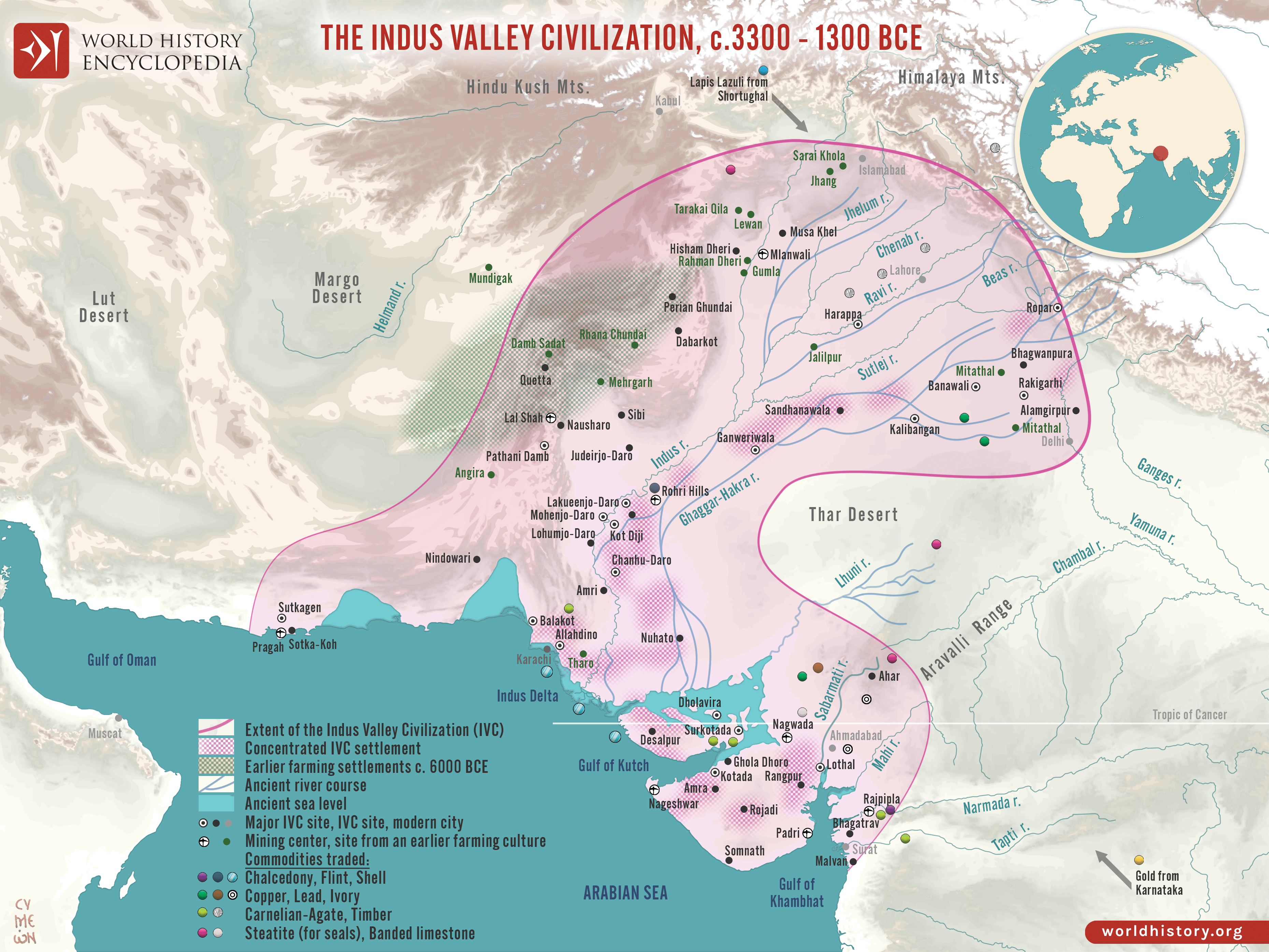
The [Indus Valley Civilization](https://www.worldhistory.org/Indus_Valley_Civilization/) (c. 3300–1300 BCE) was one of the earliest complex societies of the [Bronze Age](https://www.worldhistory.org/disambiguation/Bronze_Age/) world, extending across parts of present-day Pakistan and northwestern [India](https://www.worldhistory.org/india/). Its most developed phase, often called the Mature Harappan period (c. 2600–1900 BCE), saw the emergence of large, carefully planned urban centers integrated within a wide regional network. Major [cities](https://www.worldhistory.org/city/) such as Harappa and Mohenjo-daro demonstrate sophisticated civic organization, with grid-based street layouts, standardized brick construction, and extensive drainage systems. These settlements formed part of a broader system of towns, craft centers, and [trade](https://www.worldhistory.org/disambiguation/trade/) nodes that connected the Indus region with neighboring cultural spheres.
Archaeological evidence indicates that Indus communities participated in long-distance exchange networks linking South Asia with regions such as [Mesopotamia](https://www.worldhistory.org/Mesopotamia/), where Indus merchants were known as traders from “Meluhha.” Despite their urban scale and economic reach, Indus cities show little clear evidence of monumental palaces or royal tombs, suggesting forms of governance that differed from the more visibly hierarchical systems of contemporary civilizations. After c. 1900 BCE the major urban centers gradually declined, and by c. 1300 BCE the urban phase had largely disappeared. Scholars commonly associate this transformation with environmental change, shifting river systems, and the reorganization of regional trade networks rather than a single catastrophic event.
#### Editorial Review
This human-authored image has been reviewed by our editorial team before publication to ensure accuracy, reliability and adherence to academic standards in accordance with our [editorial policy](https://www.worldhistory.org/static/editorial-policy/).
## About the Author
Simeon is a freelance visual designer and history educator, passionate about the human stories that shape the past.
- [Linkedin Profile](https://www.linkedin.com/in/simeon-netchev/)
## Cite This Work
### APA
Netchev, S. (2026, March 09). Map of the Indus Valley Civilization, c. 3300-1300 BCE: Cities, Trade, and Settlement in the Bronze Age. *World History Encyclopedia*.
### Chicago
Netchev, Simeon. "Map of the Indus Valley Civilization, c. 3300-1300 BCE: Cities, Trade, and Settlement in the Bronze Age." *World History Encyclopedia*, March 09, 2026. .
### MLA
Netchev, Simeon. "Map of the Indus Valley Civilization, c. 3300-1300 BCE: Cities, Trade, and Settlement in the Bronze Age." *World History Encyclopedia*, 09 Mar 2026, .
## License & Copyright
Submitted by [Simeon Netchev](https://www.worldhistory.org/user/simeonnetchev/ "User Page: Simeon Netchev"), published on 09 March 2026. The copyright holder has published this content under the following license: [Creative Commons Attribution-NonCommercial-NoDerivs](https://creativecommons.org/licenses/by-nc/4.0deed.en). This licence only allows others to download this content and share it with others as long as the author is credited, but they can't change the content in any way or use it commercially. When republishing on the web a hyperlink back to the original content source URL must be included. Please note that content linked from this page may have different licensing terms.