---
title: Hercules and Aramaic Inscription from Behistoun
author: dynamosquito
source: https://www.worldhistory.org/image/3143/hercules-and-aramaic-inscription-from-behistoun/
format: machine-readable-alternate
license: Creative Commons Attribution-ShareAlike (https://creativecommons.org/licenses/by-sa/4.0)
updated: 1970-01-01
---
# Hercules and Aramaic Inscription from Behistoun
_Authored by dynamosquito_
## Image File
[](https://www.worldhistory.org/uploads/images/3143.jpg)
## Image Caption
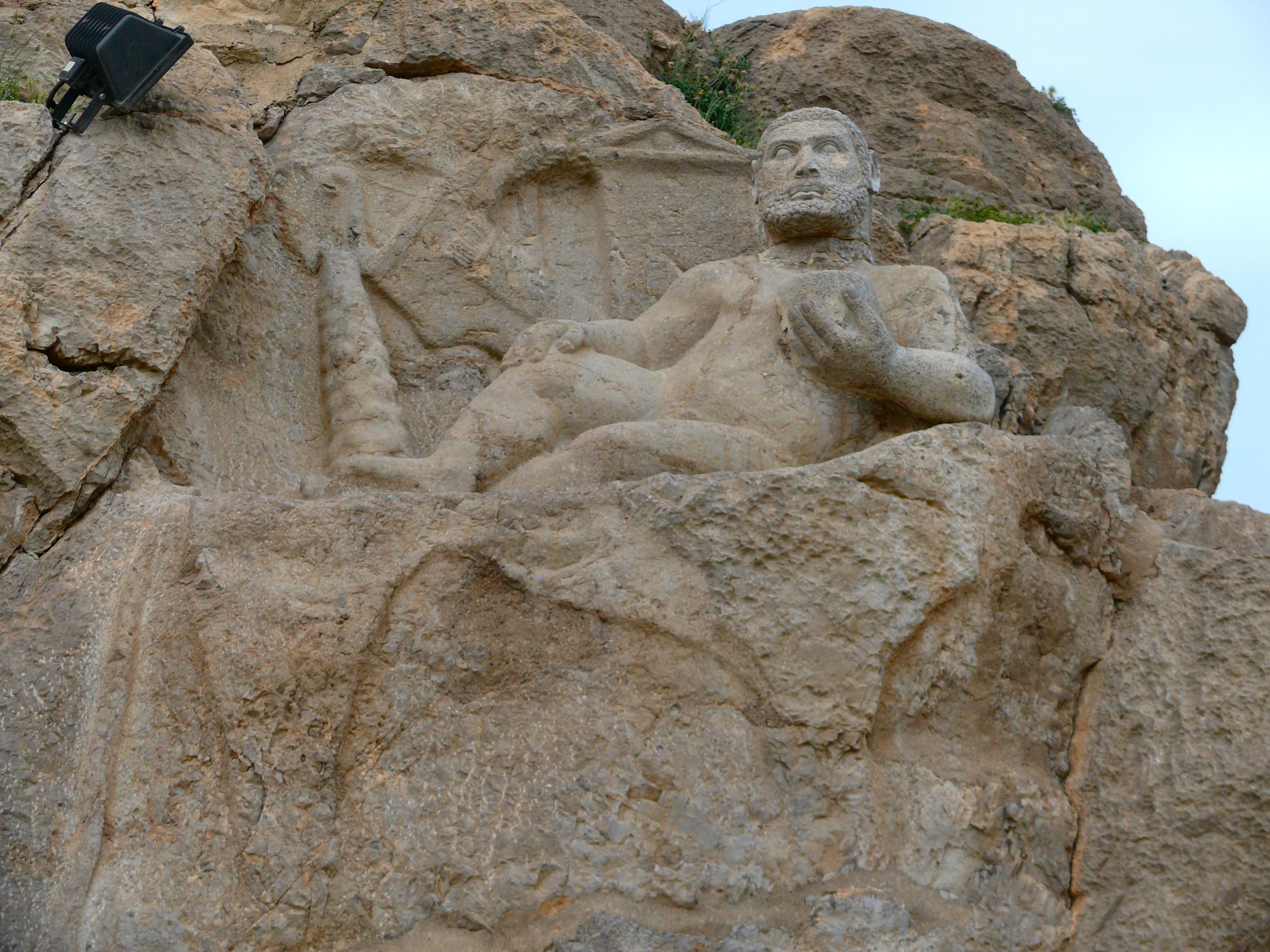
According to its [Greek](https://www.worldhistory.org/disambiguation/greek/) inscription, the rock relief representing [Hercules](https://www.worldhistory.org/hercules/) at Behistun was carved in 148 BCE , being dedicated to a local [Seleucid](https://www.worldhistory.org/Seleucid_Empire/) governor called Kleomenes. The Aramaic inscription says: "In year 164, in the month of Panemos, Hyakinthos son of Pantauchos dedicated this statue of [Herakles](https://www.worldhistory.org/hercules/) Kallinikos "Glorious in victory" for the safety of Kleomenes, the governor of the Upper Satrapies.”. It shows us that [Persis](https://www.worldhistory.org/Persis/) was under control of both a Greek governor and a Persian king (known by coins), which can be linked to the idea of predecessing fratarakas rule side by side with Greek satraps. A religious syncretism occurred in Iran soon after the beginning of the Seleucid dynasty, seeing Hercules assimilated with the old Iranian divinity of power Verethragna. In this relief, Hercules is shown in a languorous attitude, laying naked on the skin of a lion (probably the Nemean lion he killed as one of his 12 labours) , holding a bowl, under the shadow of an olive tree. His traditional wood bludgeon lay near him. If the topic is typically Greek, both the fashion and carving technique reveal the relief was carved by an Iranian artist, unfamiliar with the greek iconography. The main reason was probably because it was not a royal relief but one of a local person.
## Cite This Work
### APA
dynamosquito. (2014, October 13). Hercules and Aramaic Inscription from Behistoun. *World History Encyclopedia*.
### Chicago
dynamosquito. "Hercules and Aramaic Inscription from Behistoun." *World History Encyclopedia*, October 13, 2014. .
### MLA
dynamosquito. "Hercules and Aramaic Inscription from Behistoun." *World History Encyclopedia*, 13 Oct 2014, .
## License & Copyright
[](https://www.flickr.com/photos/dynamosquito/4000748339/?rb=1)This image was first published on [Flickr](http://www.flickr.com). [Original image](https://www.flickr.com/photos/dynamosquito/4000748339/?rb=1) by [**dynamosquito**](https://www.flickr.com/photos/dynamosquito/4000748339/?rb=1). Submitted by [Antoine Simonin](https://www.worldhistory.org/user/Deathfinger/ "User Page: Antoine Simonin"), published on 13 October 2014. The copyright holder has published this content under the following license: [Creative Commons Attribution-ShareAlike](https://creativecommons.org/licenses/by-sa/4.0deed.en). This license lets others remix, tweak, and build upon a work even for commercial reasons, as long as they credit the author and license their new creations under the identical terms. When republishing on the web a hyperlink back to the original content source URL must be included. Please note that content linked from this page may have different licensing terms.