---
title: 12 Renaissance Pigments That Shaped Masterpieces: Color, Trade & Materials in Renaissance Painting
author: Simeon Netchev
source: https://www.worldhistory.org/image/22435/12-renaissance-pigments-that-shaped-masterpieces/
format: machine-readable-alternate
license: Creative Commons Attribution-NonCommercial-NoDerivs (https://creativecommons.org/licenses/by-nc/4.0)
updated: 2026-11-24
---
# 12 Renaissance Pigments That Shaped Masterpieces: Color, Trade & Materials in Renaissance Painting
_Authored by [Simeon Netchev](https://www.worldhistory.org/user/simeonnetchev/)_
## Image File
[](https://www.worldhistory.org/uploads/images/22435.png)
## Image Caption
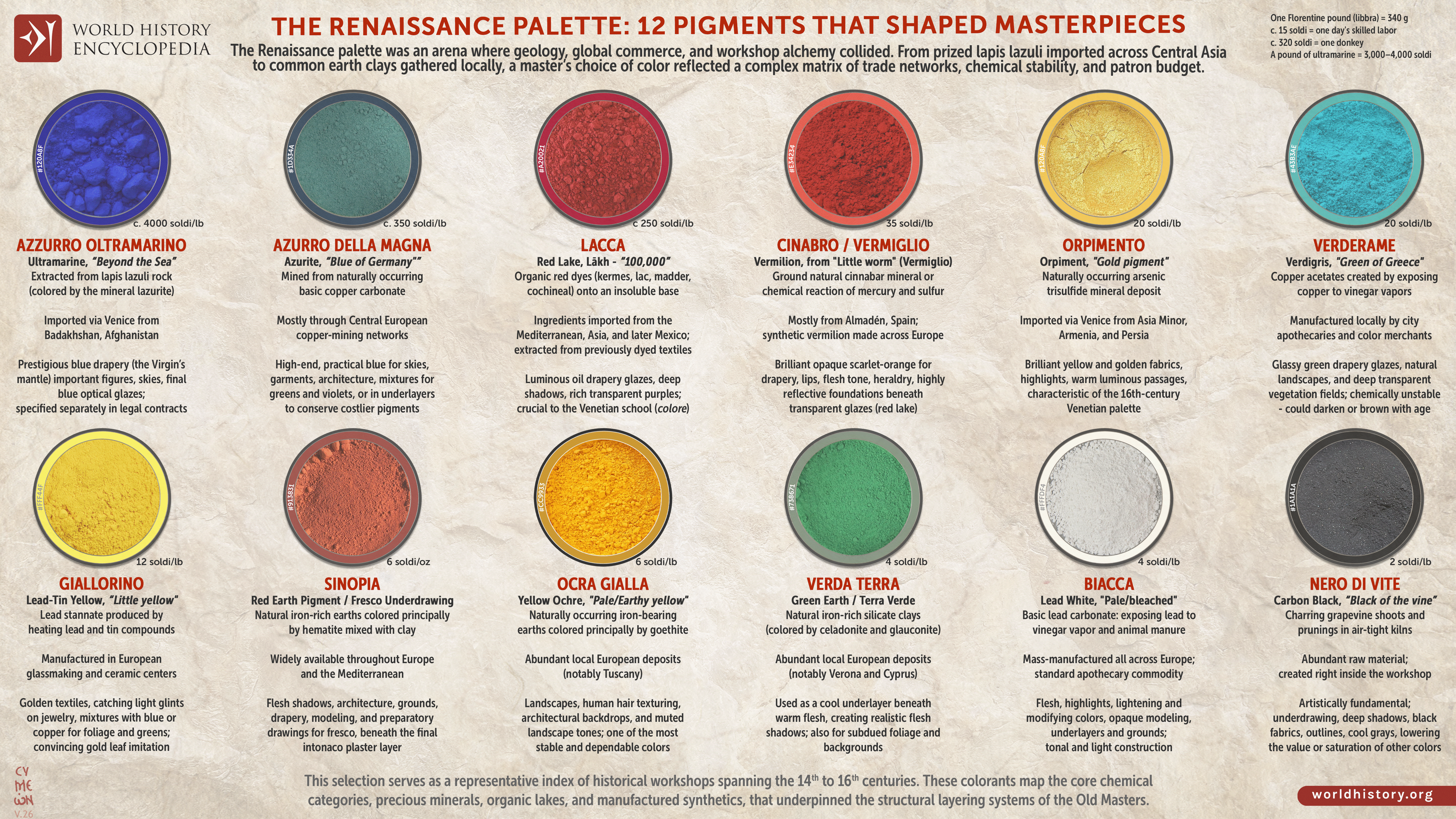
During the Renaissance (c. 1400–1600), painters worked with pigments derived from minerals, metals, earths, plants, and insects. Their palettes reflected both artistic knowledge and wider economic networks: some colors were inexpensive local materials, while others depended on long-distance [trade](https://www.worldhistory.org/disambiguation/trade/) and could cost more than a skilled worker earned in months. Patrons sometimes specified expensive pigments in contracts, making color itself an expression of wealth, status, commerce, and cultural exchange.
1. **Ultramarine (Azzurro Oltremarino) –** made from lapis lazuli imported from Badakhshan in Afghanistan, ultramarine was the most prestigious Renaissance blue and could cost around 4,000 soldi per Florentine pound. It was often reserved for important passages such as the [Virgin Mary](https://www.worldhistory.org/Mary,_Mother_of_Jesus/)'s robes.
2. **Azurite (Azzurro della Magna) –** a [copper](https://www.worldhistory.org/copper/)-carbonate mineral supplied largely through Central European mining networks, azurite provided a more affordable blue for skies, garments, [architecture](https://www.worldhistory.org/disambiguation/architecture/), and underlayers beneath costlier pigments.
3. **Red Lake (Lacca) –** produced from organic dyes such as kermes, lac, madder, or [cochineal](https://www.worldhistory.org/Cochineal/) fixed onto an insoluble base, red lakes created deep transparent reds and purples particularly suited to luminous oil glazes.
4. **Vermilion (Cinabro / Vermiglio) –** derived from cinnabar or manufactured from mercury and sulfur, vermilion produced a brilliant opaque scarlet used for drapery, flesh tones, heraldry, and strong highlights.
5. **Orpiment –** a naturally occurring arsenic sulfide imported through [Mediterranean](https://www.worldhistory.org/disambiguation/mediterranean/) and Asian trade networks, orpiment supplied an intense golden yellow used for fabrics, highlights, and luminous passages.
6. **Verdigris (Verderame) –** manufactured by exposing copper to vinegar vapors, verdigris produced vivid transparent greens for foliage and drapery, although its chemical instability could cause discoloration over time.
7. **Lead-Tin Yellow (Giallorino) –** a manufactured yellow created by heating lead and tin compounds, it was valued for bright highlights, golden textiles, jewelry, and mixtures producing foliage and green tones.
8. **Sinopia –** a natural iron-rich red earth widely available around the Mediterranean, sinopia was used for flesh shadows, architectural tones, drapery, and especially preparatory drawings beneath frescoes.
9. **Yellow Ochre (Ocra Gialla) –** an abundant iron-bearing earth pigment, yellow ochre was inexpensive, stable, and widely used for landscapes, hair, architecture, backgrounds, and muted flesh tones.
10. **Green Earth (Verda Terra) –** obtained from naturally occurring green clays, particularly in regions such as [Verona](https://www.worldhistory.org/Verona/) and [Cyprus](https://www.worldhistory.org/cyprus/), green earth was frequently used as an underlayer beneath flesh tones and for subdued foliage and backgrounds.
11. **Lead White (Biacca) –** manufactured by exposing lead to vinegar vapors, lead white was one of the most important workshop pigments, used for highlights, flesh, tonal modeling, grounds, and for lightening other colors.
12. **Carbon Black ([Nero](https://www.worldhistory.org/Nero/) di Vite) –** produced from charred vine shoots and other organic materials, carbon black was inexpensive and fundamental for underdrawing, outlines, deep shadows, cool grays, and tonal adjustment.
The Renaissance palette therefore reveals how painting depended on far more than artistic inspiration. Geology, chemistry, trade, workshop practice, and patronage all shaped what artists could paint and how they painted it. The growing importance of oil techniques further expanded these possibilities, allowing transparent glazes, layered color, and subtle tonal modeling. Pigments were not simply colors on a surface: they were materials embedded in the economic and technological networks of the Renaissance world.
#### Editorial Review
This human-authored image has been reviewed by our editorial team before publication to ensure accuracy, reliability and adherence to academic standards in accordance with our [editorial policy](https://www.worldhistory.org/static/editorial-policy/).
## About the Author
Simeon is a freelance visual designer and history educator, passionate about the human stories that shape the past.
- [Linkedin Profile](https://www.linkedin.com/in/simeon-netchev/)
## Cite This Work
### APA
Netchev, S. (2026, November 24). 12 Renaissance Pigments That Shaped Masterpieces: Color, Trade & Materials in Renaissance Painting. *World History Encyclopedia*.
### Chicago
Netchev, Simeon. "12 Renaissance Pigments That Shaped Masterpieces: Color, Trade & Materials in Renaissance Painting." *World History Encyclopedia*, November 24, 2026. .
### MLA
Netchev, Simeon. "12 Renaissance Pigments That Shaped Masterpieces: Color, Trade & Materials in Renaissance Painting." *World History Encyclopedia*, 24 Nov 2026, .
## License & Copyright
Submitted by [Simeon Netchev](https://www.worldhistory.org/user/simeonnetchev/ "User Page: Simeon Netchev"), published on 24 November 2026. The copyright holder has published this content under the following license: [Creative Commons Attribution-NonCommercial-NoDerivs](https://creativecommons.org/licenses/by-nc/4.0deed.en). This licence only allows others to download this content and share it with others as long as the author is credited, but they can't change the content in any way or use it commercially. When republishing on the web a hyperlink back to the original content source URL must be included. Please note that content linked from this page may have different licensing terms.