---
title: 12 Largest Contiguous Land Empires Before 1880: From the Mongol Empire to Rome, Qing China & Russia
author: Simeon Netchev
source: https://www.worldhistory.org/image/22292/12-largest-contiguous-land-empires-before-1880/
format: machine-readable-alternate
license: Creative Commons Attribution-NonCommercial-NoDerivs (https://creativecommons.org/licenses/by-nc/4.0)
updated: 2026-10-28
---
# 12 Largest Contiguous Land Empires Before 1880: From the Mongol Empire to Rome, Qing China & Russia
_Authored by [Simeon Netchev](https://www.worldhistory.org/user/simeonnetchev/)_
## Image File
[](https://www.worldhistory.org/uploads/images/22292.png)
## Image Caption
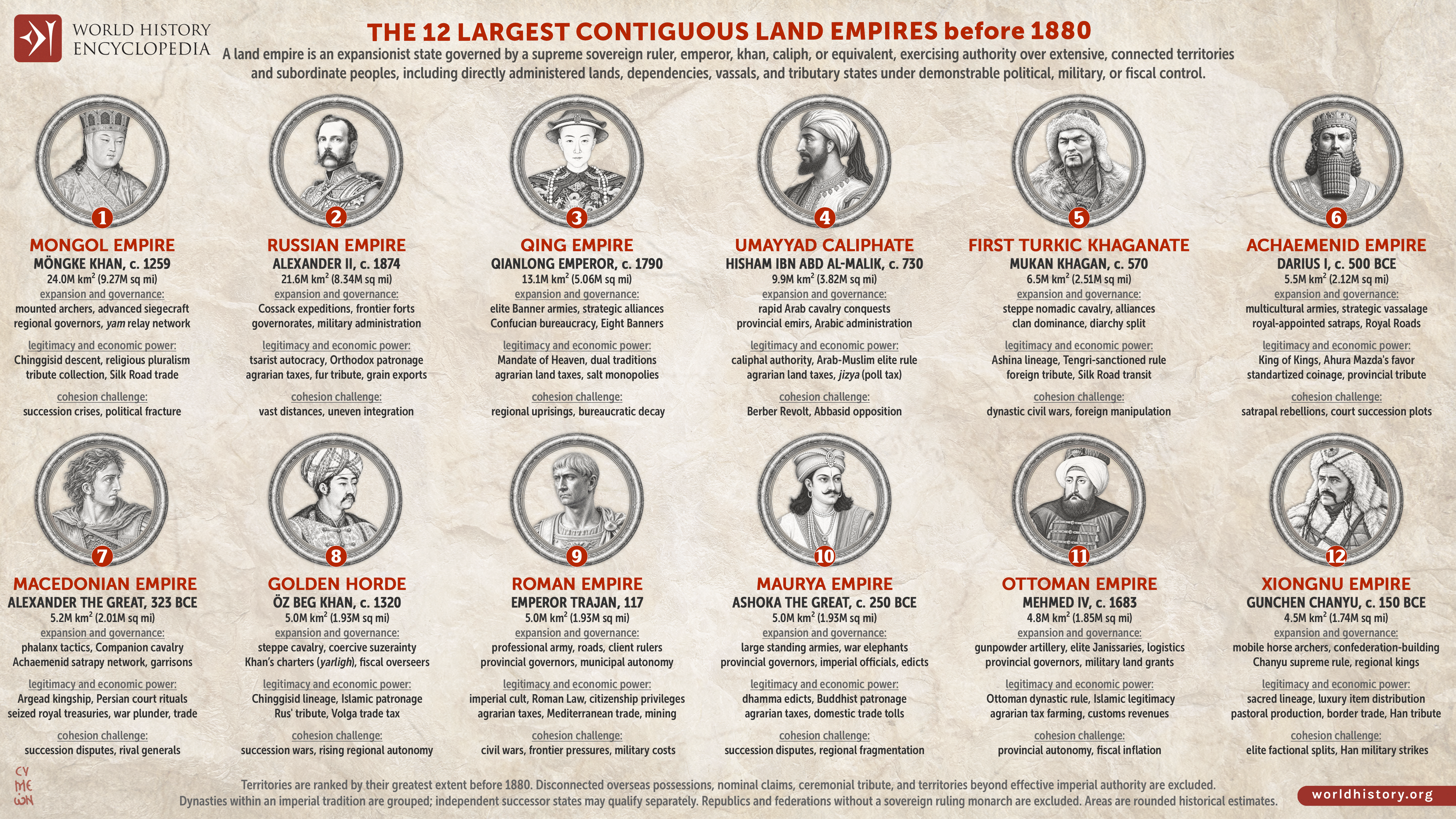
Land empires were expansive states whose rulers exercised authority over large, substantially connected territories and diverse populations. They grew through [conquest](https://www.worldhistory.org/warfare/), diplomacy, alliances, migration, and the incorporation of subordinate peoples and states, while governing through systems ranging from centralized bureaucracies to provincial administration, tributary relationships, and local rulers. The twelve empires below are ranked by their greatest estimated contiguous territorial extent before 1880, excluding disconnected overseas possessions and territories beyond demonstrable imperial control.
1. **[Mongol Empire](https://www.worldhistory.org/Mongol_Empire/) (c. 1259)** – c. 24.0 million km² – the largest contiguous land [empire](https://www.worldhistory.org/empire/) in history, combining highly mobile armies with regional governors, tribute systems, religious pluralism, and extensive Eurasian [trade](https://www.worldhistory.org/disambiguation/trade/) networks.
2. **Russian Empire (c. 1874)** – c. 21.6 million km² – expanded across northern Eurasia through conquest, settlement, frontier forts, and Cossack expeditions, administering its vast territories through increasingly centralized imperial institutions.
3. **Qing Empire (c. 1790)** – c. 13.1 million km² – reached its greatest extent under the Qianlong Emperor, combining Chinese bureaucratic government with Banner institutions, alliances, and distinct administrative systems across Inner Asia.
4. **[Umayyad Caliphate](https://www.worldhistory.org/Umayyad_Dynasty/) (c. 730)** – c. 9.9 million km² – expanded rapidly from the Iberian Peninsula to Central Asia through military conquest, governing through provincial administrations under the authority of the caliph.
5. **First Turkic Khaganate (c. 570)** – c. 6.5 million km² – united much of the Eurasian steppe through mobile cavalry, dynastic alliances, tributary relationships, and control of important [Silk Road](https://www.worldhistory.org/Silk_Road/) routes.
6. **[Achaemenid Empire](https://www.worldhistory.org/Achaemenid_Empire/) (c. 500 BCE)** – c. 5.5 million km² – governed a vast multicultural empire through satrapies, royal roads, tribute, standardized [coinage](https://www.worldhistory.org/coinage/), and accommodation of regional elites and traditions.
7. **[Macedonian Empire](https://www.worldhistory.org/macedon/) (323 BCE)** – c. 5.2 million km² – created through the conquests of [Alexander the Great](https://www.worldhistory.org/Alexander_the_Great/), combining Macedonian military power with inherited [Achaemenid](https://www.worldhistory.org/disambiguation/Achaemenid/) administrative networks and regional governors.
8. **[Golden Horde](https://www.worldhistory.org/Golden_Horde/) (c. 1320)** – c. 5.0 million km² – a major successor state of the [Mongol](https://www.worldhistory.org/Mongol_Empire/) Empire that exercised direct and tributary authority across the western Eurasian steppe and over the Rus' principalities.
9. **[Roman Empire](https://www.worldhistory.org/Roman_Empire/) (117 CE)** – c. 5.0 million km² – reached its maximum territorial extent under [Trajan](https://www.worldhistory.org/trajan/), supported by professional armies, provincial government, roads, taxation, urban networks, and extensive [Mediterranean](https://www.worldhistory.org/disambiguation/mediterranean/) trade.
10. **Maurya Empire (c. 250 BCE)** – c. 5.0 million km² – united much of the Indian subcontinent through military expansion and provincial administration, reaching its height under [Ashoka](https://www.worldhistory.org/Ashoka_the_Great/).
11. **[Ottoman Empire](https://www.worldhistory.org/Ottoman_Empire/) (c. 1683)** – c. 4.8 million km² – governed territories across southeastern [Europe](https://www.worldhistory.org/europe/), western Asia, and North [Africa](https://www.worldhistory.org/disambiguation/africa/) through provincial administration, military institutions, taxation, and negotiated relationships with local communities.
12. **Xiongnu Empire (c. 150 BCE)** – c. 4.5 million km² – built a powerful Inner Asian confederation through mounted [warfare](https://www.worldhistory.org/warfare/), dynastic leadership, regional rulers, pastoral resources, trade, and tribute relations with [Han](https://www.worldhistory.org/Han_Dynasty/) [China](https://www.worldhistory.org/china/).
The scale of these empires depended on far more than conquest alone. Taxation, communications, trade networks, military logistics, political legitimacy, and cooperation with regional elites were essential to holding extensive territories together. Their histories also expose a recurring problem of imperial rule: the larger the territory, the greater the pressures created by distance, succession disputes, regional resistance, fiscal strain, and uneven control. Comparing their maximum extent therefore reveals not only how large land empires became, but also the different strategies—and limits—of governing space on a continental scale.
#### Editorial Review
This human-authored image has been reviewed by our editorial team before publication to ensure accuracy, reliability and adherence to academic standards in accordance with our [editorial policy](https://www.worldhistory.org/static/editorial-policy/).
## About the Author
Simeon is a freelance visual designer and history educator, passionate about the human stories that shape the past.
- [Linkedin Profile](https://www.linkedin.com/in/simeon-netchev/)
## Cite This Work
### APA
Netchev, S. (2026, October 28). 12 Largest Contiguous Land Empires Before 1880: From the Mongol Empire to Rome, Qing China & Russia. *World History Encyclopedia*.
### Chicago
Netchev, Simeon. "12 Largest Contiguous Land Empires Before 1880: From the Mongol Empire to Rome, Qing China & Russia." *World History Encyclopedia*, October 28, 2026. .
### MLA
Netchev, Simeon. "12 Largest Contiguous Land Empires Before 1880: From the Mongol Empire to Rome, Qing China & Russia." *World History Encyclopedia*, 28 Oct 2026, .
## License & Copyright
Submitted by [Simeon Netchev](https://www.worldhistory.org/user/simeonnetchev/ "User Page: Simeon Netchev"), published on 28 October 2026. The copyright holder has published this content under the following license: [Creative Commons Attribution-NonCommercial-NoDerivs](https://creativecommons.org/licenses/by-nc/4.0deed.en). This licence only allows others to download this content and share it with others as long as the author is credited, but they can't change the content in any way or use it commercially. When republishing on the web a hyperlink back to the original content source URL must be included. Please note that content linked from this page may have different licensing terms.