---
title: 12 Women Rulers of the Ancient World: Queens, Regents & Empresses Who Exercised State Power
author: Simeon Netchev
source: https://www.worldhistory.org/image/22197/12-women-rulers-of-the-ancient-world/
format: machine-readable-alternate
license: Creative Commons Attribution-NonCommercial-NoDerivs (https://creativecommons.org/licenses/by-nc/4.0)
updated: 2026-09-28
---
# 12 Women Rulers of the Ancient World: Queens, Regents & Empresses Who Exercised State Power
_Authored by [Simeon Netchev](https://www.worldhistory.org/user/simeonnetchev/)_
## Image File
[](https://www.worldhistory.org/uploads/images/22197.png)
## Image Caption
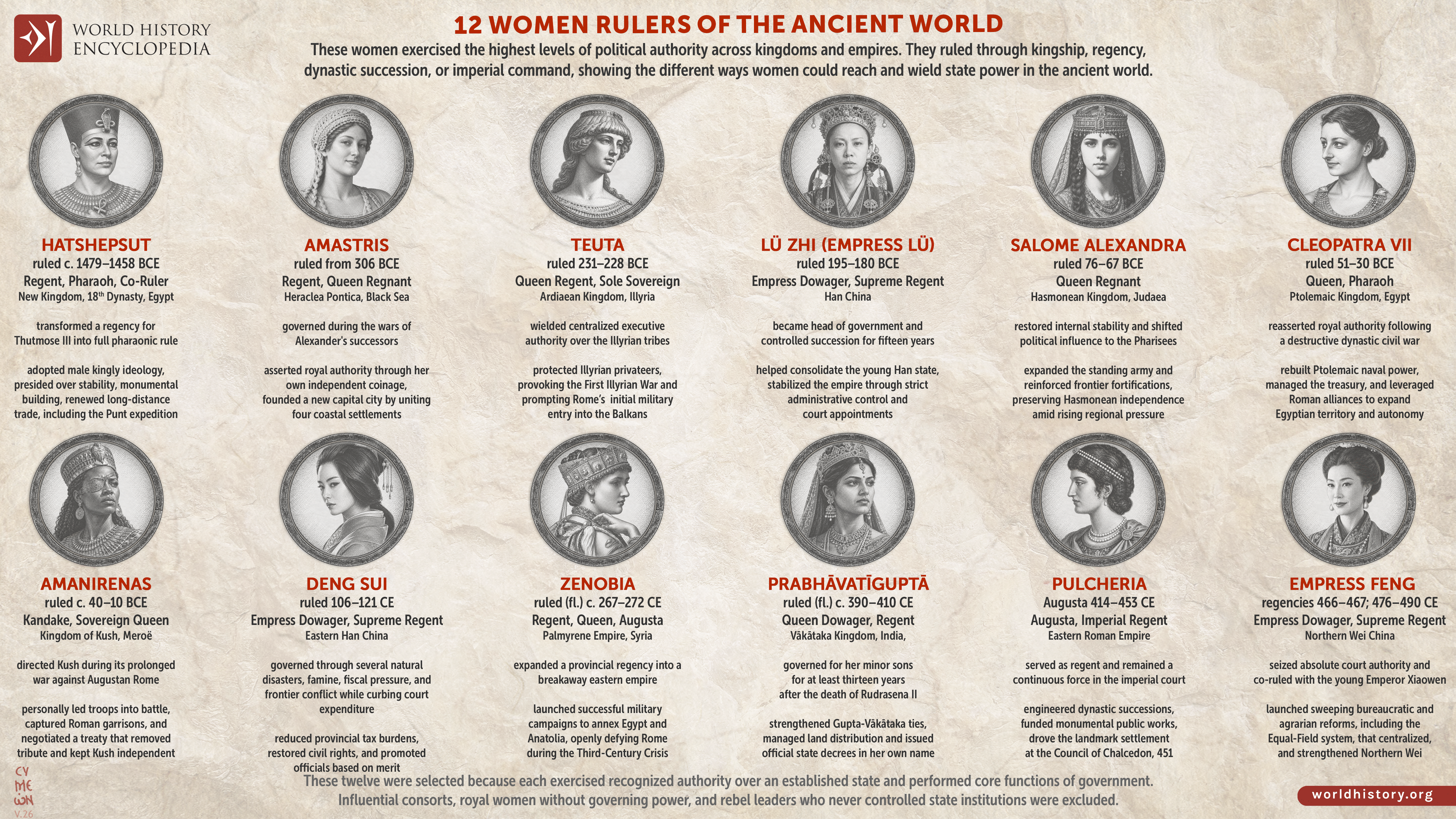
Political power in the ancient world rested on dynastic legitimacy, control of court and military institutions, religious authority, and the ability to maintain stability. Although most ancient political systems favored male succession, [women](https://www.worldhistory.org/disambiguation/women/) could still emerge as sovereigns, regents, co-rulers, or dominant figures at court. The twelve rulers below show how women exercised real state power across different regions, periods, and political systems.
1. **[Hatshepsut](https://www.worldhistory.org/hatshepsut/) (c. 1479–1458 BCE)** – [New Kingdom](https://www.worldhistory.org/disambiguation/New_Kingdom/) [Egypt](https://www.worldhistory.org/egypt/) – began as regent for [Thutmose III](https://www.worldhistory.org/Thutmose_III/) before assuming full pharaonic authority, promoting monumental construction, political stability, and long-distance [trade](https://www.worldhistory.org/disambiguation/trade/), including the expedition to [Punt](https://www.worldhistory.org/punt/).
2. **[Amastris](https://www.worldhistory.org/Amastris/) (from 306 BCE)** – Heraclea Pontica – exercised independent royal authority during the Wars of [Alexander](https://www.worldhistory.org/disambiguation/Alexander/)'s Successors, issued [coinage](https://www.worldhistory.org/coinage/) in her own name, and founded a new capital by uniting several Black Sea settlements.
3. **Teuta (231–228 BCE)** – Ardiaean Kingdom of Illyria – ruled first as queen regent and then as sovereign, directing Illyrian policy and supporting maritime raiding that contributed to the First Illyrian [War](https://www.worldhistory.org/disambiguation/War/) with [Rome](https://www.worldhistory.org/Rome/).
4. **Lü Zhi, Empress Lü (195–180 BCE)** – [Han](https://www.worldhistory.org/Han_Dynasty/) [China](https://www.worldhistory.org/china/) – became the dominant political authority after the [death](https://www.worldhistory.org/disambiguation/Death/) of Emperor Gaozu, controlled imperial succession, and helped consolidate the early Han state through court appointments and centralized administration.
5. **Salome Alexandra (76–67 BCE)** – Hasmonean [Judaea](https://www.worldhistory.org/disambiguation/judaea/) – ruled as queen regnant, restored internal stability, expanded the army and fortifications, and shifted political influence toward the [Pharisees](https://www.worldhistory.org/Pharisees/).
6. **[Cleopatra VII](https://www.worldhistory.org/Cleopatra_VII/) (51–30 BCE)** – [Ptolemaic Egypt](https://www.worldhistory.org/Ptolemaic_Egypt/) – reasserted royal authority after dynastic conflict, strengthened Egypt's finances and naval power, and used alliances with Rome to defend and expand Ptolemaic influence.
7. **Amanirenas (c. 40–10 BCE)** – Kingdom of [Kush](https://www.worldhistory.org/Kush/) – directed Kush during its war with Augustan Rome, led military resistance, and negotiated a settlement that preserved Kushite independence without [Roman](https://www.worldhistory.org/disambiguation/Roman/) tribute.
8. **Deng [Sui](https://www.worldhistory.org/Sui_Dynasty/) (106–121 CE)** – Eastern Han China – governed as empress dowager during famine, natural disasters, fiscal pressure, and frontier conflict, reducing tax burdens and promoting officials on merit.
9. **[Zenobia](https://www.worldhistory.org/zenobia/) (c. 267–272 CE)** – Palmyrene [Empire](https://www.worldhistory.org/empire/) – transformed a regency into an independent eastern imperial regime, conquering Egypt and much of [Anatolia](https://www.worldhistory.org/Asia_Minor/) before being defeated by Emperor [Aurelian](https://www.worldhistory.org/Aurelian/).
10. **Prabhāvatīguptā (c. 390–410 CE)** – Vākāṭaka Kingdom, [India](https://www.worldhistory.org/india/) – governed for her minor sons for more than a decade, strengthened [Gupta](https://www.worldhistory.org/disambiguation/gupta/)-Vākāṭaka ties, managed land grants, and issued official decrees in her own name.
11. **Pulcheria (414–453 CE)** – [Eastern Roman Empire](https://www.worldhistory.org/Byzantine_Empire/) – served as regent and remained a major force in imperial politics, influencing dynastic succession, religious policy, public patronage, and the settlement reached at the [Council of Chalcedon](https://www.worldhistory.org/Council_of_Chalcedon/) in 451 CE.
12. **Empress Feng (regencies 466–467 and 476–490 CE)** – Northern Wei China – exercised dominant authority at court, ruled alongside the young Emperor Xiaowen, and supported major administrative and agrarian reforms, including the Equal-Field system.
These twelve are only part of a much larger story. Other women ruled, governed, or shaped states in ways that are poorly documented, disputed, or lost to us entirely. Our understanding is also shaped by the surviving evidence—often written by later, male authors who could present female authority as unusual or threatening. Their histories therefore reveal not only how women exercised power, but also how historical memory is created, preserved, and sometimes distorted by the sources that survive.
#### Editorial Review
This human-authored image has been reviewed by our editorial team before publication to ensure accuracy, reliability and adherence to academic standards in accordance with our [editorial policy](https://www.worldhistory.org/static/editorial-policy/).
## About the Author
Simeon is a freelance visual designer and history educator, passionate about the human stories that shape the past.
- [Linkedin Profile](https://www.linkedin.com/in/simeon-netchev/)
## Cite This Work
### APA
Netchev, S. (2026, September 28). 12 Women Rulers of the Ancient World: Queens, Regents & Empresses Who Exercised State Power. *World History Encyclopedia*.
### Chicago
Netchev, Simeon. "12 Women Rulers of the Ancient World: Queens, Regents & Empresses Who Exercised State Power." *World History Encyclopedia*, September 28, 2026. .
### MLA
Netchev, Simeon. "12 Women Rulers of the Ancient World: Queens, Regents & Empresses Who Exercised State Power." *World History Encyclopedia*, 28 Sep 2026, .
## License & Copyright
Submitted by [Simeon Netchev](https://www.worldhistory.org/user/simeonnetchev/ "User Page: Simeon Netchev"), published on 28 September 2026. The copyright holder has published this content under the following license: [Creative Commons Attribution-NonCommercial-NoDerivs](https://creativecommons.org/licenses/by-nc/4.0deed.en). This licence only allows others to download this content and share it with others as long as the author is credited, but they can't change the content in any way or use it commercially. When republishing on the web a hyperlink back to the original content source URL must be included. Please note that content linked from this page may have different licensing terms.