---
title: 12 Blue Riband Ocean Liners, 1838–1938: A Century of the Transatlantic Speed Race
author: Simeon Netchev
source: https://www.worldhistory.org/image/22161/12-blue-riband-ocean-liners-1838-1938/
format: machine-readable-alternate
license: Creative Commons Attribution-NonCommercial-NoDerivs (https://creativecommons.org/licenses/by-nc/4.0)
updated: 2026-09-22
---
# 12 Blue Riband Ocean Liners, 1838–1938: A Century of the Transatlantic Speed Race
_Authored by [Simeon Netchev](https://www.worldhistory.org/user/simeonnetchev/)_
## Image File
[](https://www.worldhistory.org/uploads/images/22161.png)
## Image Caption
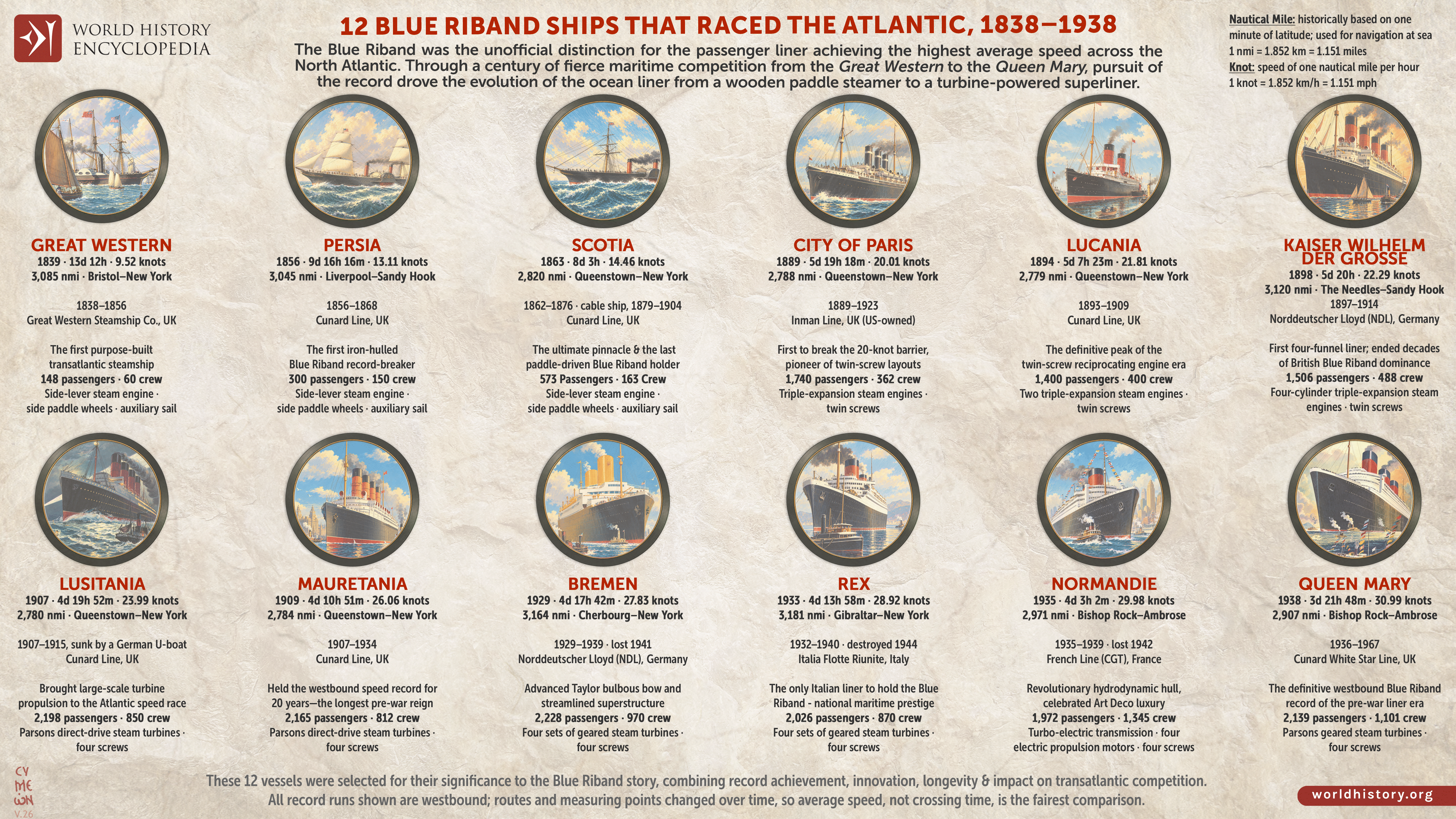
The Blue Riband of the Atlantic was the unofficial distinction awarded to the passenger liner achieving the highest average speed on a regular transatlantic crossing. Emerging in the age of steam, it reflected major advances in marine engineering during the 19th and early 20th centuries. Over the course of a century, wooden paddle steamers gave way to iron and steel hulls, screw propulsion, compound and triple-expansion engines, and eventually powerful steam turbines. Because routes and measuring points changed over time, the Blue Riband was judged primarily by average speed rather than total passage time, and eastbound and westbound records were treated separately.
1. **Great Western (1839)** - Great Western Steam Ship Co., United Kingdom – crossed from Bristol to New York at 9.52 knots, becoming the first purpose-built transatlantic steamship and the first Blue Riband holder of the steam age.
2. **[Persia](https://www.worldhistory.org/Persia/) (1856)** - Cunard Line, United Kingdom – achieved 13.11 knots on the Liverpool–Sandy Hook route and became the first iron-hulled Blue Riband record-holder.
3. **Scotia (1863)** - Cunard Line, United Kingdom – reached 14.46 knots between Queenstown and New York and represented the final and most advanced stage of the paddle-driven record liners.
4. **[City](https://www.worldhistory.org/city/) of [Paris](https://www.worldhistory.org/disambiguation/paris/) (1889) -** Inman Line, United Kingdom (US-owned) – averaged 20.01 knots on the Queenstown–New York crossing, becoming the first liner to break the 20-knot barrier and a pioneer of the twin-screw era.
5. **Lucania (1894)** - Cunard Line, United Kingdom – raised the record to 21.81 knots on the Queenstown–New York route and marked the mature peak of the twin-screw reciprocating-engine liner.
6. **Kaiser Wilhelm der Grosse (1898)** - Norddeutscher Lloyd, Germany – recorded 22.29 knots between the Needles and Sandy Hook, becoming the first four-funnel liner and ending decades of British Blue Riband dominance.
7. **Lusitania (1907)** - Cunard Line, United Kingdom – reached 23.99 knots on the Queenstown–New York crossing and brought large-scale turbine propulsion into the Atlantic speed race.
8. **[Mauretania](https://www.worldhistory.org/Mauretania/) (1909)** - Cunard Line, United Kingdom – achieved 26.06 knots on the Queenstown–New York route and held the westbound speed record for 20 years.
9. **Bremen (1929)** - Norddeutscher Lloyd, Germany – set a new [mark](https://www.worldhistory.org/disambiguation/Mark/) of 27.83 knots between Cherbourg and New York, combining advanced hull design with geared steam turbines.
10. **Rex (1933)** - Italia Flotte Riunite, [Italy](https://www.worldhistory.org/italy/) – averaged 28.92 knots on the Gibraltar–New York run and became the only Italian liner to hold the Blue Riband.
11. **Normandie (1935)** - French Line (Compagnie Générale Transatlantique), France – reached 29.98 knots between Bishop Rock and Ambrose, representing the high point of French liner design and advanced turbo-electric propulsion.
12. **Queen Mary (1938)** - Cunard White Star Line, United Kingdom – achieved 30.99 knots on the Bishop Rock–Ambrose route, securing the definitive westbound Blue Riband record of the pre-[war](https://www.worldhistory.org/disambiguation/War/) liner era.
Together, these ships show how the Blue Riband expressed the close relationship between [industrialization](https://www.worldhistory.org/disambiguation/Industrialization/), engineering innovation, migration, commercial competition, and national prestige. Companies such as Cunard, Norddeutscher Lloyd, the French Line, and the Italian Line used fast liners to attract passengers and symbolize technological power. From Great Western to Queen Mary, representative record speeds rose from about 9 to 31 knots, reducing the Atlantic crossing from nearly two weeks to under four days and transforming the ocean liner into a major instrument of global mobility and industrial modernity.
#### Editorial Review
This human-authored image has been reviewed by our editorial team before publication to ensure accuracy, reliability and adherence to academic standards in accordance with our [editorial policy](https://www.worldhistory.org/static/editorial-policy/).
## About the Author
Simeon is a freelance visual designer and history educator, passionate about the human stories that shape the past.
- [Linkedin Profile](https://www.linkedin.com/in/simeon-netchev/)
## Cite This Work
### APA
Netchev, S. (2026, September 22). 12 Blue Riband Ocean Liners, 1838–1938: A Century of the Transatlantic Speed Race. *World History Encyclopedia*.
### Chicago
Netchev, Simeon. "12 Blue Riband Ocean Liners, 1838–1938: A Century of the Transatlantic Speed Race." *World History Encyclopedia*, September 22, 2026. .
### MLA
Netchev, Simeon. "12 Blue Riband Ocean Liners, 1838–1938: A Century of the Transatlantic Speed Race." *World History Encyclopedia*, 22 Sep 2026, .
## License & Copyright
Submitted by [Simeon Netchev](https://www.worldhistory.org/user/simeonnetchev/ "User Page: Simeon Netchev"), published on 22 September 2026. The copyright holder has published this content under the following license: [Creative Commons Attribution-NonCommercial-NoDerivs](https://creativecommons.org/licenses/by-nc/4.0deed.en). This licence only allows others to download this content and share it with others as long as the author is credited, but they can't change the content in any way or use it commercially. When republishing on the web a hyperlink back to the original content source URL must be included. Please note that content linked from this page may have different licensing terms.