---
title: Twelve Spices That Changed the World: Trade, Empire, and the Global Age of Spices, 1450–1650
author: Simeon Netchev
source: https://www.worldhistory.org/image/22137/twelve-spices-that-changed-the-world/
format: machine-readable-alternate
license: Creative Commons Attribution-NonCommercial-NoDerivs (https://creativecommons.org/licenses/by-nc/4.0)
updated: 2026-09-16
---
# Twelve Spices That Changed the World: Trade, Empire, and the Global Age of Spices, 1450–1650
_Authored by [Simeon Netchev](https://www.worldhistory.org/user/simeonnetchev/)_
## Image File
[](https://www.worldhistory.org/uploads/images/22137.png)
## Image Caption
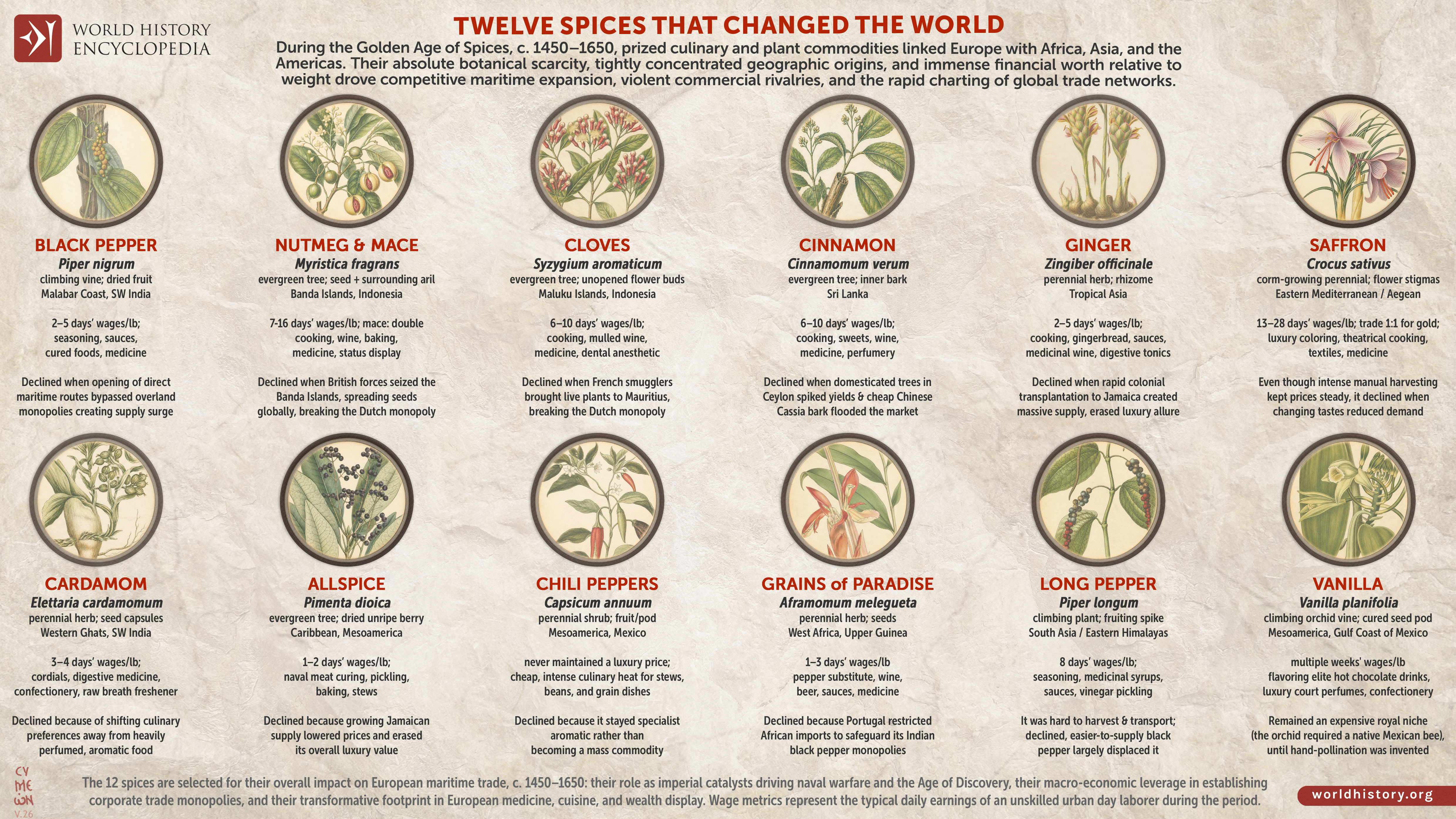
Between c. 1450 and 1650, demand for spices and other high-value plant commodities became an important catalyst for European maritime expansion. [Pepper](https://www.worldhistory.org/Pepper/), cinnamon, cloves, and nutmeg were especially prized because their principal sources lay thousands of kilometres from European markets and were already embedded within extensive Asian, Indian Ocean, Middle Eastern, and [Mediterranean](https://www.worldhistory.org/disambiguation/mediterranean/) [trade](https://www.worldhistory.org/disambiguation/trade/) networks. European attempts to reach these markets directly by sea contributed to the wider maritime expansion conventionally known as the Age of Discovery and intensified competition for control of production centres, ports, and oceanic routes.
1. **Black Pepper (Piper nigrum)** – grown on [India](https://www.worldhistory.org/india/)'s Malabar Coast, pepper was one of the most important commodities of the spice trade and a major incentive for European attempts to reach Asian markets directly by sea.
2. **Nutmeg and Mace (Myristica fragrans)** – native to the Banda Islands, these two spices from the same fruit became exceptionally valuable commodities and the focus of intense Dutch efforts to monopolize production.
3. **Cloves (Syzygium aromaticum)** – originating in the Maluku Islands, cloves commanded high prices in European markets and became another major target of Portuguese and Dutch commercial expansion.
4. **Cinnamon (Cinnamomum verum)** – strongly associated with Sri Lanka, cinnamon became a valuable object of Portuguese, Dutch, and later British competition before wider cultivation and cheaper substitutes reduced its exclusivity.
5. **Ginger (Zingiber officinale)** – originating in tropical Asia, ginger was already widely traded before European oceanic expansion and became increasingly cultivated across tropical colonial regions.
6. **Saffron (Crocus sativus)** – valued for colouring, [medicine](https://www.worldhistory.org/disambiguation/medicine/), cuisine, and luxury consumption, saffron remained expensive because its stigmas required extremely labour-intensive harvesting.
7. **Cardamom (Elettaria cardamomum)** – originating in the Western Ghats of India, cardamom circulated through long-established Asian and Indian Ocean trading networks and was prized for culinary and medicinal uses.
8. **Allspice (Pimenta dioica)** – native to the Caribbean and Mesoamerica, especially associated with Jamaica, allspice entered European trade after transatlantic expansion and became important in cooking, preservation, and baking.
9. **Chili Peppers (Capsicum annuum)** – domesticated in the Americas, chili peppers spread rapidly across [Africa](https://www.worldhistory.org/disambiguation/africa/) and Asia through the [Columbian Exchange](https://www.worldhistory.org/Columbian_Exchange/), profoundly transforming cuisines despite never becoming a major European luxury spice.
10. **Grains of Paradise (Aframomum melegueta)** – a West African spice traded through Guinea Coast networks, it served as a pepper substitute in [Europe](https://www.worldhistory.org/europe/) before losing ground as Asian black pepper became more readily available.
11. **Long Pepper (Piper longum)** – an important South Asian spice in ancient and medieval trade, long pepper gradually lost its European market as black pepper became cheaper and easier to obtain.
12. **Vanilla (Vanilla planifolia)** – originating in Mesoamerica, vanilla entered European luxury consumption after the Spanish [conquest](https://www.worldhistory.org/warfare/) but remained expensive because successful cultivation depended on specialized pollination.
Together, these commodities demonstrate how geography, scarcity, commerce, and state power became increasingly interconnected in the emerging early modern global [economy](https://www.worldhistory.org/disambiguation/economy/). European powers sought not simply access to spices but control over their cultivation, shipping routes, ports, and distribution, contributing to colonial conquest, naval [warfare](https://www.worldhistory.org/warfare/), and the rise of chartered companies such as the [Dutch East India Company](https://www.worldhistory.org/Dutch_East_India_Company/) (VOC, 1602) and English [East India Company](https://www.worldhistory.org/East_India_Company/) (1600). At the same time, American crops such as chili peppers, allspice, and vanilla entered older Afro-Eurasian trading systems, showing that early globalization developed through the increasingly forceful connection of already extensive regional networks.
#### Editorial Review
This human-authored image has been reviewed by our editorial team before publication to ensure accuracy, reliability and adherence to academic standards in accordance with our [editorial policy](https://www.worldhistory.org/static/editorial-policy/).
## About the Author
Simeon is a freelance visual designer and history educator, passionate about the human stories that shape the past.
- [Linkedin Profile](https://www.linkedin.com/in/simeon-netchev/)
## Cite This Work
### APA
Netchev, S. (2026, September 16). Twelve Spices That Changed the World: Trade, Empire, and the Global Age of Spices, 1450–1650. *World History Encyclopedia*.
### Chicago
Netchev, Simeon. "Twelve Spices That Changed the World: Trade, Empire, and the Global Age of Spices, 1450–1650." *World History Encyclopedia*, September 16, 2026. .
### MLA
Netchev, Simeon. "Twelve Spices That Changed the World: Trade, Empire, and the Global Age of Spices, 1450–1650." *World History Encyclopedia*, 16 Sep 2026, .
## License & Copyright
Submitted by [Simeon Netchev](https://www.worldhistory.org/user/simeonnetchev/ "User Page: Simeon Netchev"), published on 16 September 2026. The copyright holder has published this content under the following license: [Creative Commons Attribution-NonCommercial-NoDerivs](https://creativecommons.org/licenses/by-nc/4.0deed.en). This licence only allows others to download this content and share it with others as long as the author is credited, but they can't change the content in any way or use it commercially. When republishing on the web a hyperlink back to the original content source URL must be included. Please note that content linked from this page may have different licensing terms.