---
title: Alexander the Great’s Eight Bodyguards: The Somatophylakes and the Macedonian Empire
author: Simeon Netchev
source: https://www.worldhistory.org/image/22057/alexander-the-greats-eight-bodyguards/
format: machine-readable-alternate
license: Creative Commons Attribution-NonCommercial-NoDerivs (https://creativecommons.org/licenses/by-nc/4.0)
updated: 2026-09-04
---
# Alexander the Great’s Eight Bodyguards: The Somatophylakes and the Macedonian Empire
_Authored by [Simeon Netchev](https://www.worldhistory.org/user/simeonnetchev/)_
## Image File
[](https://www.worldhistory.org/uploads/images/22057.png)
## Image Caption
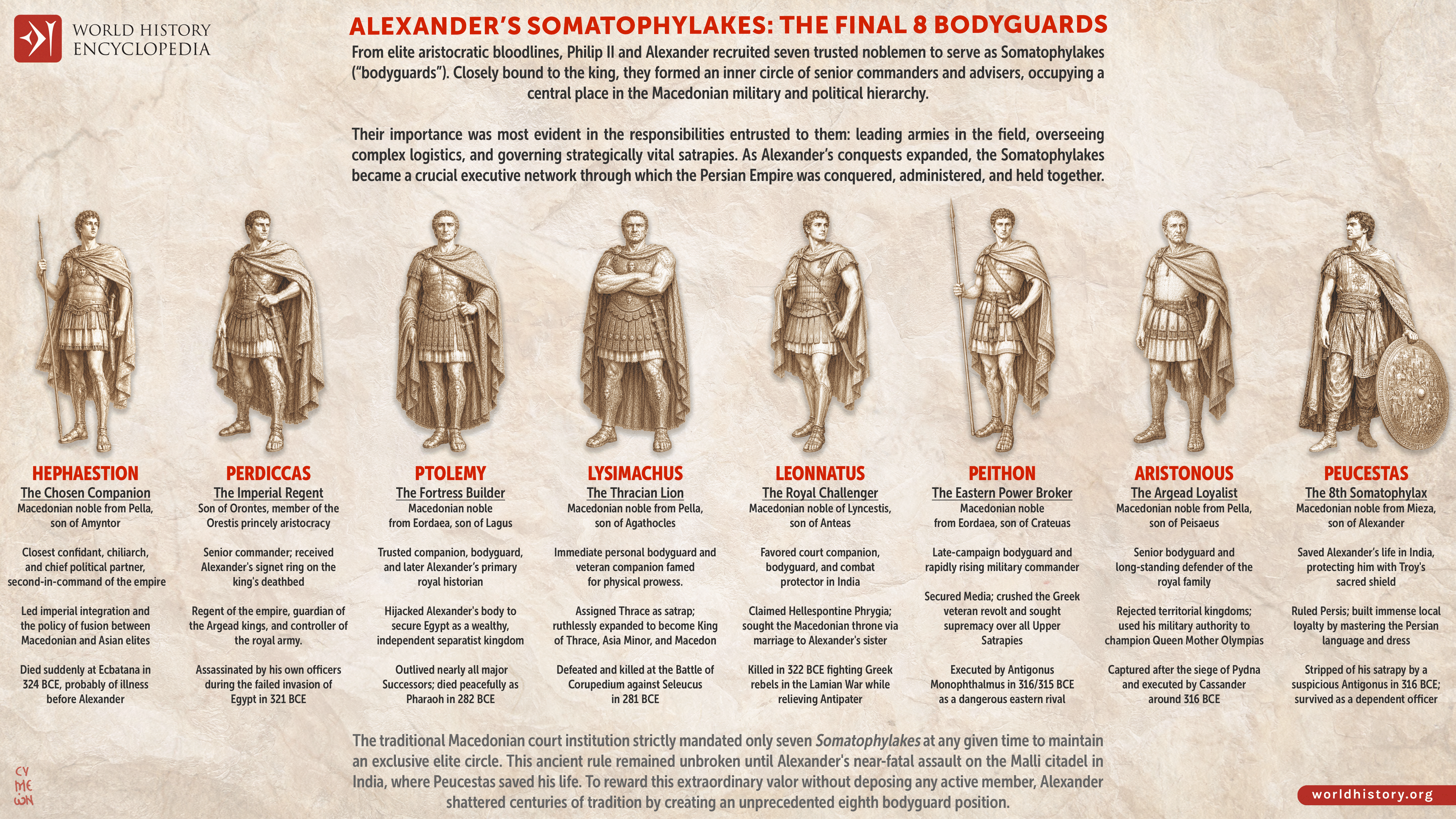
Under [Philip II of Macedon](https://www.worldhistory.org/Philip_II_of_Macedon/) (reign 359–336 BCE) and [Alexander the Great](https://www.worldhistory.org/Alexander_the_Great/) (reign 336–323 BCE), the *somatophylakes* (“bodyguards”) formed an exceptionally exclusive circle of trusted Macedonian nobles around the king. Traditionally limited to seven men, they were distinct from ordinary battlefield guards and often served as senior commanders, governors, and royal advisers. During [Alexander](https://www.worldhistory.org/disambiguation/Alexander/)’s final campaigns, Peucestas was admitted as an unprecedented eighth somatophylax after helping save the wounded king during the Mallian campaign.
1. **[Hephaestion](https://www.worldhistory.org/Hephaestion/)** – Alexander’s closest companion and later chiliarch, he became one of the king’s most important military and political partners before dying at Ecbatana in 324 BCE.
2. **[Perdiccas](https://www.worldhistory.org/Perdiccas/)** – a senior commander who became regent of Alexander’s [empire](https://www.worldhistory.org/empire/) and guardian of the Argead kings after 323 BCE; he was killed by his own officers during the invasion of [Egypt](https://www.worldhistory.org/egypt/) in 321 BCE.
3. **[Ptolemy](https://www.worldhistory.org/disambiguation/Ptolemy/)** – a trusted bodyguard and commander who secured Egypt after Alexander’s [death](https://www.worldhistory.org/disambiguation/Death/), seized Alexander’s body, and eventually founded the [Ptolemaic dynasty](https://www.worldhistory.org/Ptolemaic_Dynasty/).
4. **[Lysimachus](https://www.worldhistory.org/Lysimachus/)** – a veteran companion appointed to govern Thrace in 323 BCE; he later built a powerful kingdom spanning Thrace and parts of [Asia Minor](https://www.worldhistory.org/Asia_Minor/) and [Macedon](https://www.worldhistory.org/macedon/).
5. **Leonnatus** – a prominent bodyguard who received Hellespontine [Phrygia](https://www.worldhistory.org/phrygia/) after Alexander’s death and became involved in dynastic politics before being killed in the Lamian [War](https://www.worldhistory.org/disambiguation/War/) in 322 BCE.
6. **Peithon** – appointed [satrap](https://www.worldhistory.org/Persian_Governor/) of [Media](https://www.worldhistory.org/disambiguation/media/), he suppressed the revolt of [Greek](https://www.worldhistory.org/disambiguation/greek/) veterans in the east and later sought greater control over the Upper Satrapies before being executed by [Antigonus](https://www.worldhistory.org/disambiguation/Antigonus/).
7. **Aristonous** – a long-serving bodyguard who remained loyal to the [Argead dynasty](https://www.worldhistory.org/Argead_Dynasty/) and supported [Olympias](https://www.worldhistory.org/Olympias/) during the Successor struggles before being executed by [Cassander](https://www.worldhistory.org/Cassander/) around 316 BCE.
8. **Peucestas** – rewarded for helping save Alexander during the Mallian assault, he became satrap of [Persis](https://www.worldhistory.org/Persis/) and gained unusual local support by adopting elements of Persian language, dress, and court [culture](https://www.worldhistory.org/disambiguation/culture/).
After Alexander’s death at [Babylon](https://www.worldhistory.org/babylon/) in 323 BCE, proximity to the king became valuable political capital. Several former *somatophylakes* transformed royal trust, military commands, and provincial appointments into independent power bases, while others remained defenders of the Argead dynasty. Their careers trace the fragmentation of Alexander’s personal empire and the emergence of the [Hellenistic](https://www.worldhistory.org/Hellenic_World/) kingdoms during the Wars of the Successors (323–281 BCE).
#### Editorial Review
This human-authored image has been reviewed by our editorial team before publication to ensure accuracy, reliability and adherence to academic standards in accordance with our [editorial policy](https://www.worldhistory.org/static/editorial-policy/).
## About the Author
Simeon is a freelance visual designer and history educator, passionate about the human stories that shape the past.
- [Linkedin Profile](https://www.linkedin.com/in/simeon-netchev/)
## Cite This Work
### APA
Netchev, S. (2026, September 04). Alexander the Great’s Eight Bodyguards: The Somatophylakes and the Macedonian Empire. *World History Encyclopedia*.
### Chicago
Netchev, Simeon. "Alexander the Great’s Eight Bodyguards: The Somatophylakes and the Macedonian Empire." *World History Encyclopedia*, September 04, 2026. .
### MLA
Netchev, Simeon. "Alexander the Great’s Eight Bodyguards: The Somatophylakes and the Macedonian Empire." *World History Encyclopedia*, 04 Sep 2026, .
## License & Copyright
Submitted by [Simeon Netchev](https://www.worldhistory.org/user/simeonnetchev/ "User Page: Simeon Netchev"), published on 04 September 2026. The copyright holder has published this content under the following license: [Creative Commons Attribution-NonCommercial-NoDerivs](https://creativecommons.org/licenses/by-nc/4.0deed.en). This licence only allows others to download this content and share it with others as long as the author is credited, but they can't change the content in any way or use it commercially. When republishing on the web a hyperlink back to the original content source URL must be included. Please note that content linked from this page may have different licensing terms.