---
title: The Bayeux Tapestry in 12 Scenes: Conquest, Propaganda, and the Norman Claim to England, 1066
author: Simeon Netchev
source: https://www.worldhistory.org/image/22011/the-bayeux-tapestry-in-12-scenes/
format: machine-readable-alternate
license: Creative Commons Attribution-NonCommercial-NoDerivs (https://creativecommons.org/licenses/by-nc/4.0)
updated: 2026-09-15
---
# The Bayeux Tapestry in 12 Scenes: Conquest, Propaganda, and the Norman Claim to England, 1066
_Authored by [Simeon Netchev](https://www.worldhistory.org/user/simeonnetchev/)_
## Image File
[](https://www.worldhistory.org/uploads/images/22011.png)
## Image Caption
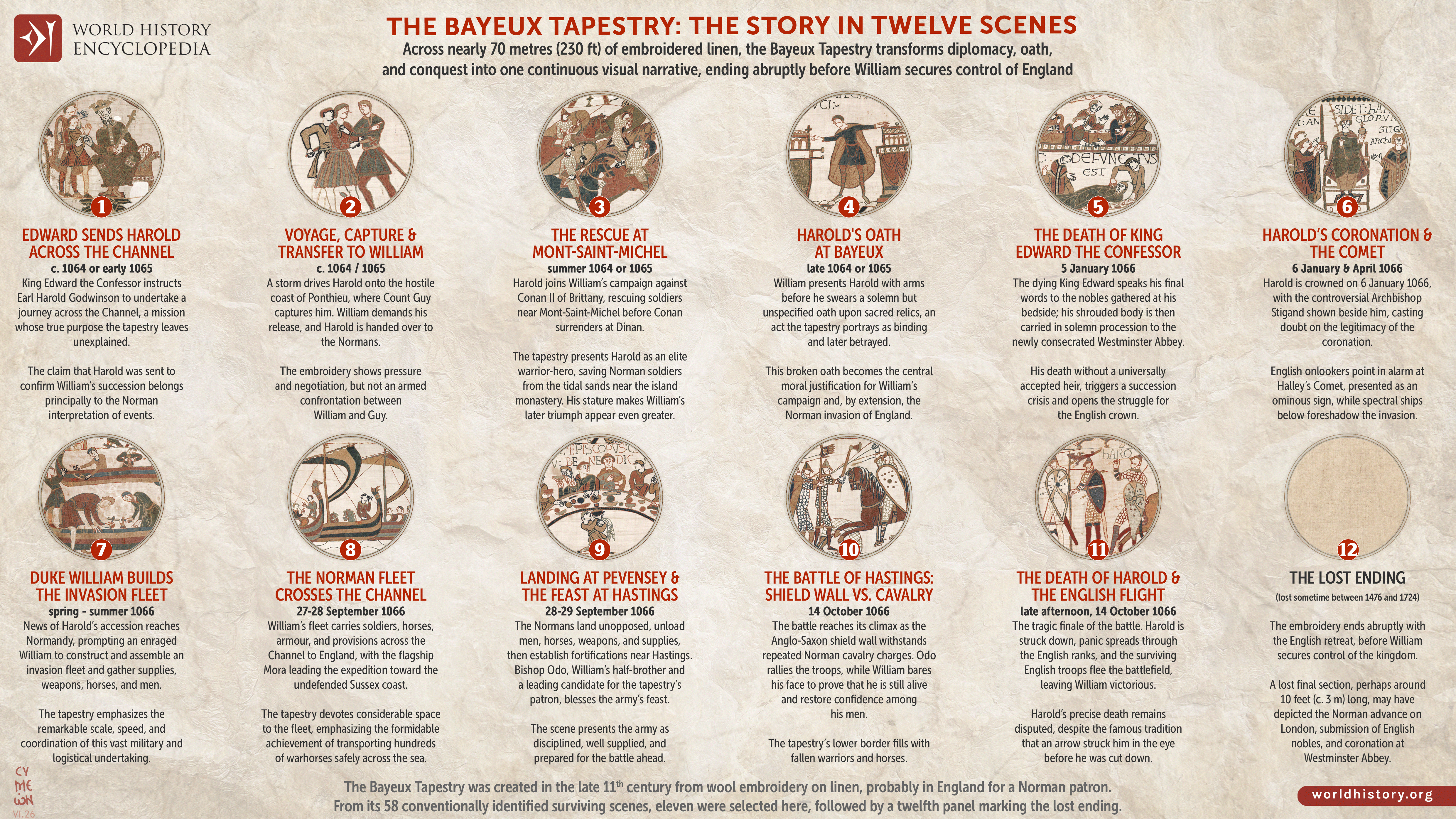
The [Bayeux Tapestry](https://www.worldhistory.org/Bayeux_Tapestry/), created in the late 11th century, probably in [England](https://www.worldhistory.org/disambiguation/england/) for a Norman patron, is one of the most important surviving visual sources for the [Norman Conquest of England](https://www.worldhistory.org/Norman_Conquest_of_England/) in 1066. Despite its name, it is not a woven tapestry but an embroidery of wool thread on linen extending nearly 70 metres (230 ft). Its narrative follows the succession crisis after the [death](https://www.worldhistory.org/disambiguation/Death/) of [Edward the Confessor](https://www.worldhistory.org/Edward_the_Confessor/), the accession of [Harold Godwinson](https://www.worldhistory.org/Harold_Godwinson/), and the invasion of William, Duke of Normandy, culminating in the [Battle of Hastings](https://www.worldhistory.org/Battle_of_Hastings/). The twelve scenes here summarize the embroidery's main storyline.
1. **Edward sends Harold across the Channel** (c. 1064 or early 1065) – King Edward dispatches Earl Harold Godwinson on a mission to Normandy, though the tapestry leaves its precise purpose unexplained.
2. **Voyage, capture, and transfer to William** (c. 1064/1065) – Harold is driven to Ponthieu, captured by Count Guy, and then handed over to Duke William.
3. **The rescue at [Mont-Saint-Michel](https://www.worldhistory.org/Mont-Saint-Michel/)** (summer 1064 or 1065) – Harold joins William's Breton campaign and is shown rescuing soldiers from the tidal sands before Conan II surrenders at Dinan.
4. **Harold's oath at Bayeux** (late 1064 or 1065) – Harold swears a solemn oath to William on sacred relics, a moment the tapestry presents as crucial and later broken.
5. **The death of Edward the Confessor** (5 January 1066) – Edward dies without an uncontested heir, opening a succession crisis that becomes the central cause of the conflict.
6. **Harold's coronation and the comet** (6 January / 4 April 1066) – Harold is crowned king, while the appearance of Halley's Comet is shown as an ominous sign of coming upheaval.
7. **Duke William builds the invasion fleet** (spring–summer 1066) – news of Harold's accession prompts William to organize ships, weapons, horses, and supplies for an invasion of England.
8. **The Norman fleet crosses the Channel** (27–28 September 1066) – William's fleet sails successfully to England, transporting men, horses, and equipment across the sea.
9. **Landing at Pevensey and the feast at Hasting**s (28–29 September 1066) – the Normans land unopposed, establish themselves, and are shown preparing for the campaign ahead.
10. **The [Battle](https://www.worldhistory.org/disambiguation/battle/) of Hastings: shield [wall](https://www.worldhistory.org/wall/) vs. cavalry** (14 October 1066) – the battle reaches its climax as the English shield wall withstands repeated Norman assaults.
11. **The death of Harold and the English flight** (late afternoon, 14 October 1066) – Harold falls, the English line collapses, and William's victory is secured.
12. **The lost ending** – the surviving embroidery ends abruptly, but a missing final section may once have shown the Norman advance on London, the submission of English nobles, and William's coronation.
The Bayeux Tapestry is not simply a record of events but also an interpretation of the [conquest](https://www.worldhistory.org/warfare/). By emphasizing Harold's oath and presenting its violation as the moral justification for William's invasion, it supports the Norman claim to the English throne. At the same time, its rich imagery preserves exceptional evidence for 11th-century ships, weapons, armour, clothing, [architecture](https://www.worldhistory.org/disambiguation/architecture/), ceremony, and [warfare](https://www.worldhistory.org/warfare/). The surviving embroidery ends before William fully secures England, reminding us that even this famous visual narrative is both incomplete and carefully shaped in its message.
#### Editorial Review
This human-authored image has been reviewed by our editorial team before publication to ensure accuracy, reliability and adherence to academic standards in accordance with our [editorial policy](https://www.worldhistory.org/static/editorial-policy/).
## About the Author
Simeon is a freelance visual designer and history educator, passionate about the human stories that shape the past.
- [Linkedin Profile](https://www.linkedin.com/in/simeon-netchev/)
## Cite This Work
### APA
Netchev, S. (2026, August 10). The Bayeux Tapestry in 12 Scenes: Conquest, Propaganda, and the Norman Claim to England, 1066. *World History Encyclopedia*.
### Chicago
Netchev, Simeon. "The Bayeux Tapestry in 12 Scenes: Conquest, Propaganda, and the Norman Claim to England, 1066." *World History Encyclopedia*, August 10, 2026. .
### MLA
Netchev, Simeon. "The Bayeux Tapestry in 12 Scenes: Conquest, Propaganda, and the Norman Claim to England, 1066." *World History Encyclopedia*, 10 Aug 2026, .
## License & Copyright
Submitted by [Simeon Netchev](https://www.worldhistory.org/user/simeonnetchev/ "User Page: Simeon Netchev"), published on 10 August 2026. The copyright holder has published this content under the following license: [Creative Commons Attribution-NonCommercial-NoDerivs](https://creativecommons.org/licenses/by-nc/4.0deed.en). This licence only allows others to download this content and share it with others as long as the author is credited, but they can't change the content in any way or use it commercially. When republishing on the web a hyperlink back to the original content source URL must be included. Please note that content linked from this page may have different licensing terms.