---
title: Japan's Kamikaze Warfare (1944–1945): Japan's Organized Special Attack Campaign in WW II
author: Simeon Netchev
source: https://www.worldhistory.org/image/21937/japans-kamikaze-warfare-1944-1945/
format: machine-readable-alternate
license: Creative Commons Attribution-NonCommercial-NoDerivs (https://creativecommons.org/licenses/by-nc/4.0)
updated: 2026-08-03
---
# Japan's Kamikaze Warfare (1944–1945): Japan's Organized Special Attack Campaign in WW II
_Authored by [Simeon Netchev](https://www.worldhistory.org/user/simeonnetchev/)_
## Image File
[](https://www.worldhistory.org/uploads/images/21937.png)
## Image Caption
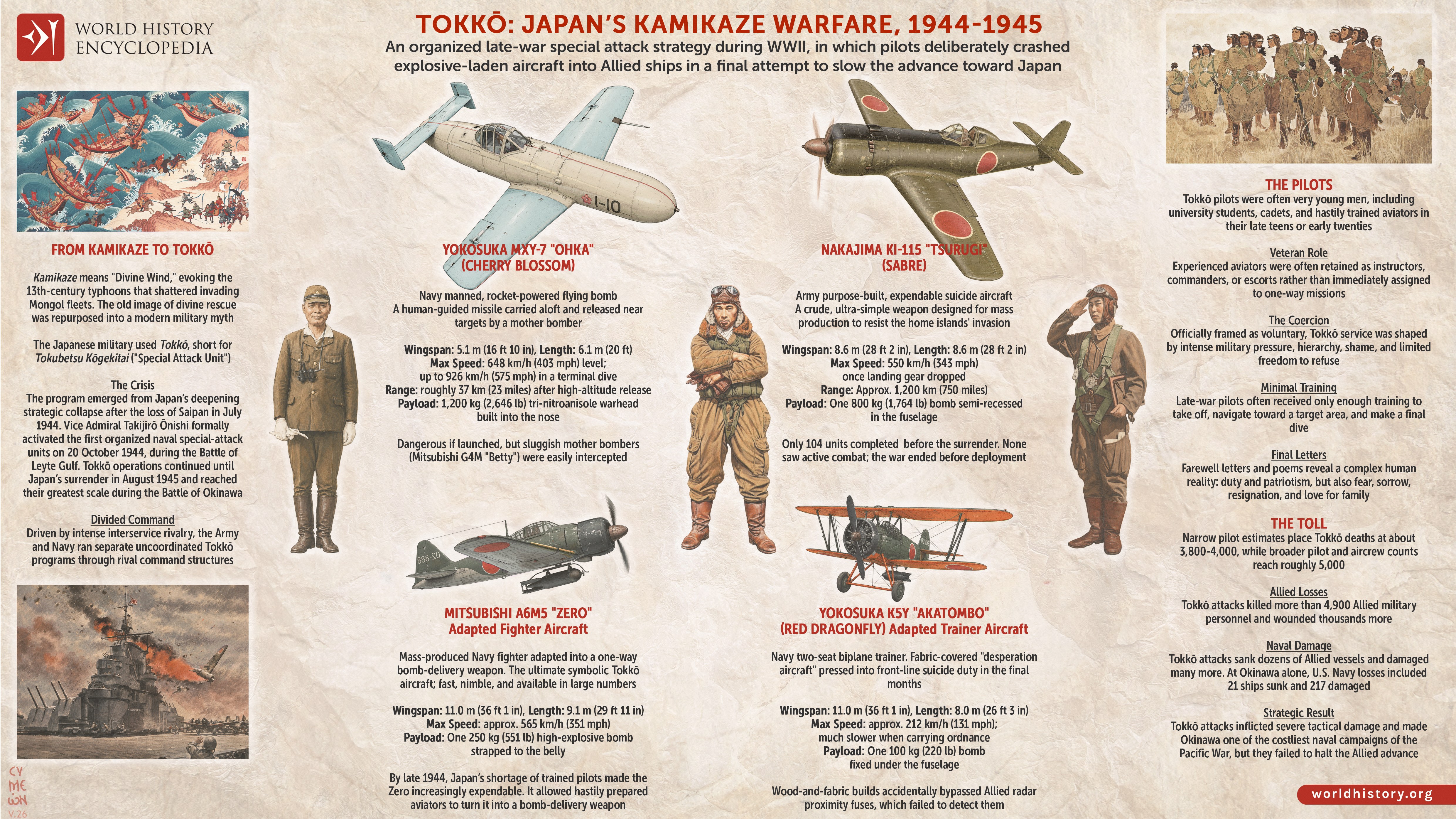
Kamikaze or Tokkō (short for Tokubetsu Kōgekitai, "Special Attack Units") was [Japan](https://www.worldhistory.org/disambiguation/Japan/)'s organized campaign of deliberate suicide attacks during the final phase of the Second World [War](https://www.worldhistory.org/disambiguation/War/) (1939–1945). Emerging amid Japan's deteriorating strategic position in 1944, the program reflected severe shortages of trained pilots, fuel, and modern aircraft, as well as the growing inability of the Imperial Japanese armed forces to contest Allied naval and air superiority. The first officially organized Tokkō operations were initiated under Vice Admiral Takijirō Ōnishi (1881–1945) during the [Battle](https://www.worldhistory.org/disambiguation/battle/) of Leyte Gulf (October 1944), where expendable aircraft were deliberately crashed into Allied warships in an effort to inflict disproportionate losses and delay the Allied advance toward the Japanese home islands.
Tokkō attacks reached their greatest intensity during the Battle of Okinawa (April–June 1945), one of the largest and costliest campaigns of the Pacific War. Although these operations damaged or sank numerous Allied vessels and imposed significant human and material losses, they failed to alter the overall strategic balance. The campaign has since become a subject of extensive historical study, illustrating the interaction of military desperation, ideology, institutional pressure, and personal sacrifice. Beyond its military significance, Tokkō remains one of the most enduring and controversial symbols of Japan's final wartime mobilization and the human cost of total war.
#### Editorial Review
This human-authored image has been reviewed by our editorial team before publication to ensure accuracy, reliability and adherence to academic standards in accordance with our [editorial policy](https://www.worldhistory.org/static/editorial-policy/).
## About the Author
Simeon is a freelance visual designer and history educator, passionate about the human stories that shape the past.
- [Linkedin Profile](https://www.linkedin.com/in/simeon-netchev/)
## Cite This Work
### APA
Netchev, S. (2026, August 03). Japan's Kamikaze Warfare (1944–1945): Japan's Organized Special Attack Campaign in WW II. *World History Encyclopedia*.
### Chicago
Netchev, Simeon. "Japan's Kamikaze Warfare (1944–1945): Japan's Organized Special Attack Campaign in WW II." *World History Encyclopedia*, August 03, 2026. .
### MLA
Netchev, Simeon. "Japan's Kamikaze Warfare (1944–1945): Japan's Organized Special Attack Campaign in WW II." *World History Encyclopedia*, 03 Aug 2026, .
## License & Copyright
Submitted by [Simeon Netchev](https://www.worldhistory.org/user/simeonnetchev/ "User Page: Simeon Netchev"), published on 03 August 2026. The copyright holder has published this content under the following license: [Creative Commons Attribution-NonCommercial-NoDerivs](https://creativecommons.org/licenses/by-nc/4.0deed.en). This licence only allows others to download this content and share it with others as long as the author is credited, but they can't change the content in any way or use it commercially. When republishing on the web a hyperlink back to the original content source URL must be included. Please note that content linked from this page may have different licensing terms.