---
title: Hippodrome, Caesarea Maritima
author: Patrick Scott Smith, M. A.
source: https://www.worldhistory.org/image/21689/hippodrome-caesarea-maritima/
format: machine-readable-alternate
license: Creative Commons Attribution-NonCommercial-NoDerivs (https://creativecommons.org/licenses/by-nc/4.0)
updated: 2026-04-08
---
# Hippodrome, Caesarea Maritima
_Authored by [Patrick Scott Smith, M. A. ](https://www.worldhistory.org/user/patrickscottsmith1956/)_
## Image File
[](https://www.worldhistory.org/uploads/images/21689.jpg)
## Image Caption
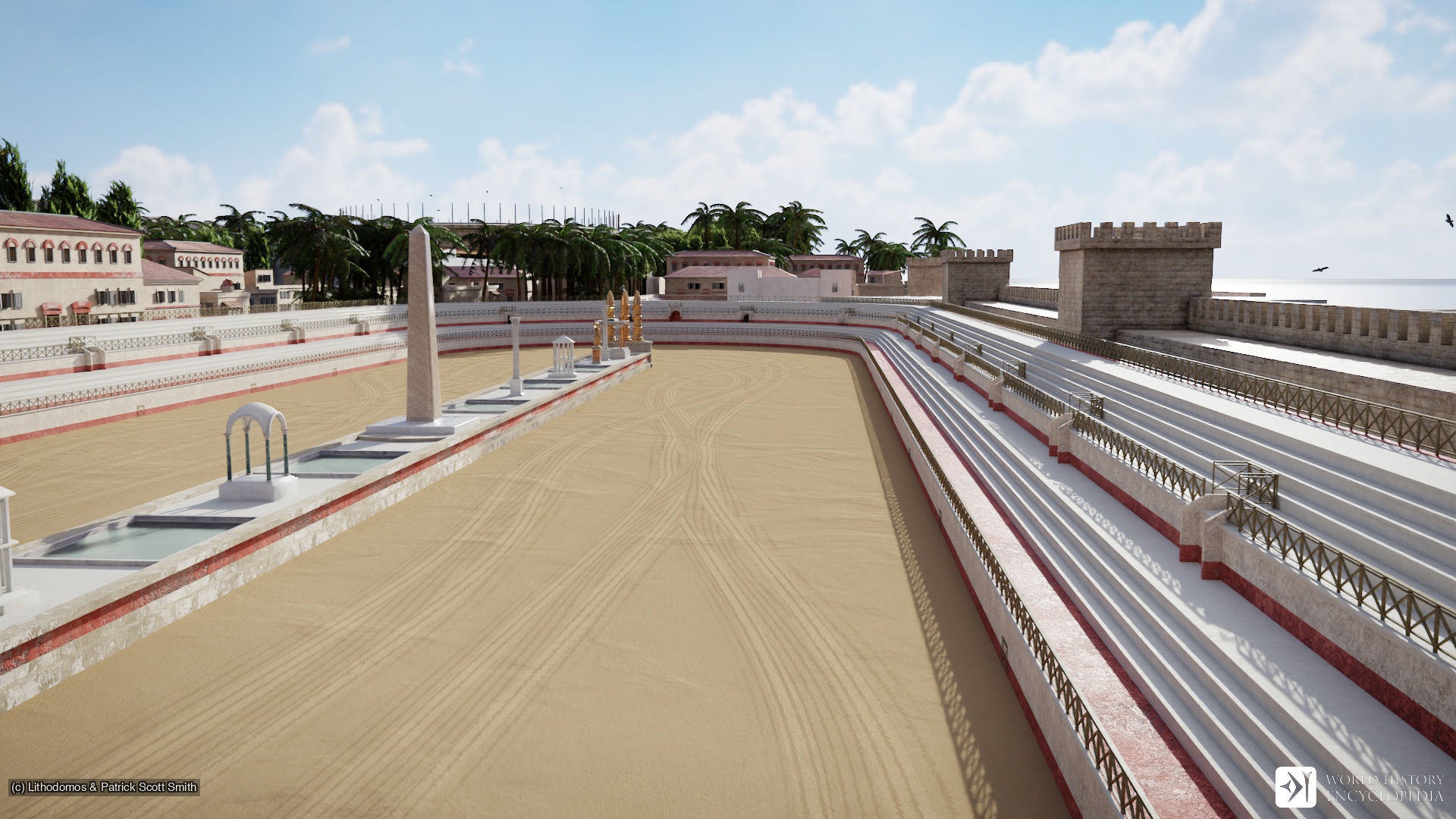
Home to one of the most popular ancient sports, [chariot](https://www.worldhistory.org/chariot/) racing, the hippodrome at [Caesarea Maritima](https://www.worldhistory.org/Caesarea_Maritima/) was one of the main structures in the [city](https://www.worldhistory.org/city/). Dating to the 2nd century CE, it is located along the coast south of the theater. Its perimeter, with a U-shape, reaches a length of 265 meters (869 ft) along the north-south axis.
The best preserved areas are the eastern row of seats (*cavea*) and the southern curved side. The local kurkar stone served exclusively as the building material. The arena, approximately 300 meters (984 ft) long and 50.5 meters (166 ft) wide at 2.2 meters (7.2 ft) above sea level, was enclosed on the east, south, and west by the *cavea* in 12 rows, with a seating capacity of approximately 10,000. The rounded gallery (*sphendonê*) was in the south. The seats were retained on two parallel walls with a fill of earth in between. The starting gates (*carceres*), like all other parts of the hippodrome, were built of kurkar stone and coated with white plaster.
Using archaeological reports by Ehud Netzer, Barbara Burrell, Kenneth Holum, Robert Bull, and others, along with [Flavius Josephus](https://www.worldhistory.org/Flavius_Josephus/)' eyewitness descriptions, the image you see is part of the collaborative work of Lithodomos and Patrick Scott Smith.
#### Editorial Review
This human-authored image has been reviewed by our editorial team before publication to ensure accuracy, reliability and adherence to academic standards in accordance with our [editorial policy](https://www.worldhistory.org/static/editorial-policy/).
## About the Author
Presenting research for the American Society of Overseas Research and Missouri Academy of Science and writing for the Association for the Scientific Study of Religion, Patrick Smith won the 2015 and 2024 Frank Forwood Award for Excellence in Research.
## Cite This Work
### APA
A., P. S. S. M. (2026, April 08). Hippodrome, Caesarea Maritima. *World History Encyclopedia*.
### Chicago
A., Patrick Scott Smith, M.. "Hippodrome, Caesarea Maritima." *World History Encyclopedia*, April 08, 2026. .
### MLA
A., Patrick Scott Smith, M.. "Hippodrome, Caesarea Maritima." *World History Encyclopedia*, 08 Apr 2026, .
## License & Copyright
Submitted by [Patrick Scott Smith, M. A.](https://www.worldhistory.org/user/patrickscottsmith1956/ "User Page: Patrick Scott Smith, M. A."), published on 08 April 2026. The copyright holder has published this content under the following license: [Creative Commons Attribution-NonCommercial-NoDerivs](https://creativecommons.org/licenses/by-nc/4.0deed.en). This licence only allows others to download this content and share it with others as long as the author is credited, but they can't change the content in any way or use it commercially. When republishing on the web a hyperlink back to the original content source URL must be included. Please note that content linked from this page may have different licensing terms.