---
title: Map of Medieval India, c. 1360
author: Simeon Netchev
source: https://www.worldhistory.org/image/21584/map-of-medieval-india-c-1360/
format: machine-readable-alternate
license: Creative Commons Attribution-NonCommercial-NoDerivs (https://creativecommons.org/licenses/by-nc/4.0)
updated: 2026-02-13
---
# Map of Medieval India, c. 1360
_Authored by [Simeon Netchev](https://www.worldhistory.org/user/simeonnetchev/)_
## Image File
[](https://www.worldhistory.org/uploads/images/21584.png)
## Image Caption
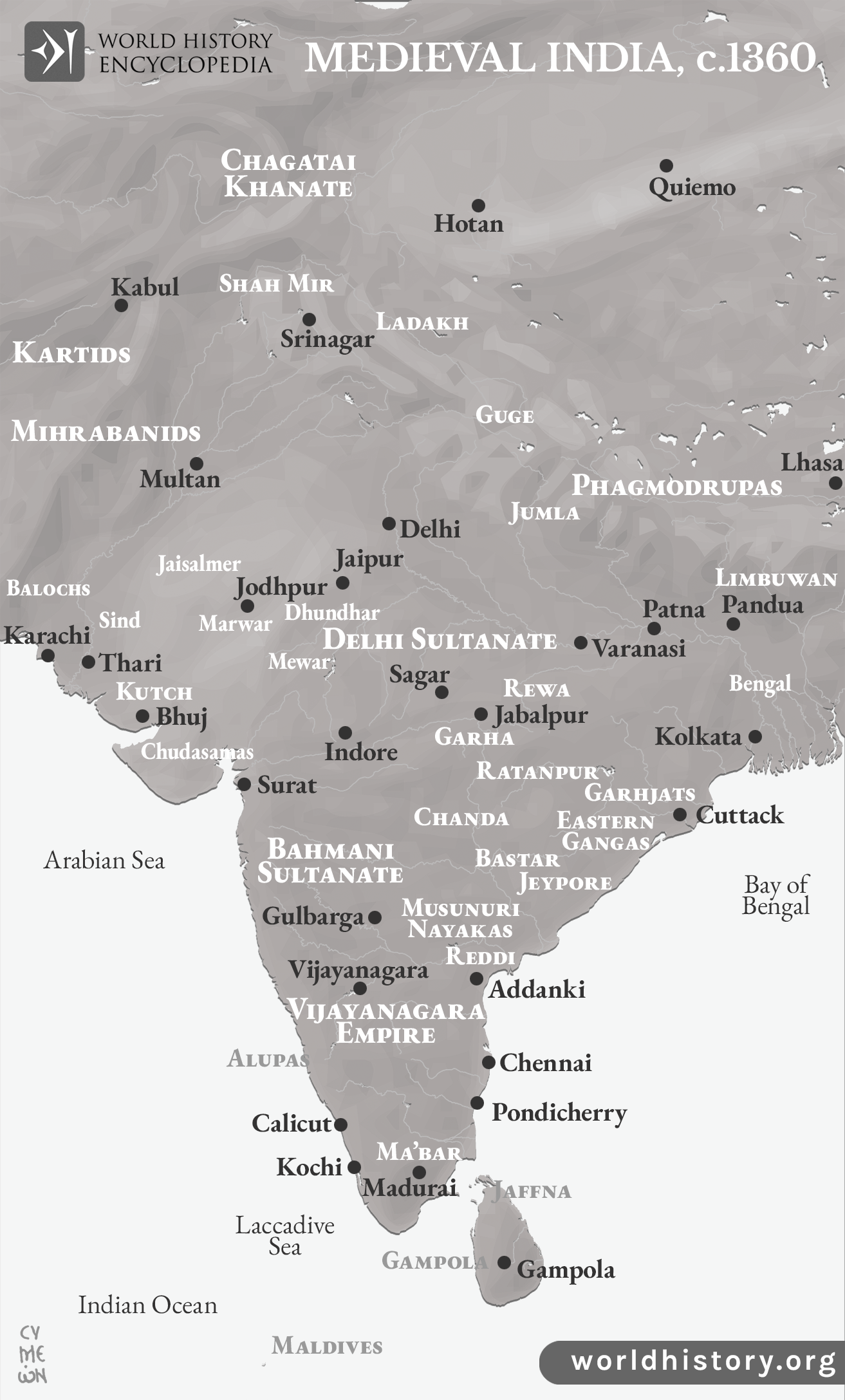
Medieval [India](https://www.worldhistory.org/india/) around the mid-14th century (c. 1360) was characterized by political fragmentation, regional consolidation, and intense interaction between Islamic sultanates and long-established Indic polities. Following the weakening of the Delhi Sultanate after the [death](https://www.worldhistory.org/disambiguation/Death/) of [Muhammad](https://www.worldhistory.org/disambiguation/Muhammad/) bin Tughluq (reign 1325-1351), imperial authority over the subcontinent fractured, giving rise to a [mosaic](https://www.worldhistory.org/Mosaic/) of successor states. While Delhi remained a major political and symbolic center, its effective control was increasingly challenged by provincial governors, military elites, and emerging regional dynasties who asserted autonomy in response to fiscal strain, rebellion, and demographic disruption.
This period saw the parallel consolidation of powerful regional kingdoms, including the Bahmani Sultanate in the Deccan (founded 1347), the Vijayanagara [Empire](https://www.worldhistory.org/empire/) in the south (founded 1336), and a range of Rajput, eastern Gangetic, and Himalayan polities. These states competed and cooperated through [warfare](https://www.worldhistory.org/warfare/), diplomacy, [trade](https://www.worldhistory.org/disambiguation/trade/), and cultural exchange, shaping a plural political landscape rather than a unified imperial system. Long-distance commerce across the Indian Ocean and overland routes continued to bind India to the wider Islamic world and East Asia, while religious institutions, both Islamic and [Hindu](https://www.worldhistory.org/hinduism/), played central roles in governance, patronage, and social organization.
#### Editorial Review
This human-authored image has been reviewed by our editorial team before publication to ensure accuracy, reliability and adherence to academic standards in accordance with our [editorial policy](https://www.worldhistory.org/static/editorial-policy/).
## About the Author
Simeon is a freelance visual designer and history educator, passionate about the human stories that shape the past.
- [Linkedin Profile](https://www.linkedin.com/in/simeon-netchev/)
## Cite This Work
### APA
Netchev, S. (2026, February 13). Map of Medieval India, c. 1360. *World History Encyclopedia*.
### Chicago
Netchev, Simeon. "Map of Medieval India, c. 1360." *World History Encyclopedia*, February 13, 2026. .
### MLA
Netchev, Simeon. "Map of Medieval India, c. 1360." *World History Encyclopedia*, 13 Feb 2026, .
## License & Copyright
Submitted by [Simeon Netchev](https://www.worldhistory.org/user/simeonnetchev/ "User Page: Simeon Netchev"), published on 13 February 2026. The copyright holder has published this content under the following license: [Creative Commons Attribution-NonCommercial-NoDerivs](https://creativecommons.org/licenses/by-nc/4.0deed.en). This licence only allows others to download this content and share it with others as long as the author is credited, but they can't change the content in any way or use it commercially. When republishing on the web a hyperlink back to the original content source URL must be included. Please note that content linked from this page may have different licensing terms.