---
title: The Seven Sacks of Rome
author: Simeon Netchev
source: https://www.worldhistory.org/image/21542/the-seven-sacks-of-rome/
format: machine-readable-alternate
license: Creative Commons Attribution-NonCommercial-NoDerivs (https://creativecommons.org/licenses/by-nc/4.0)
updated: 2026-02-02
---
# The Seven Sacks of Rome
_Authored by [Simeon Netchev](https://www.worldhistory.org/user/simeonnetchev/)_
## Image File
[](https://www.worldhistory.org/uploads/images/21542.png)
## Image Caption
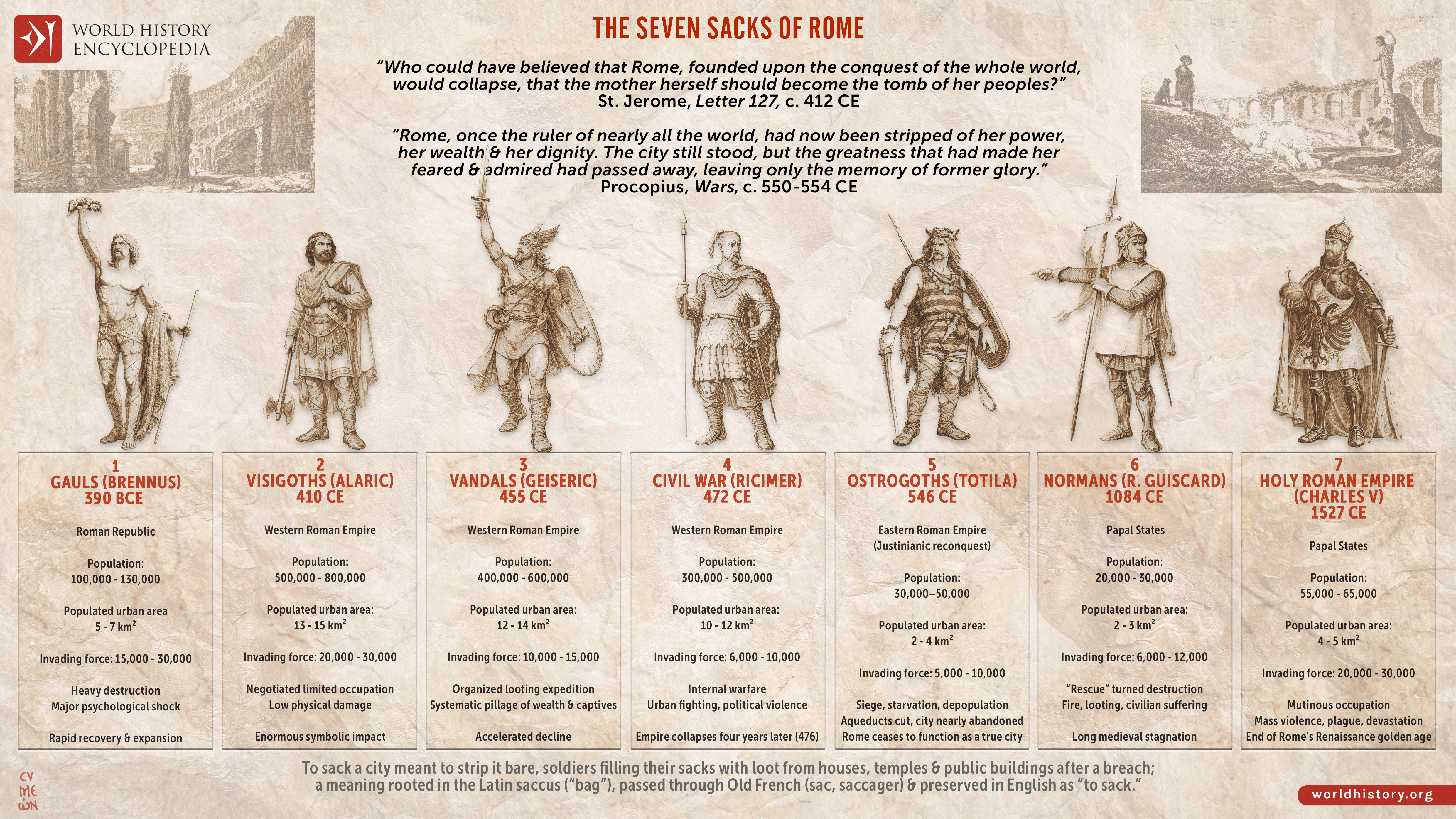
An infographic of the seven times the [city](https://www.worldhistory.org/city/) of [Rome](https://www.worldhistory.org/Rome/) was sacked. Across more than 1,900 years (390 BCE–1527 CE), the sacks of Rome reveal not a single moment of collapse, but a recurring pattern of vulnerability shaped by shifting political systems, military power, and imperial overstretch. From the Republican era through the Western and Eastern [Roman](https://www.worldhistory.org/disambiguation/Roman/) Empires and into the early modern period, Rome’s fortunes rose and fell with the structures meant to protect it.
Early sacks occurred when Rome was still a dominant [Mediterranean](https://www.worldhistory.org/disambiguation/mediterranean/) power; later ones reflected fragmentation, civil [war](https://www.worldhistory.org/disambiguation/War/), demographic decline, and the gradual loss of strategic relevance. In each case, the sack was less a cause than a symptom of deeper systemic strain, whether internal political instability, economic contraction, or the erosion of centralized authority.
Over time, the meaning of a sack changed. In the Republican and early imperial periods, Rome recovered rapidly, reaffirming its dominance. By the 5th century CE, however, repeated crises during the decline of the [Western Roman Empire](https://www.worldhistory.org/Western_Roman_Empire/) (traditionally ending in 476) accelerated long-term depopulation and administrative collapse, even as the [Eastern Roman Empire](https://www.worldhistory.org/Byzantine_Empire/) briefly restored the city under Justinian (reigned 527–565). In the medieval and early modern world, Rome endured as a symbolic and religious center rather than an imperial capital, making later sacks, such as that of 1527, deeply traumatic despite the city’s reduced political power. Taken together, the sacks of Rome underscore a central historical insight: the city did not fall once, but repeatedly adapted, declined, and transformed, with each crisis reflecting a new balance of power in the Mediterranean world.
#### Editorial Review
This human-authored image has been reviewed by our editorial team before publication to ensure accuracy, reliability and adherence to academic standards in accordance with our [editorial policy](https://www.worldhistory.org/static/editorial-policy/).
## About the Author
Simeon is a freelance visual designer and history educator, passionate about the human stories that shape the past.
- [Linkedin Profile](https://www.linkedin.com/in/simeon-netchev/)
## Cite This Work
### APA
Netchev, S. (2026, February 02). The Seven Sacks of Rome. *World History Encyclopedia*.
### Chicago
Netchev, Simeon. "The Seven Sacks of Rome." *World History Encyclopedia*, February 02, 2026. .
### MLA
Netchev, Simeon. "The Seven Sacks of Rome." *World History Encyclopedia*, 02 Feb 2026, .
## License & Copyright
Submitted by [Simeon Netchev](https://www.worldhistory.org/user/simeonnetchev/ "User Page: Simeon Netchev"), published on 02 February 2026. The copyright holder has published this content under the following license: [Creative Commons Attribution-NonCommercial-NoDerivs](https://creativecommons.org/licenses/by-nc/4.0deed.en). This licence only allows others to download this content and share it with others as long as the author is credited, but they can't change the content in any way or use it commercially. When republishing on the web a hyperlink back to the original content source URL must be included. Please note that content linked from this page may have different licensing terms.