---
title: Map of the Cradles of Early Civilization: Global Pathways to Agriculture, Urban Centers & Early States
author: Simeon Netchev
source: https://www.worldhistory.org/image/21507/map-of-the-cradles-of-early-civilization/
format: machine-readable-alternate
license: Creative Commons Attribution-NonCommercial-NoDerivs (https://creativecommons.org/licenses/by-nc/4.0)
updated: 2026-01-23
---
# Map of the Cradles of Early Civilization: Global Pathways to Agriculture, Urban Centers & Early States
_Authored by [Simeon Netchev](https://www.worldhistory.org/user/simeonnetchev/)_
## Image File
[](https://www.worldhistory.org/uploads/images/21507.png)
## Image Caption
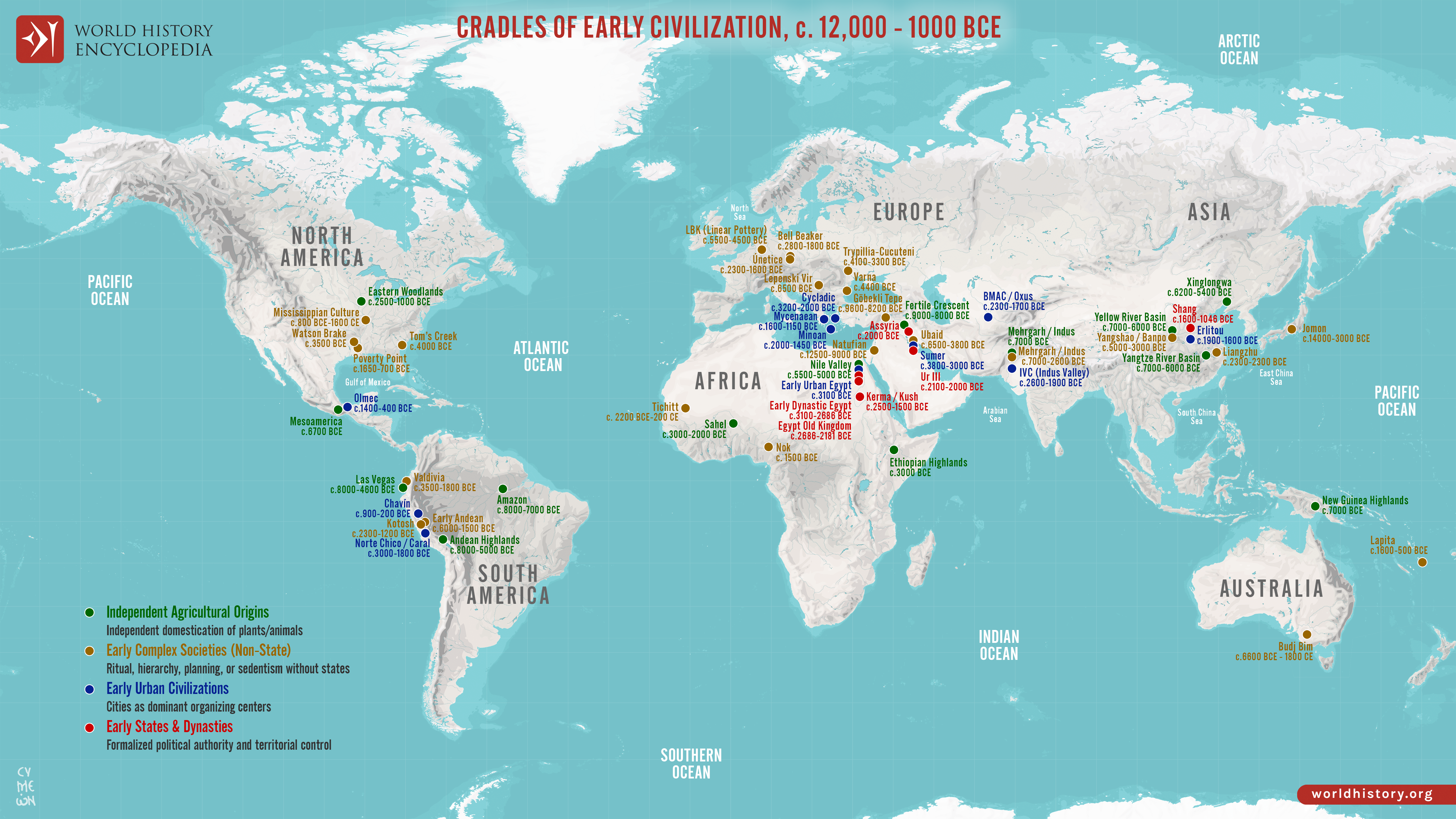
A map of the cradles of early [civilization](https://www.worldhistory.org/civilization/). The pathways toward early civilization between c. 12,000 and 1,000 BCE were neither uniform nor linear. In the wake of the last [Ice Age](https://www.worldhistory.org/Ice_Age/), climatic change encouraged communities in different parts of the world to experiment independently with cultivation, domestication, and increasingly settled ways of life. Over long timescales, these experiments produced diverse forms of social complexity shaped by local environments and resources, rather than a single, universal model of development.
Across regions such as the [Fertile Crescent](https://www.worldhistory.org/Fertile_Crescent/), the [Nile](https://www.worldhistory.org/nile/) Valley, the Indus, and the Yellow and Yangtze river basins, some societies moved toward urban centers, centralized authority, and dynastic rule. Elsewhere, complex societies emerged without [cities](https://www.worldhistory.org/city/) or formal states, sustained instead by ritual landscapes, long-distance exchange, and layered social hierarchies. Independent agricultural traditions in the Americas, [Africa](https://www.worldhistory.org/disambiguation/africa/), New Guinea, and East Asia underscore that “civilization” took many forms. Human societies confronted similar challenges but responded in different ways, producing multiple, parallel routes to achieve an ever more complex [culture](https://www.worldhistory.org/disambiguation/culture/).
#### Editorial Review
This human-authored image has been reviewed by our editorial team before publication to ensure accuracy, reliability and adherence to academic standards in accordance with our [editorial policy](https://www.worldhistory.org/static/editorial-policy/).
## About the Author
Simeon is a freelance visual designer and history educator, passionate about the human stories that shape the past.
- [Linkedin Profile](https://www.linkedin.com/in/simeon-netchev/)
## Cite This Work
### APA
Netchev, S. (2026, January 23). Map of the Cradles of Early Civilization: Global Pathways to Agriculture, Urban Centers & Early States. *World History Encyclopedia*.
### Chicago
Netchev, Simeon. "Map of the Cradles of Early Civilization: Global Pathways to Agriculture, Urban Centers & Early States." *World History Encyclopedia*, January 23, 2026. .
### MLA
Netchev, Simeon. "Map of the Cradles of Early Civilization: Global Pathways to Agriculture, Urban Centers & Early States." *World History Encyclopedia*, 23 Jan 2026, .
## License & Copyright
Submitted by [Simeon Netchev](https://www.worldhistory.org/user/simeonnetchev/ "User Page: Simeon Netchev"), published on 23 January 2026. The copyright holder has published this content under the following license: [Creative Commons Attribution-NonCommercial-NoDerivs](https://creativecommons.org/licenses/by-nc/4.0deed.en). This licence only allows others to download this content and share it with others as long as the author is credited, but they can't change the content in any way or use it commercially. When republishing on the web a hyperlink back to the original content source URL must be included. Please note that content linked from this page may have different licensing terms.