---
title: Seven-Bowl Sweetmeat Dish from Iran
author: Nathalie Choubineh
source: https://www.worldhistory.org/image/20916/seven-bowl-sweetmeat-dish-from-iran/
format: machine-readable-alternate
license: Creative Commons Attribution-NonCommercial-ShareAlike (https://creativecommons.org/licenses/by-nc-sa/4.0/)
updated: 2025-09-02
---
# Seven-Bowl Sweetmeat Dish from Iran
_Authored by [Nathalie Choubineh](https://www.worldhistory.org/user/nathalie.choubineh/)_
## Image File
[](https://www.worldhistory.org/uploads/images/20916.jpg)
## Image Caption
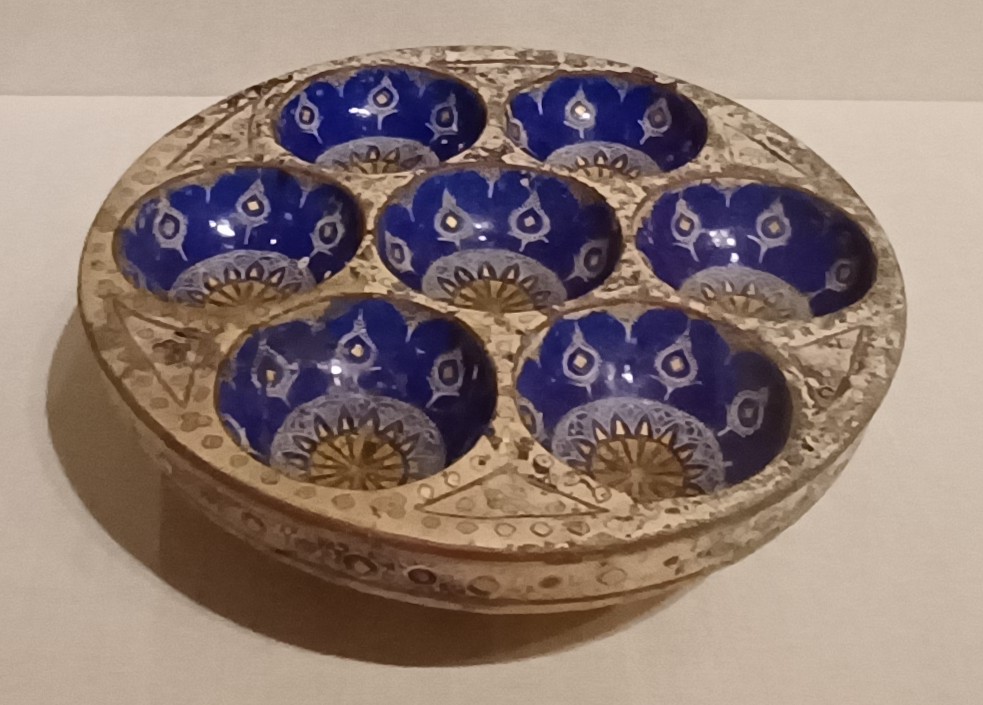
Seven-bowl sweetmeat dish from Iran, 13th to 14th century.
Sweetmeat dishes are notable for their infrequent presence amongst the vast array of Persian ceramic ware. Their history dates back to at least the Seljuk period in the 11th century, when examples of large, round, and solid forms, often divided into compartments, demonstrate the interplay between traditional Persian craftsmanship and broader exchanges with international markets and manufacturers, both in the East and West.
These dishes could be fashioned from a variety of materials, including glazed terracotta, coloured glass, painted porcelain, or a silicon-grained stonepaste commonly referred to as frit. Such items were considered luxurious tableware, reserved for serving an assortment of small sweets and nuts during special occasions.
Of particular interest is the design of the seven-bowl sweetmeat dish. The presence of seven individual compartments may indicate a connection to Naurooz, the Persian New Year, during which it is traditional to present seven blessed edibles collectively known as Haft Seen, or the 'Seven S-words'.
San Diego Museum of Art, California.
#### Editorial Review
This human-authored image has been reviewed by our editorial team before publication to ensure accuracy, reliability and adherence to academic standards in accordance with our [editorial policy](https://www.worldhistory.org/static/editorial-policy/).
## About the Author
Nathalie is a translator and independent researcher of dance in the ancient world with a focus on Ancient Greece and the Near East. She has published works in ancient dance, ethnomusicology, and literature. She loves learning and sharing knowledge.
- [Facebook Profile](https://www.facebook.com/nathalie.choubineh/)
- [Linkedin Profile](https://www.linkedin.com/in/nathalie-choubineh-035a8451/)
## External Links
- [In Harmony Brings to Light the Calderwood Collection of Islamic Art | Index Magazine | Harvard Art Museums](https://harvardartmuseums.org/article/in-harmony-brings-to-light-the-calderwood-collection-of-islamic-art)
## Cite This Work
### APA
Choubineh, N. (2025, September 02). Seven-Bowl Sweetmeat Dish from Iran. *World History Encyclopedia*.
### Chicago
Choubineh, Nathalie. "Seven-Bowl Sweetmeat Dish from Iran." *World History Encyclopedia*, September 02, 2025. .
### MLA
Choubineh, Nathalie. "Seven-Bowl Sweetmeat Dish from Iran." *World History Encyclopedia*, 02 Sep 2025, .
## License & Copyright
Submitted by [Nathalie Choubineh](https://www.worldhistory.org/user/nathalie.choubineh/ "User Page: Nathalie Choubineh"), published on 02 September 2025. The copyright holder has published this content under the following license: [Creative Commons Attribution-NonCommercial-ShareAlike](https://creativecommons.org/licenses/by-nc-sa/4.0/deed.en). This license lets others remix, tweak, and build upon this content non-commercially, as long as they credit the author and license their new creations under the identical terms. When republishing on the web a hyperlink back to the original content source URL must be included. Please note that content linked from this page may have different licensing terms.