---
title: Map of the Rise and Fall of Carthage (c. 650-146 BCE)
author: Simeon Netchev
source: https://www.worldhistory.org/image/20574/map-of-the-rise-and-fall-of-carthage-c-650-146-bce/
format: machine-readable-alternate
license: Creative Commons Attribution-NonCommercial-NoDerivs (https://creativecommons.org/licenses/by-nc/4.0)
updated: 2025-12-09
---
# Map of the Rise and Fall of Carthage (c. 650-146 BCE)
_Authored by [Simeon Netchev](https://www.worldhistory.org/user/simeonnetchev/)_
## Image File
[](https://www.worldhistory.org/uploads/images/20574.png)
## Image Caption
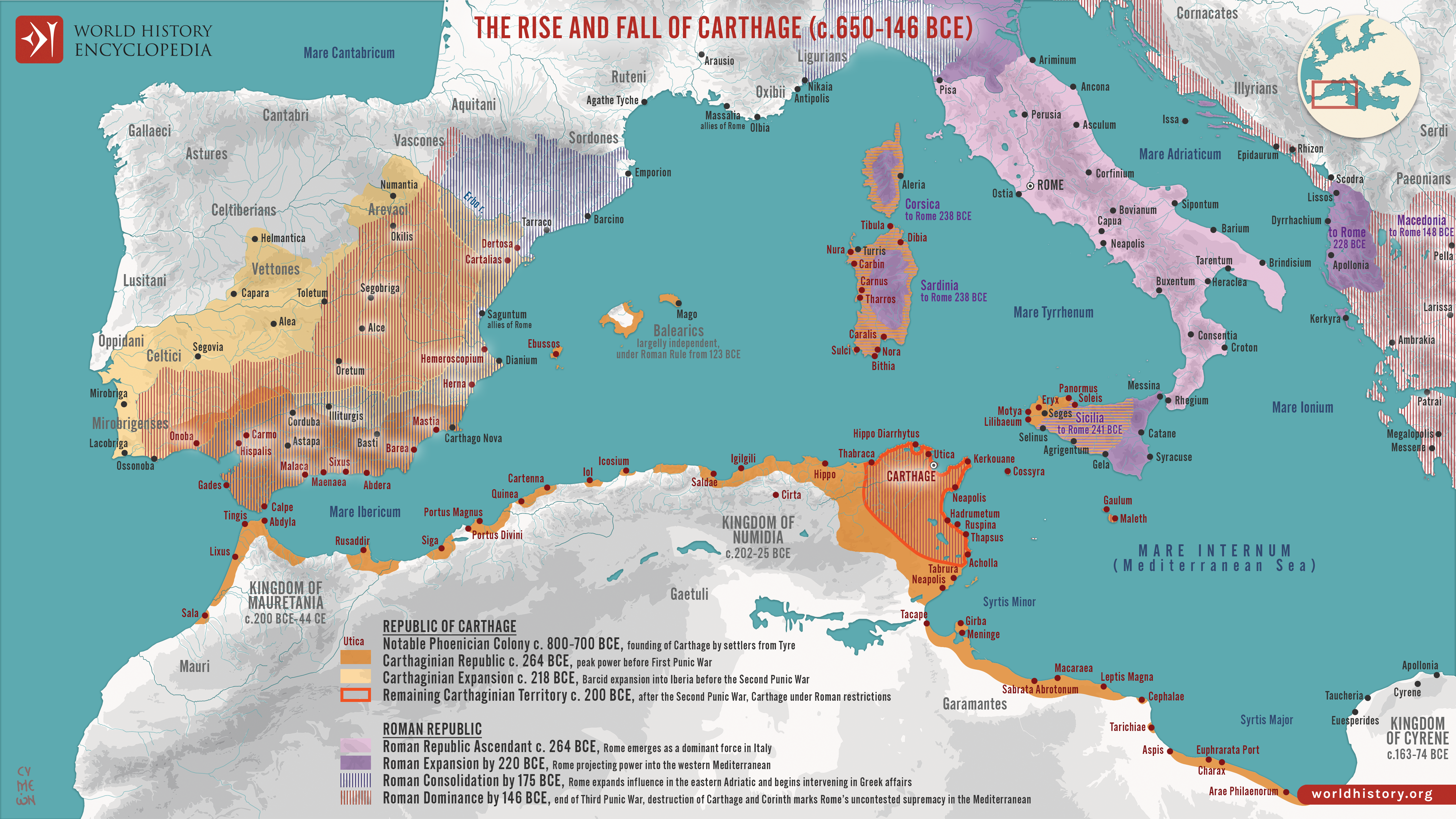
[Carthage](https://www.worldhistory.org/carthage/) (c. 814–146 BCE) emerged as the leading Phoenician power in the western [Mediterranean](https://www.worldhistory.org/disambiguation/mediterranean/) following its foundation by settlers from [Tyre](https://www.worldhistory.org/Tyre/) around c. 814 BCE. Built on maritime [trade](https://www.worldhistory.org/disambiguation/trade/), naval dominance, and a dense network of colonies across North [Africa](https://www.worldhistory.org/disambiguation/africa/), southern [Iberia](https://www.worldhistory.org/disambiguation/iberia/), and [Sicily](https://www.worldhistory.org/sicily/), Carthage developed into a commercial [empire](https://www.worldhistory.org/empire/) that controlled key sea lanes and resource flows. Its political system combined aristocratic councils with elected magistrates, while its [economy](https://www.worldhistory.org/disambiguation/economy/) relied heavily on long-distance trade and mercenary armies. By the 3rd century BCE, Carthage had become [Rome](https://www.worldhistory.org/Rome/)’s principal rival for Mediterranean supremacy.
This rivalry culminated in the [Punic Wars](https://www.worldhistory.org/Punic_Wars/) (264–146 BCE), three systemic conflicts that reshaped Mediterranean power. Under [Hannibal](https://www.worldhistory.org/hannibal/) Barca (247–183 BCE), Carthage achieved its greatest military success during the [Second Punic War](https://www.worldhistory.org/Second_Punic_War/) (218–201 BCE), including decisive victories over [Roman](https://www.worldhistory.org/disambiguation/Roman/) armies in [Italy](https://www.worldhistory.org/italy/). However, Rome’s superior manpower, logistics, and political resilience ultimately prevailed. After renewed tensions, the [Third Punic War](https://www.worldhistory.org/Third_Punic_War/) (149–146 BCE) ended with the destruction of Carthage in 146 BCE, the enslavement of its population, and the formal absorption of its territory into the [Roman Republic](https://www.worldhistory.org/Roman_Republic/), marking Rome’s irreversible rise as the dominant Mediterranean power.
#### Editorial Review
This human-authored image has been reviewed by our editorial team before publication to ensure accuracy, reliability and adherence to academic standards in accordance with our [editorial policy](https://www.worldhistory.org/static/editorial-policy/).
## About the Author
Simeon is a freelance visual designer and history educator, passionate about the human stories that shape the past.
- [Linkedin Profile](https://www.linkedin.com/in/simeon-netchev/)
## Cite This Work
### APA
Netchev, S. (2025, December 09). Map of the Rise and Fall of Carthage (c. 650-146 BCE). *World History Encyclopedia*.
### Chicago
Netchev, Simeon. "Map of the Rise and Fall of Carthage (c. 650-146 BCE)." *World History Encyclopedia*, December 09, 2025. .
### MLA
Netchev, Simeon. "Map of the Rise and Fall of Carthage (c. 650-146 BCE)." *World History Encyclopedia*, 09 Dec 2025, .
## License & Copyright
Submitted by [Simeon Netchev](https://www.worldhistory.org/user/simeonnetchev/ "User Page: Simeon Netchev"), published on 09 December 2025. The copyright holder has published this content under the following license: [Creative Commons Attribution-NonCommercial-NoDerivs](https://creativecommons.org/licenses/by-nc/4.0deed.en). This licence only allows others to download this content and share it with others as long as the author is credited, but they can't change the content in any way or use it commercially. When republishing on the web a hyperlink back to the original content source URL must be included. Please note that content linked from this page may have different licensing terms.