---
title: The Seven Prince-Electors of the Holy Roman Empire: The Golden Bull and the Election of the King of the Romans
author: Simeon Netchev
source: https://www.worldhistory.org/image/20526/the-seven-prince-electors-of-the-holy-roman-empire/
format: machine-readable-alternate
license: Creative Commons Attribution-NonCommercial-NoDerivs (https://creativecommons.org/licenses/by-nc/4.0)
updated: 2026-08-02
---
# The Seven Prince-Electors of the Holy Roman Empire: The Golden Bull and the Election of the King of the Romans
_Authored by [Simeon Netchev](https://www.worldhistory.org/user/simeonnetchev/)_
## Image File
[](https://www.worldhistory.org/uploads/images/20526.png)
## Image Caption
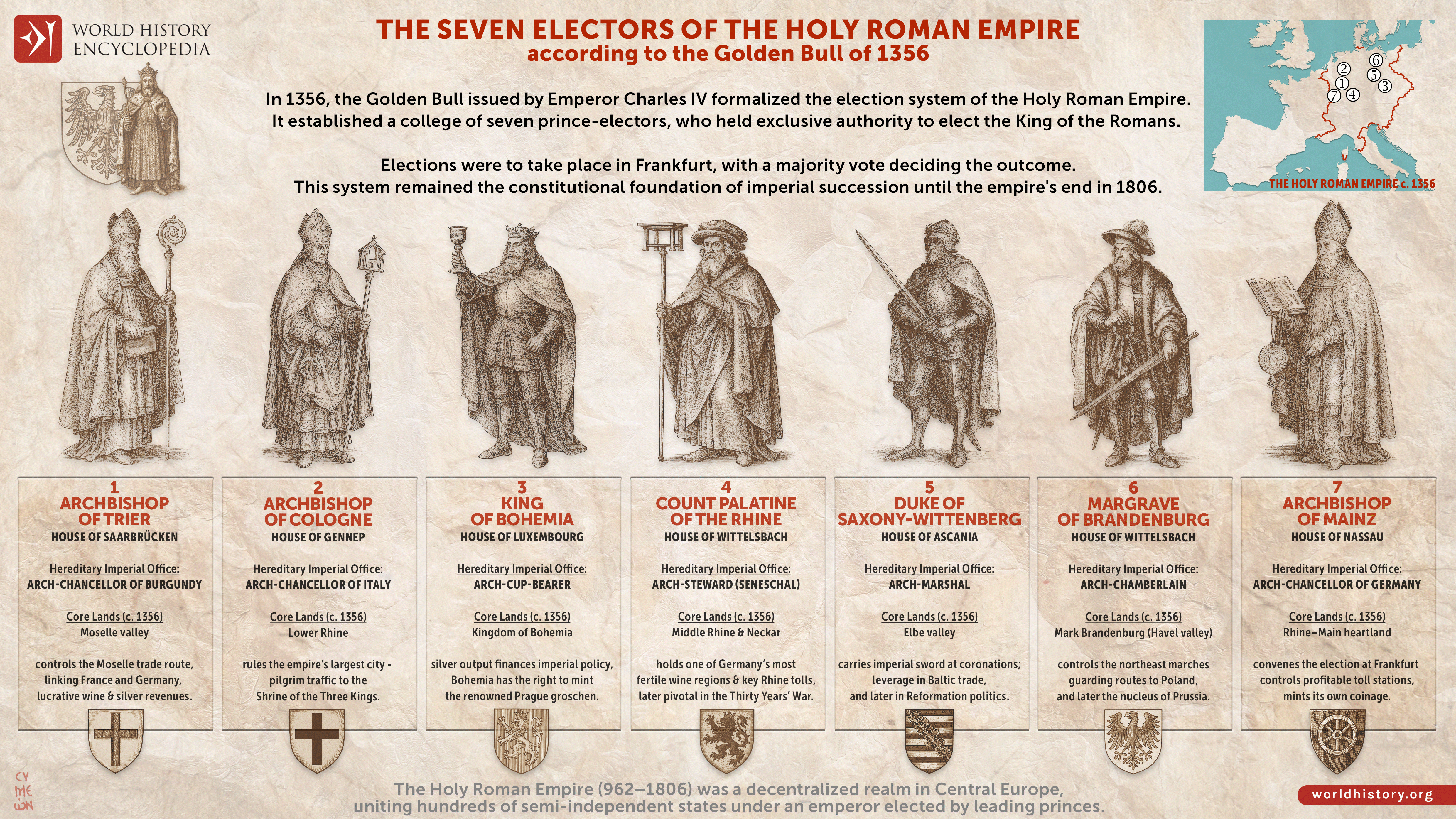
The [Holy Roman Empire](https://www.worldhistory.org/Holy_Roman_Empire/) (962–1806) was a decentralized and composite political order in which authority was distributed among the monarch, territorial princes, ecclesiastical rulers, imperial [cities](https://www.worldhistory.org/city/), and other estates. Royal election had developed over several centuries before the Golden Bull of 1356, issued under Charles IV (King of the Romans, 1346–1378; Holy [Roman Emperor](https://www.worldhistory.org/Roman_Emperor/), 1355–1378). Rather than creating the electoral system, the decree codified its membership and procedures. It confirmed seven prince-electors: three ecclesiastical electors from Mainz, Trier, and Cologne, and four secular electors from Bohemia, the Palatinate, Saxony-Wittenberg, and Brandenburg, and established majority voting for the election of the King of the Romans, the prospective emperor.
The Golden Bull sought to reduce conflicts over succession by clarifying voting rights, electoral procedure, and the privileges of the electors. At the same time, it strengthened their territorial authority and confirmed their elevated position above other imperial princes. Its significance was therefore double-edged: it created greater stability at the centre while reinforcing the [Empire](https://www.worldhistory.org/empire/)’s decentralized political structure.
#### Editorial Review
This human-authored image has been reviewed by our editorial team before publication to ensure accuracy, reliability and adherence to academic standards in accordance with our [editorial policy](https://www.worldhistory.org/static/editorial-policy/).
## About the Author
Simeon is a freelance visual designer and history educator, passionate about the human stories that shape the past.
- [Linkedin Profile](https://www.linkedin.com/in/simeon-netchev/)
## Cite This Work
### APA
Netchev, S. (2026, August 02). The Seven Prince-Electors of the Holy Roman Empire: The Golden Bull and the Election of the King of the Romans. *World History Encyclopedia*.
### Chicago
Netchev, Simeon. "The Seven Prince-Electors of the Holy Roman Empire: The Golden Bull and the Election of the King of the Romans." *World History Encyclopedia*, August 02, 2026. .
### MLA
Netchev, Simeon. "The Seven Prince-Electors of the Holy Roman Empire: The Golden Bull and the Election of the King of the Romans." *World History Encyclopedia*, 02 Aug 2026, .
## License & Copyright
Submitted by [Simeon Netchev](https://www.worldhistory.org/user/simeonnetchev/ "User Page: Simeon Netchev"), published on 02 August 2026. The copyright holder has published this content under the following license: [Creative Commons Attribution-NonCommercial-NoDerivs](https://creativecommons.org/licenses/by-nc/4.0deed.en). This licence only allows others to download this content and share it with others as long as the author is credited, but they can't change the content in any way or use it commercially. When republishing on the web a hyperlink back to the original content source URL must be included. Please note that content linked from this page may have different licensing terms.