---
title: Map of Europe after the Congress of Berlin, 1878: From Italian and German Unification to Balkan Crisis
author: Simeon Netchev
source: https://www.worldhistory.org/image/20139/map-of-europe-after-the-congress-of-berlin-1878/
format: machine-readable-alternate
license: Creative Commons Attribution-NonCommercial-NoDerivs (https://creativecommons.org/licenses/by-nc/4.0)
updated: 2026-03-22
---
# Map of Europe after the Congress of Berlin, 1878: From Italian and German Unification to Balkan Crisis
_Authored by [Simeon Netchev](https://www.worldhistory.org/user/simeonnetchev/)_
## Image File
[](https://www.worldhistory.org/uploads/images/20139.png)
## Image Caption
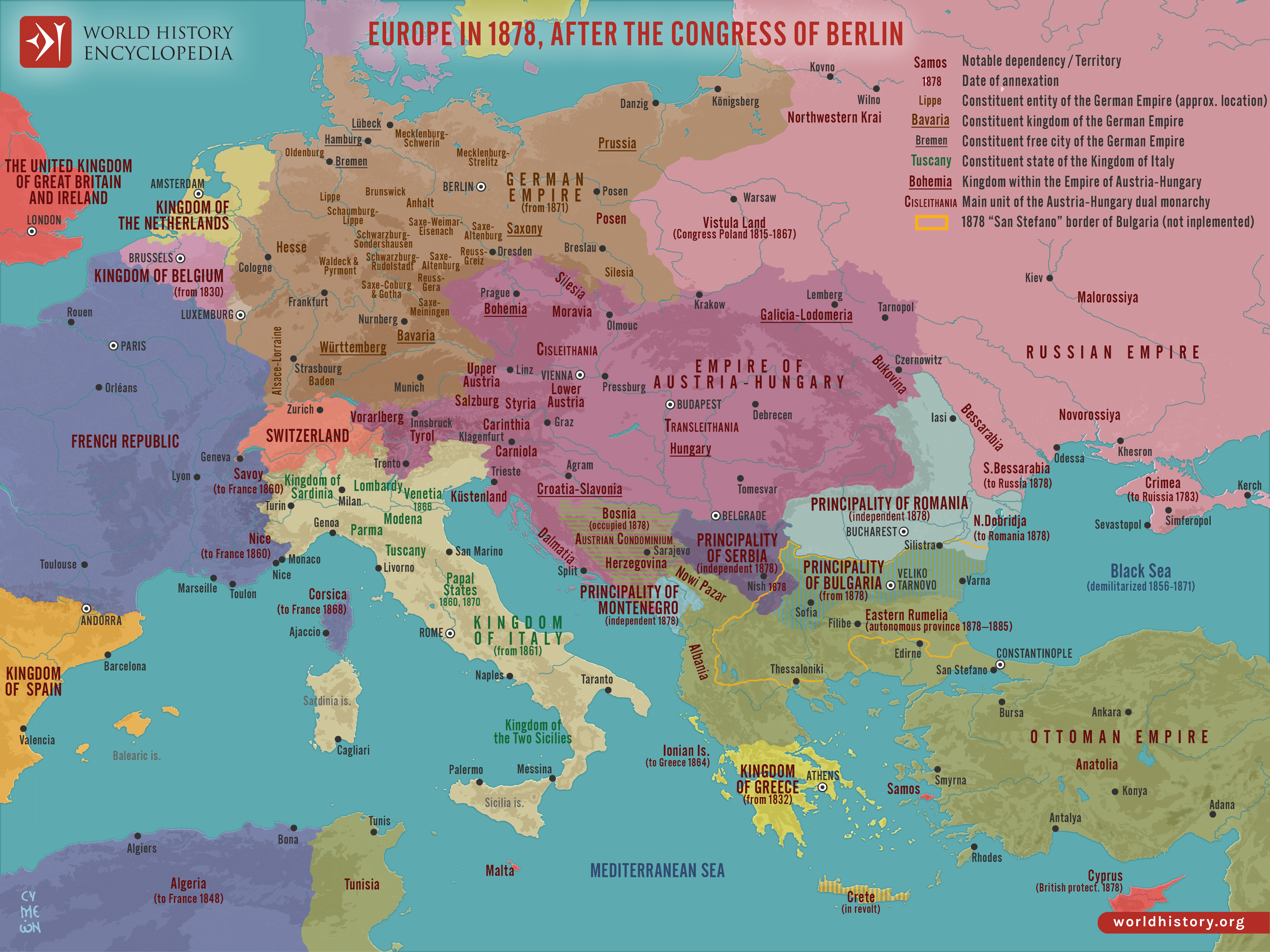
The mid-19th century transformation of [Europe](https://www.worldhistory.org/europe/) was driven above all by the unification of [Italy](https://www.worldhistory.org/italy/) and Germany, which reduced long-standing political fragmentation and introduced powerful new nation-states into an already competitive [continental system](https://www.worldhistory.org/Continental_System/). In Italy, the kingdom of Piedmont-Sardinia became the nucleus of unification, a process achieved through [war](https://www.worldhistory.org/disambiguation/War/), diplomacy, and nationalism between 1859 and 1871 under Victor Emmanuel II (king of Sardinia 1849–1861; king of Italy 1861–1878). In Central Europe, Prussia led the process of German unification through a series of conflicts directed by Otto von Bismarck, culminating in the proclamation of the German [Empire](https://www.worldhistory.org/empire/) in 1871 under Wilhelm I (king of Prussia 1861–1888; German emperor 1871–1888). Together, these developments marked a broader transition from the post-Napoleonic order to an age increasingly defined by nationalism, great-power rivalry, and alliance politics.
This new political landscape was further redefined by the Congress of Berlin (June–July 1878), convened in the aftermath of the Russo-Turkish War (1877–1878). The congress sought to contain Russian influence while preserving a workable balance among the great powers. It recognized the independence of Romania, Serbia, and Montenegro, reduced the size of Bulgaria, and authorized Austria-Hungary to occupy Bosnia and Herzegovina. Although presented as a stabilizing settlement, the Berlin agreements left many national aspirations unresolved and intensified rivalries in the Balkans, contributing to the tensions that would shape late 19th- and early 20th-century European diplomacy.
#### Editorial Review
This human-authored image has been reviewed by our editorial team before publication to ensure accuracy, reliability and adherence to academic standards in accordance with our [editorial policy](https://www.worldhistory.org/static/editorial-policy/).
## About the Author
Simeon is a freelance visual designer and history educator, passionate about the human stories that shape the past.
- [Linkedin Profile](https://www.linkedin.com/in/simeon-netchev/)
## Cite This Work
### APA
Netchev, S. (2026, March 22). Map of Europe after the Congress of Berlin, 1878: From Italian and German Unification to Balkan Crisis. *World History Encyclopedia*.
### Chicago
Netchev, Simeon. "Map of Europe after the Congress of Berlin, 1878: From Italian and German Unification to Balkan Crisis." *World History Encyclopedia*, March 22, 2026. .
### MLA
Netchev, Simeon. "Map of Europe after the Congress of Berlin, 1878: From Italian and German Unification to Balkan Crisis." *World History Encyclopedia*, 22 Mar 2026, .
## License & Copyright
Submitted by [Simeon Netchev](https://www.worldhistory.org/user/simeonnetchev/ "User Page: Simeon Netchev"), published on 22 March 2026. The copyright holder has published this content under the following license: [Creative Commons Attribution-NonCommercial-NoDerivs](https://creativecommons.org/licenses/by-nc/4.0deed.en). This licence only allows others to download this content and share it with others as long as the author is credited, but they can't change the content in any way or use it commercially. When republishing on the web a hyperlink back to the original content source URL must be included. Please note that content linked from this page may have different licensing terms.