---
title: Cities Founded or Renamed in Hadrian’s Name (117 -138 CE)
author: Simeon Netchev
source: https://www.worldhistory.org/image/20133/cities-founded-or-renamed-in-hadrians-name-117--13/
format: machine-readable-alternate
license: Creative Commons Attribution-NonCommercial-NoDerivs (https://creativecommons.org/licenses/by-nc/4.0)
updated: 2026-02-05
---
# Cities Founded or Renamed in Hadrian’s Name (117 -138 CE)
_Authored by [Simeon Netchev](https://www.worldhistory.org/user/simeonnetchev/)_
## Image File
[](https://www.worldhistory.org/uploads/images/20133.png)
## Image Caption
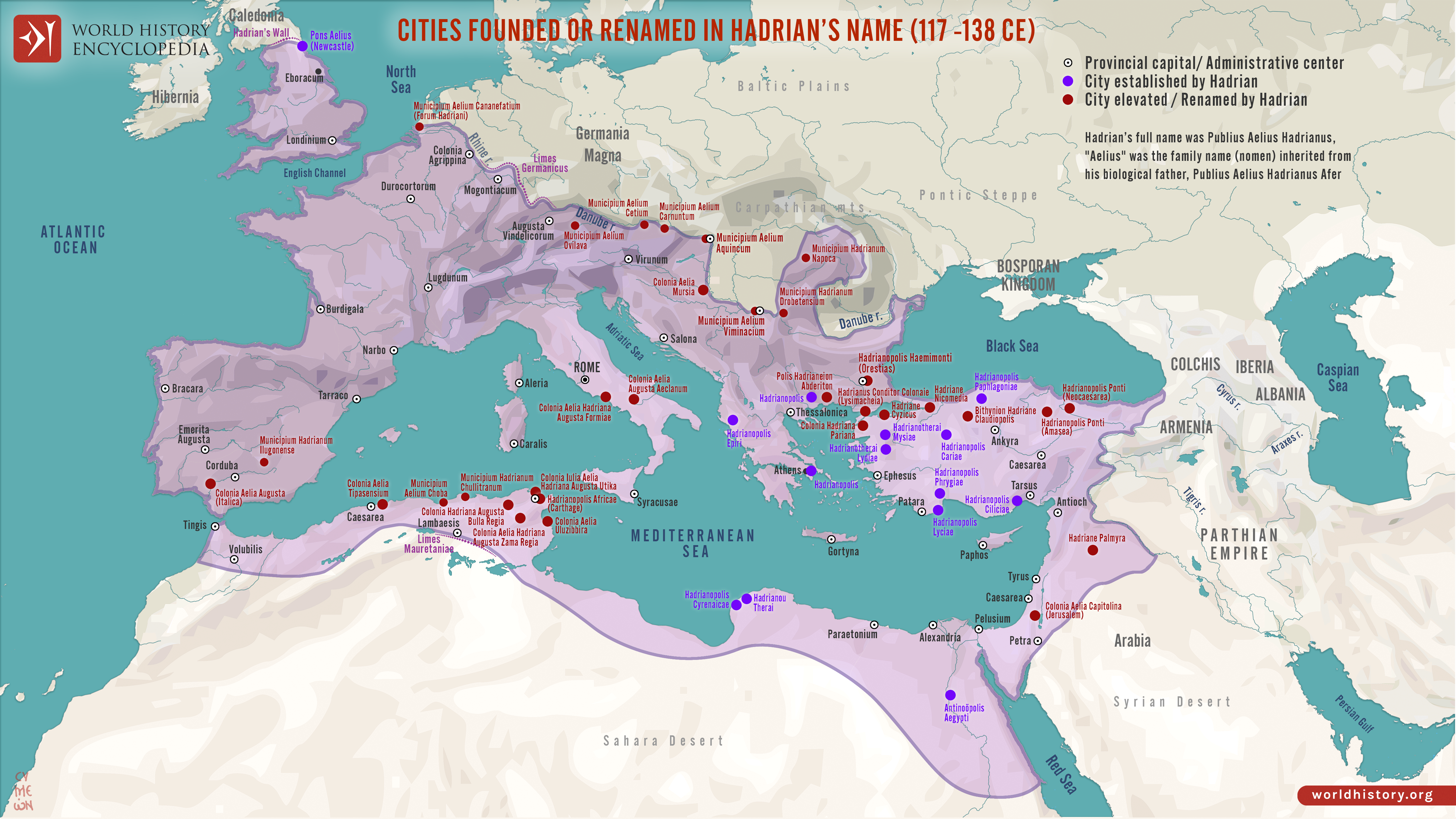
During the reign of Emperor [Hadrian](https://www.worldhistory.org/hadrian/) (reigned 117–138 CE), urban patronage became a central tool of imperial governance and representation. Unlike his predecessor [Trajan](https://www.worldhistory.org/trajan/), whose rule emphasized territorial expansion, Hadrian focused on consolidation, integration, and the symbolic projection of [Roman](https://www.worldhistory.org/disambiguation/Roman/) authority across the provinces. One expression of this policy was the founding, refounding, or renaming of [cities](https://www.worldhistory.org/city/) in his honor, most commonly as Hadrianopolis (Ἁδριανούπολις), linking local urban identities directly to the emperor and the imperial center.
These acts were not merely honorific. Cities associated with Hadrian often received elevated legal status, new civic institutions, monumental [architecture](https://www.worldhistory.org/disambiguation/architecture/), and infrastructure improvements, reinforcing loyalty while embedding Roman administrative and cultural norms. Hadrian’s extensive travels allowed him to engage directly with provincial elites, using urban development to stabilize frontiers, reward cooperation, and promote a shared imperial identity. In this way, cities bearing his name became enduring markers of a broader imperial strategy, one that favored cultural integration and administrative cohesion over [conquest](https://www.worldhistory.org/warfare/), and helped sustain the [Roman Empire](https://www.worldhistory.org/Roman_Empire/) during the high point of its territorial reach.
Notable examples include:
- Hadrianopolis (modern Edirne, [Turkey](https://www.worldhistory.org/Asia_Minor/)) – A prominent Roman, [Byzantine](https://www.worldhistory.org/disambiguation/Byzantine/), and later Ottoman [city](https://www.worldhistory.org/city/).
- Antinoöpolis ([Egypt](https://www.worldhistory.org/egypt/)) – Founded in 130 CE in memory of Hadrian’s beloved [Antinous](https://www.worldhistory.org/antinous/), who drowned in the [Nile](https://www.worldhistory.org/nile/).
- Aelia Capitolina ([Jerusalem](https://www.worldhistory.org/jerusalem/)) – After crushing the Bar Kokhba Revolt (132–136 CE), Hadrian rebuilt Jerusalem as Aelia Capitolina banned Jewish practices and dedicated the city to [Jupiter](https://www.worldhistory.org/jupiter/) Capitolinus.
- Hadrianopolis (modern Amasea, Turkey) – The city of Amasea in Pontus was enhanced under Hadrian.
- Hadrianopolis (modern Neocaesarea/Niksar, Turkey) – The Pontic city of Neocaesarea was strengthened and expanded, gaining the name Hadrianopolis.
- Hadrianopolis (modern Napoca/Cluj-Napoca, Romania) – Hadrian granted municipal status to Napoca, renaming it Hadrianopolis and expanding its importance in the province of [Dacia](https://www.worldhistory.org/dacia/).
- Colonia Hadriana ([Carthage](https://www.worldhistory.org/carthage/), Tunisia) – Hadrian refounded Carthage as Colonia Hadriana, reviving the city as an important Roman hub in North [Africa](https://www.worldhistory.org/disambiguation/africa/).
- Hadrianopolis (Bulla Regia, Tunisia) – The North African city of Bulla Regia received Hadrian’s patronage and was temporarily renamed Hadrianopolis.
- Colonia Aelia Augusta Italica (Italica, Spain) – Hadrian’s birthplace, Italica, was expanded and renamed Colonia Aelia Augusta Italica in his honor.
- The Hadrianic Quarter in [Athens](https://www.worldhistory.org/Athens/) – Hadrian transformed Athens into a major cultural center, sponsoring the construction of an entirely new district, including the Library of Hadrian and the Arch of Hadrian, which symbolized the city’s new era under Roman rule.
#### Editorial Review
This human-authored image has been reviewed by our editorial team before publication to ensure accuracy, reliability and adherence to academic standards in accordance with our [editorial policy](https://www.worldhistory.org/static/editorial-policy/).
## About the Author
Simeon is a freelance visual designer and history educator, passionate about the human stories that shape the past.
- [Linkedin Profile](https://www.linkedin.com/in/simeon-netchev/)
## Cite This Work
### APA
Netchev, S. (2025, March 11). Cities Founded or Renamed in Hadrian’s Name (117 -138 CE). *World History Encyclopedia*.
### Chicago
Netchev, Simeon. "Cities Founded or Renamed in Hadrian’s Name (117 -138 CE)." *World History Encyclopedia*, March 11, 2025. .
### MLA
Netchev, Simeon. "Cities Founded or Renamed in Hadrian’s Name (117 -138 CE)." *World History Encyclopedia*, 11 Mar 2025, .
## License & Copyright
Submitted by [Simeon Netchev](https://www.worldhistory.org/user/simeonnetchev/ "User Page: Simeon Netchev"), published on 11 March 2025. The copyright holder has published this content under the following license: [Creative Commons Attribution-NonCommercial-NoDerivs](https://creativecommons.org/licenses/by-nc/4.0deed.en). This licence only allows others to download this content and share it with others as long as the author is credited, but they can't change the content in any way or use it commercially. When republishing on the web a hyperlink back to the original content source URL must be included. Please note that content linked from this page may have different licensing terms.