---
title: Map of the World Known to Europeans in 1000 CE
author: Simeon Netchev
source: https://www.worldhistory.org/image/20051/map-of-the-world-known-to-europeans-in-1000-ce/
format: machine-readable-alternate
license: Creative Commons Attribution-NonCommercial-NoDerivs (https://creativecommons.org/licenses/by-nc/4.0)
updated: 2026-01-15
---
# Map of the World Known to Europeans in 1000 CE
_Authored by [Simeon Netchev](https://www.worldhistory.org/user/simeonnetchev/)_
## Image File
[](https://www.worldhistory.org/uploads/images/20051.png)
## Image Caption
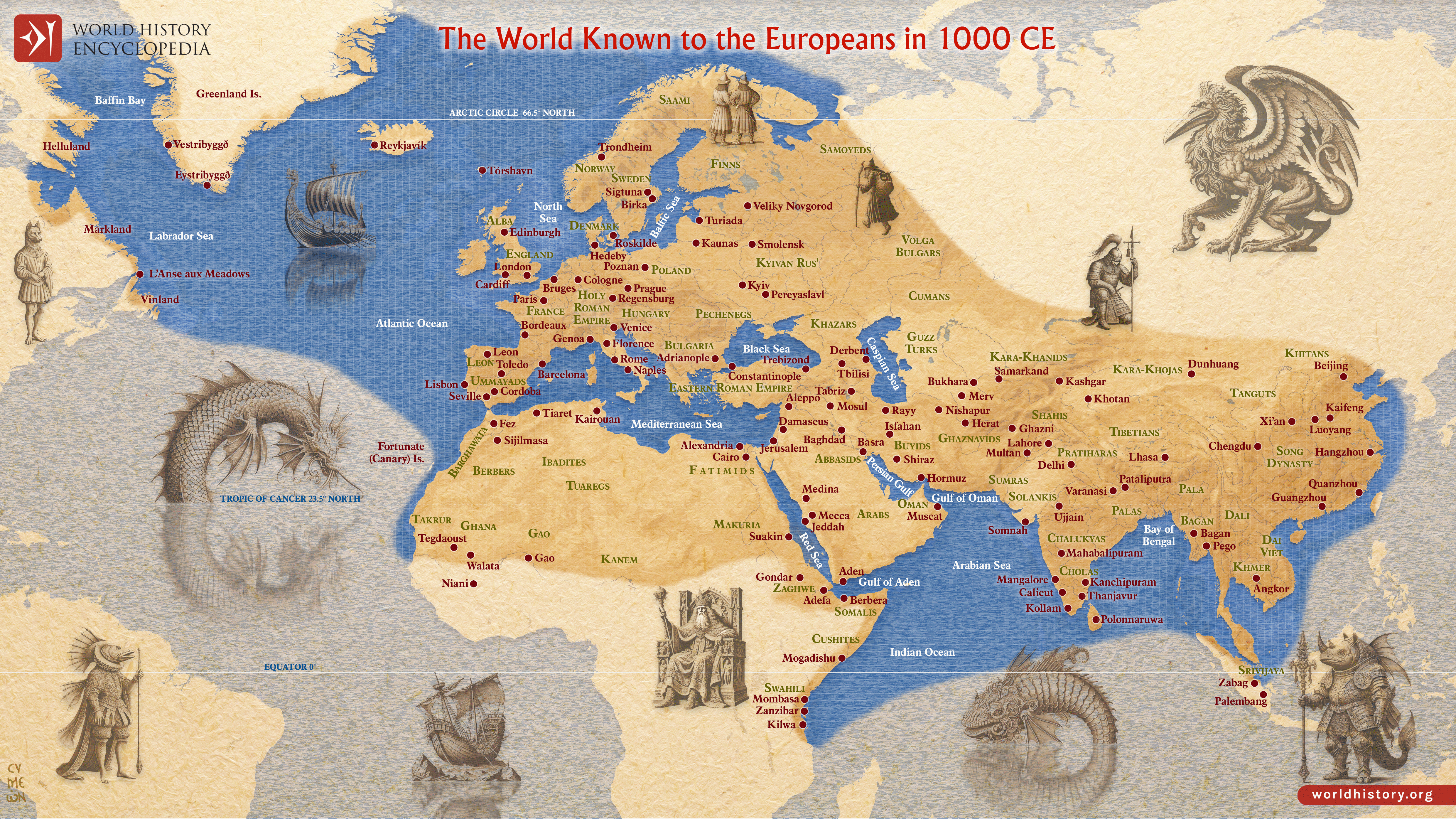
Around 1000 CE, European knowledge of the wider world was limited, uneven, yet slowly expanding, shaped less by direct exploration than by inherited classical learning, religious frameworks, and selective contact through [trade](https://www.worldhistory.org/disambiguation/trade/) and pilgrimage. Northern [Europe](https://www.worldhistory.org/europe/) experienced outward movement through [Viking](https://www.worldhistory.org/Vikings/) expansion (c. 800–1050), which carried Norse sailors across the North Atlantic to Iceland, Greenland, and briefly [Vinland](https://www.worldhistory.org/Vinland/) in North America. Elsewhere, Europe remained politically fragmented, and its worldview was still anchored in [Roman](https://www.worldhistory.org/disambiguation/Roman/) geography, Biblical tradition, and late antique scholarship rather than systematic global inquiry.
Meaningful awareness of Afro-Eurasian connections came primarily through interaction with the [Islamic Caliphates](https://www.worldhistory.org/Islamic_Caliphates/), whose commercial and intellectual networks linked the [Mediterranean](https://www.worldhistory.org/disambiguation/mediterranean/) to North [Africa](https://www.worldhistory.org/disambiguation/africa/), the Red Sea, the Indian Ocean, Central Asia, and [China](https://www.worldhistory.org/china/). European merchants, diplomats, and pilgrims encountered Islamic intermediaries who transmitted knowledge of places such as the [Ghana Empire](https://www.worldhistory.org/Ghana_Empire/), [Egypt](https://www.worldhistory.org/egypt/), and the [Swahili Coast](https://www.worldhistory.org/Swahili_Coast/), where [cities](https://www.worldhistory.org/city/) like [Kilwa](https://www.worldhistory.org/Kilwa/) and Mogadishu thrived within Indian Ocean trade systems. Beyond these zones, much of sub-Saharan Africa, inner Asia, and East Asia remained abstract or mythical in European thought, illustrating a world known not through dominance or exploration, but through distance, mediation, and imagination.
#### Editorial Review
This human-authored image has been reviewed by our editorial team before publication to ensure accuracy, reliability and adherence to academic standards in accordance with our [editorial policy](https://www.worldhistory.org/static/editorial-policy/).
## About the Author
Simeon is a freelance visual designer and history educator, passionate about the human stories that shape the past.
- [Linkedin Profile](https://www.linkedin.com/in/simeon-netchev/)
## Cite This Work
### APA
Netchev, S. (2025, February 17). Map of the World Known to Europeans in 1000 CE. *World History Encyclopedia*.
### Chicago
Netchev, Simeon. "Map of the World Known to Europeans in 1000 CE." *World History Encyclopedia*, February 17, 2025. .
### MLA
Netchev, Simeon. "Map of the World Known to Europeans in 1000 CE." *World History Encyclopedia*, 17 Feb 2025, .
## License & Copyright
Submitted by [Simeon Netchev](https://www.worldhistory.org/user/simeonnetchev/ "User Page: Simeon Netchev"), published on 17 February 2025. The copyright holder has published this content under the following license: [Creative Commons Attribution-NonCommercial-NoDerivs](https://creativecommons.org/licenses/by-nc/4.0deed.en). This licence only allows others to download this content and share it with others as long as the author is credited, but they can't change the content in any way or use it commercially. When republishing on the web a hyperlink back to the original content source URL must be included. Please note that content linked from this page may have different licensing terms.