---
title: Five Ships of Exploration
author: Simeon Netchev
source: https://www.worldhistory.org/image/19881/five-ships-of-exploration/
format: machine-readable-alternate
license: Creative Commons Attribution-NonCommercial-NoDerivs (https://creativecommons.org/licenses/by-nc/4.0)
updated: 2025-10-22
---
# Five Ships of Exploration
_Authored by [Simeon Netchev](https://www.worldhistory.org/user/simeonnetchev/)_
## Image File
[](https://www.worldhistory.org/uploads/images/19881.png)
## Image Caption
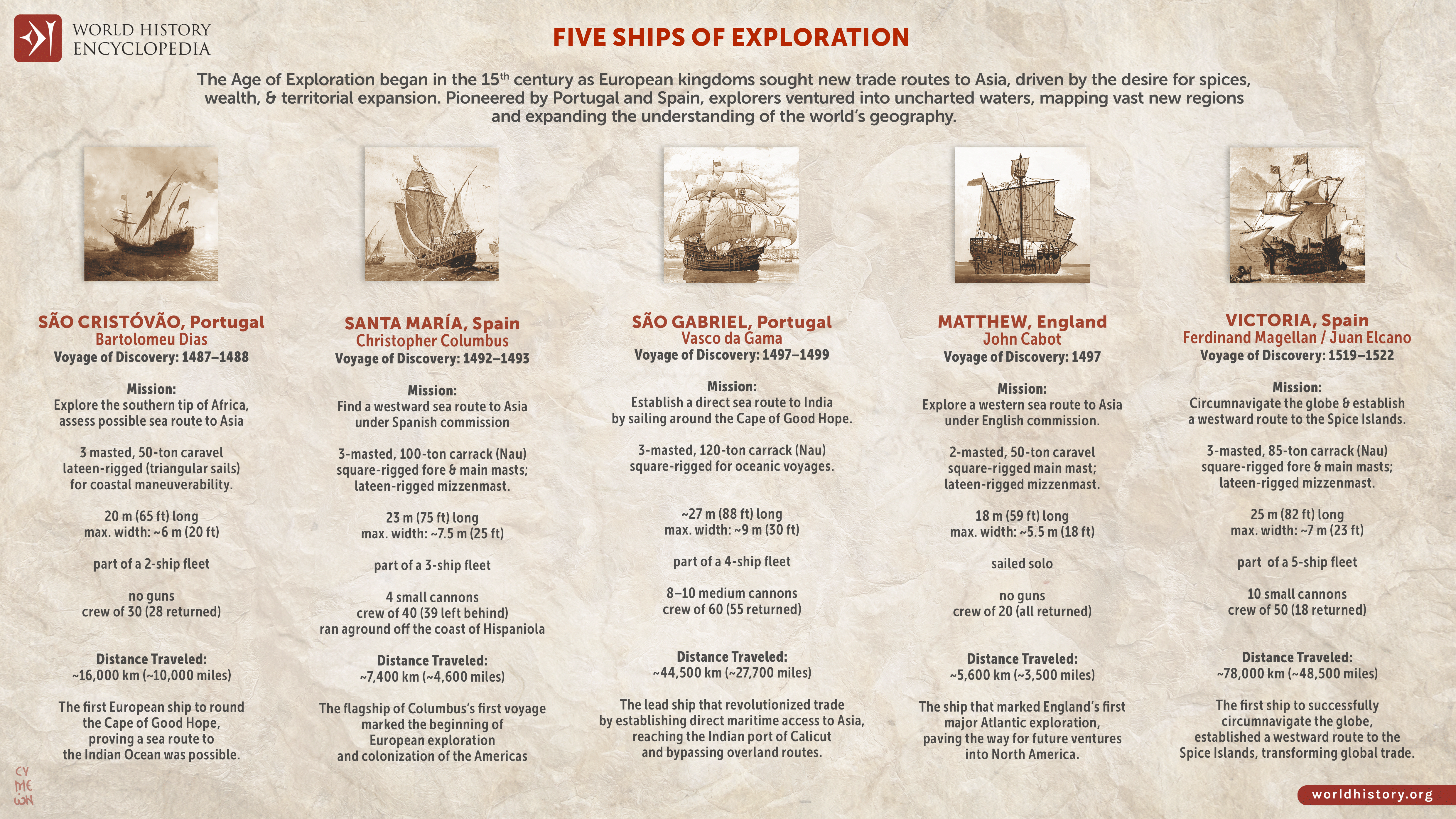
The Age of Exploration (15th–16th centuries) was propelled by a revolution in shipbuilding and navigation that transformed the limits of human travel. Innovations such as the [caravel](https://www.worldhistory.org/Caravel/) and [carrack](https://www.worldhistory.org/Carrack/), the adoption of the magnetic compass, [astrolabe](https://www.worldhistory.org/Astrolabe/), and lateen sails allowed European sailors to venture farther and more safely into the open ocean. These technological advances, combined with growing ambitions for [trade](https://www.worldhistory.org/disambiguation/trade/), wealth, and religious expansion, ushered in an unprecedented era of global exploration that connected, and often collided, distant worlds.
Five ships became icons of this maritime transformation. Bartolomeu Dias’s São Cristóvão (1488) first rounded the Cape of Good Hope, proving a sea route to Asia possible. [Vasco da Gama](https://www.worldhistory.org/Vasco_da_Gama/)’s São Gabriel (1497–1499) followed through to [India](https://www.worldhistory.org/india/), linking [Europe](https://www.worldhistory.org/europe/) and the Indian Ocean. [Christopher Columbus](https://www.worldhistory.org/Christopher_Columbus/)’s Santa María (1492) crossed the Atlantic, marking Europe’s entry into the Americas. [John Cabot](https://www.worldhistory.org/John_Cabot/)’s Matthew (1497) reached the North American coast under the English flag, and [Ferdinand Magellan](https://www.worldhistory.org/Ferdinand_Magellan/)’s Victoria (1519–1522) completed the first circumnavigation of the globe, a [triumph](https://www.worldhistory.org/Roman_Triumph/) of endurance and navigation that forever redefined humanity’s sense of the world’s scale.
#### Editorial Review
This human-authored image has been reviewed by our editorial team before publication to ensure accuracy, reliability and adherence to academic standards in accordance with our [editorial policy](https://www.worldhistory.org/static/editorial-policy/).
## About the Author
Simeon is a freelance visual designer and history educator, passionate about the human stories that shape the past.
- [Linkedin Profile](https://www.linkedin.com/in/simeon-netchev/)
## Cite This Work
### APA
Netchev, S. (2025, January 14). Five Ships of Exploration. *World History Encyclopedia*.
### Chicago
Netchev, Simeon. "Five Ships of Exploration." *World History Encyclopedia*, January 14, 2025. .
### MLA
Netchev, Simeon. "Five Ships of Exploration." *World History Encyclopedia*, 14 Jan 2025, .
## License & Copyright
Submitted by [Simeon Netchev](https://www.worldhistory.org/user/simeonnetchev/ "User Page: Simeon Netchev"), published on 14 January 2025. The copyright holder has published this content under the following license: [Creative Commons Attribution-NonCommercial-NoDerivs](https://creativecommons.org/licenses/by-nc/4.0deed.en). This licence only allows others to download this content and share it with others as long as the author is credited, but they can't change the content in any way or use it commercially. When republishing on the web a hyperlink back to the original content source URL must be included. Please note that content linked from this page may have different licensing terms.