---
title: Roman Blue-Glass Cinerary Urn from Luguvalium
author: Nathalie Choubineh
source: https://www.worldhistory.org/image/19644/roman-blue-glass-cinerary-urn-from-luguvalium/
format: machine-readable-alternate
license: Creative Commons Attribution-NonCommercial-ShareAlike (https://creativecommons.org/licenses/by-nc-sa/4.0/)
updated: 2024-11-13
---
# Roman Blue-Glass Cinerary Urn from Luguvalium
_Authored by [Nathalie Choubineh](https://www.worldhistory.org/user/nathalie.choubineh/)_
## Image File
[](https://www.worldhistory.org/uploads/images/19644.jpg)
## Image Caption
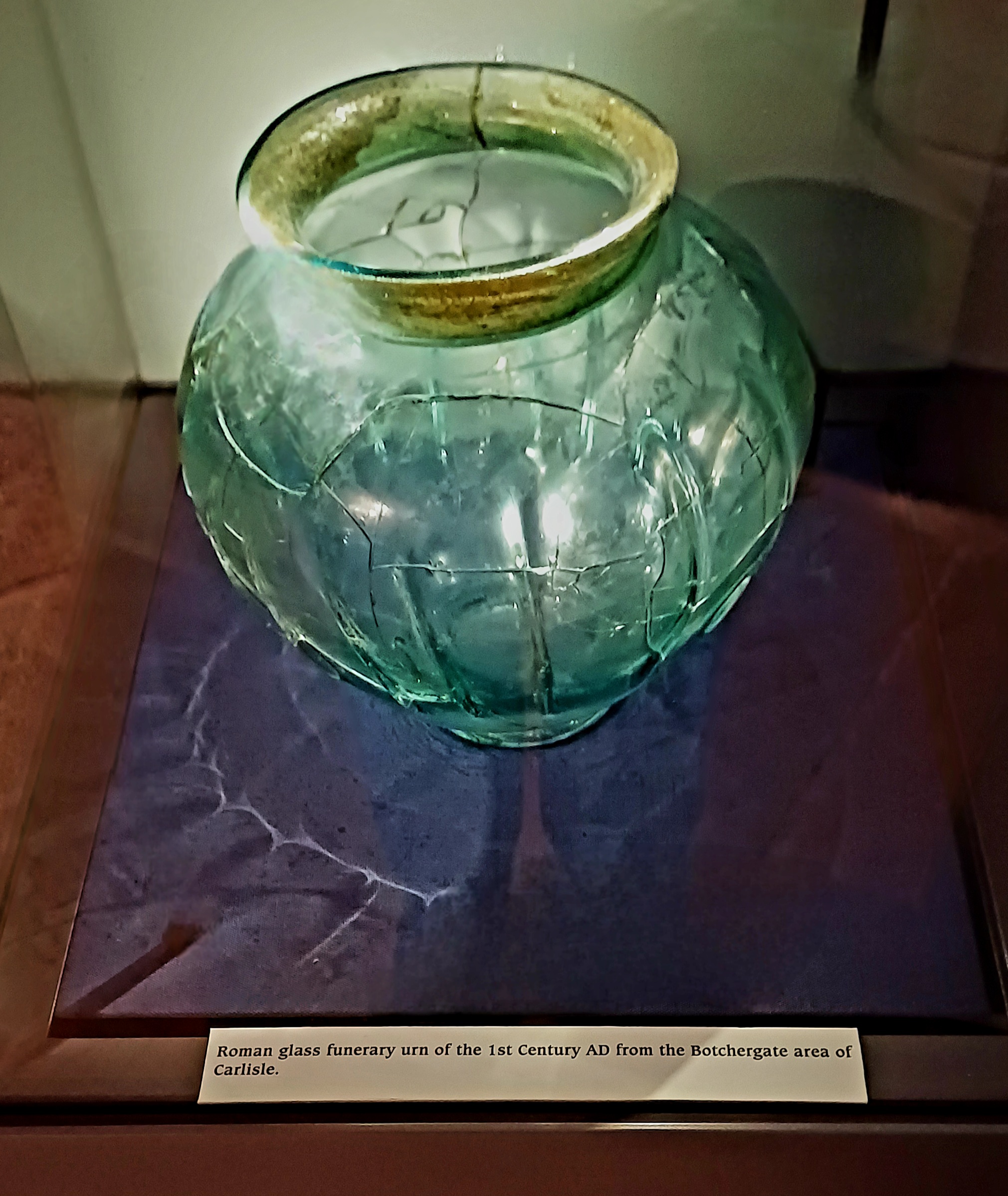
[Roman](https://www.worldhistory.org/disambiguation/Roman/) blue-glass cinerary urn, from Luguvalium (Botchergate, Carlisle), 1st century CE.
Carlisle Cathedral.
Burning the body after [death](https://www.worldhistory.org/disambiguation/Death/) and keeping the bones and ashes in the *cineraria* (funerary urns) was a deeply rooted cultural tradition in the Roman societies inherited from their [Etruscan](https://www.worldhistory.org/Etruscan_Civilization/) ancestors. Roman urns could have a curvy jar shape typical for this sort of vessel across ancient cultures. However, in a distinction from classical [Greece](https://www.worldhistory.org/greece/), they could also appear in a rectangular box shape, functioning as an ornamental sarcophagus. Diversity was also present in their material ranging from various wooden boxes to terracotta or marble vessels to white or blue glass jars. Blown glass jars were distinctly popular, and despite their relative fragility, they compose a notable number of archaeological finds particularly from parts of Western [Europe](https://www.worldhistory.org/europe/), including Belgium, [Britain](https://www.worldhistory.org/disambiguation/Britain/), France, Germany, and [Italy](https://www.worldhistory.org/italy/).
The blue-glass cinerarium in the treasury of Carlisle Cathedral is among the invaluable artefacts unearthed in Botchergate out of the old walls of Luguvalium, the Roman forerunner [city](https://www.worldhistory.org/city/) of today’s Carlisle in Cumbria, north of [England](https://www.worldhistory.org/disambiguation/england/), not far from [Hadrian's Wall](https://www.worldhistory.org/Hadrians_Wall/). Reassembled from broken pieces, the urn implies simplicity combined with a characteristic distinction expressed in a series of strong, upright lines, depressed all around its circumference. Like many of its peers, the urn was possibly crowned with a glass lid, which is now lost. The tradition of keeping human remains in funerary urns remained widespread in the [Roman Empire](https://www.worldhistory.org/Roman_Empire/) until the 4th century CE, when [Christianity](https://www.worldhistory.org/christianity/) became prominent and replaced this practice with the interment.
#### Editorial Review
This human-authored image has been reviewed by our editorial team before publication to ensure accuracy, reliability and adherence to academic standards in accordance with our [editorial policy](https://www.worldhistory.org/static/editorial-policy/).
## About the Author
Nathalie is a translator and independent researcher of dance in the ancient world with a focus on Ancient Greece and the Near East. She has published works in ancient dance, ethnomusicology, and literature. She loves learning and sharing knowledge.
- [Facebook Profile](https://www.facebook.com/nathalie.choubineh/)
- [Linkedin Profile](https://www.linkedin.com/in/nathalie-choubineh-035a8451/)
## External Links
- [Highlights – Carlisle Cathedral – Praying Cherishing Transforming](https://carlislecathedral.org.uk/visitor-information/unique-features/)
## Cite This Work
### APA
Choubineh, N. (2024, November 13). Roman Blue-Glass Cinerary Urn from Luguvalium. *World History Encyclopedia*.
### Chicago
Choubineh, Nathalie. "Roman Blue-Glass Cinerary Urn from Luguvalium." *World History Encyclopedia*, November 13, 2024. .
### MLA
Choubineh, Nathalie. "Roman Blue-Glass Cinerary Urn from Luguvalium." *World History Encyclopedia*, 13 Nov 2024, .
## License & Copyright
Submitted by [Nathalie Choubineh](https://www.worldhistory.org/user/nathalie.choubineh/ "User Page: Nathalie Choubineh"), published on 13 November 2024. The copyright holder has published this content under the following license: [Creative Commons Attribution-NonCommercial-ShareAlike](https://creativecommons.org/licenses/by-nc-sa/4.0/deed.en). This license lets others remix, tweak, and build upon this content non-commercially, as long as they credit the author and license their new creations under the identical terms. When republishing on the web a hyperlink back to the original content source URL must be included. Please note that content linked from this page may have different licensing terms.