---
title: Macedonian Burial Casket Decorations from Pydna
author: Nathalie Choubineh
source: https://www.worldhistory.org/image/19502/macedonian-burial-casket-decorations-from-pydna/
format: machine-readable-alternate
license: Creative Commons Attribution-NonCommercial-ShareAlike (https://creativecommons.org/licenses/by-nc-sa/4.0/)
updated: 2024-10-01
---
# Macedonian Burial Casket Decorations from Pydna
_Authored by [Nathalie Choubineh](https://www.worldhistory.org/user/nathalie.choubineh/)_
## Image File
[](https://www.worldhistory.org/uploads/images/19502.jpg)
## Image Caption
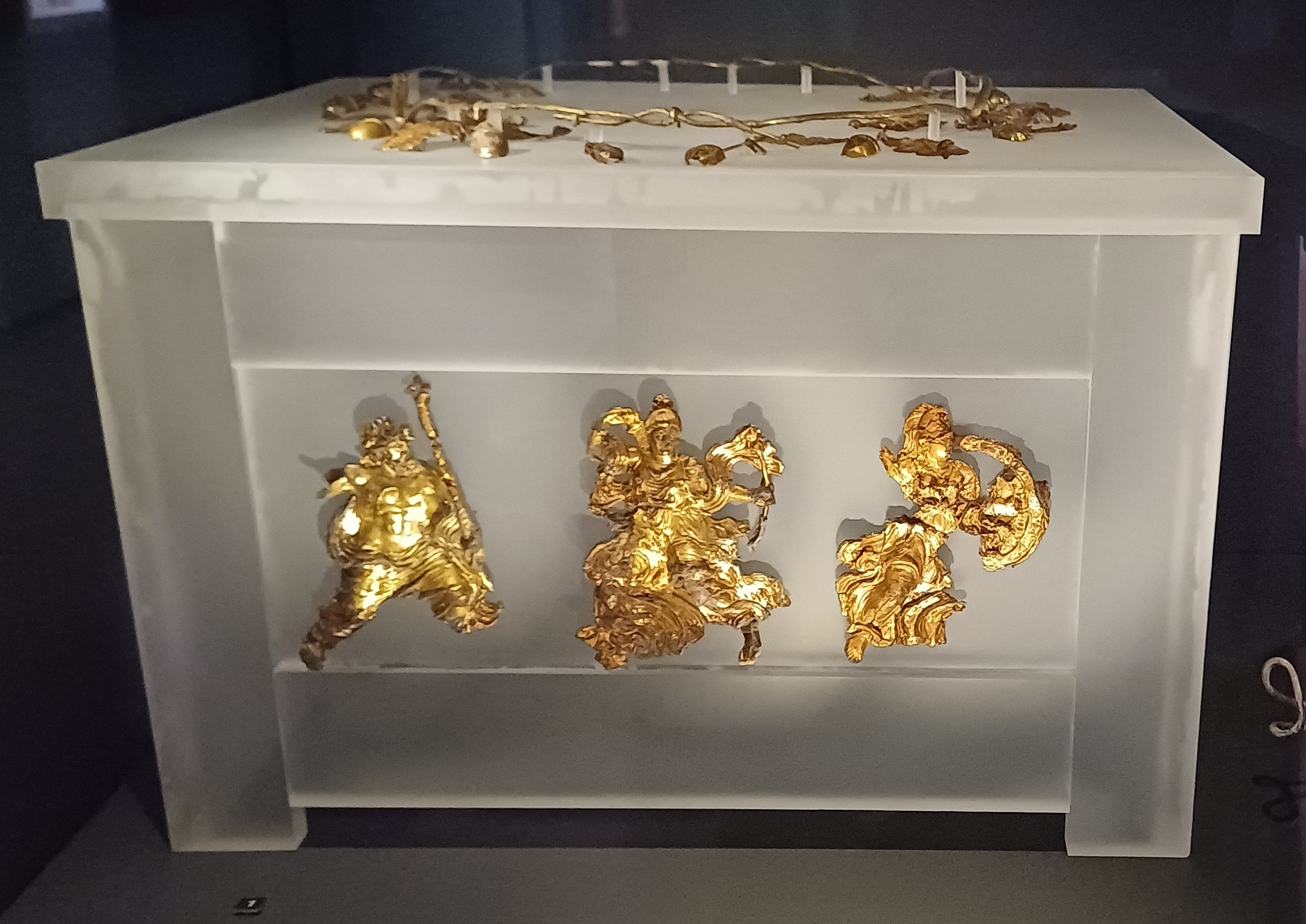
[Grave](https://www.worldhistory.org/burial/) goods from a male [burial](https://www.worldhistory.org/burial/) in the necropolis of Pydna, c. 330 BCE.
Archaeological Museum of [Thessaloniki](https://www.worldhistory.org/Thessalonica/), acc. no. Py4285.
The ancient [city](https://www.worldhistory.org/city/) of Pydna (near today's small town of Makrygialos) was a semi-independent harbour by the Thermaic Gulf in the [Aegean](https://www.worldhistory.org/aegean/). Although a [Greek](https://www.worldhistory.org/disambiguation/greek/) city today at the heart of Central Macedonia province, the city recognised the sovereignty of Macedonian kings while keeping mostly autonomous control of its affairs. A few attempts by the Greeks to capture the city in the 5th century BCE never resulted in its transition from Macedonian to Greek cultural territory. Eventually, [Philip II of Macedon](https://www.worldhistory.org/Philip_II_of_Macedon/) in his sweeping campaigns across the Greek world as part of leading the forces of the [Amphictyonic League](https://www.worldhistory.org/Amphictyonic_League/) in the Third Sacred [War](https://www.worldhistory.org/disambiguation/War/) conquered Pydna in 357 BCE. After the [death](https://www.worldhistory.org/disambiguation/Death/) of Philip's son, [Alexander the Great](https://www.worldhistory.org/Alexander_the_Great/), in 323 BCE, [Alexander](https://www.worldhistory.org/disambiguation/Alexander/)'s mother [Olympias](https://www.worldhistory.org/Olympias/) took his infant son and heir, Alexander IV, under her protection and joined the War of the Diadochi on his support. They were all captured by one of the fiercest claimants of Alexander's throne, [Cassander](https://www.worldhistory.org/Cassander/), in Pydna in 317 BCE, who executed Olympias, imprisoned Alexander IV and his mother, and married Thessalonike, [Philip II](https://www.worldhistory.org/disambiguation/Philip_II/)'s daughter from Nikesipolis of Pherae. Pydna was also the scene of Macedonian final resistance against [Rome](https://www.worldhistory.org/Rome/) in 168 BCE. The city survived well into the [Byzantine](https://www.worldhistory.org/disambiguation/Byzantine/) era.
The necropolis on the north of Pydna has given out several Macedonian burial cist-chambers. The Macedonians used gilt [silver](https://www.worldhistory.org/Silver/) figurines of deities – here representing [Zeus](https://www.worldhistory.org/zeus/), [Artemis](https://www.worldhistory.org/artemis/), and [Athena](https://www.worldhistory.org/athena/) – as grave goods to decorate the burial caskets that preserved the bones after cremation. The [gold](https://www.worldhistory.org/gold/) crown of oak leaves, the ceremonial headgear demonstrating the owner's significance, was placed on the casket, which in this case was made of wood and therefore did not last.
#### Editorial Review
This human-authored image has been reviewed by our editorial team before publication to ensure accuracy, reliability and adherence to academic standards in accordance with our [editorial policy](https://www.worldhistory.org/static/editorial-policy/).
## About the Author
Nathalie is a translator and independent researcher of dance in the ancient world with a focus on Ancient Greece and the Near East. She has published works in ancient dance, ethnomusicology, and literature. She loves learning and sharing knowledge.
- [Facebook Profile](https://www.facebook.com/nathalie.choubineh/)
- [Linkedin Profile](https://www.linkedin.com/in/nathalie-choubineh-035a8451/)
## External Links
- [A MUSEUM FOR ALL | ARCHAEOLOGICAL MUSEUM OF THESSALONIKI](https://www.amth.gr/en)
## Cite This Work
### APA
Choubineh, N. (2024, October 01). Macedonian Burial Casket Decorations from Pydna. *World History Encyclopedia*.
### Chicago
Choubineh, Nathalie. "Macedonian Burial Casket Decorations from Pydna." *World History Encyclopedia*, October 01, 2024. .
### MLA
Choubineh, Nathalie. "Macedonian Burial Casket Decorations from Pydna." *World History Encyclopedia*, 01 Oct 2024, .
## License & Copyright
Submitted by [Nathalie Choubineh](https://www.worldhistory.org/user/nathalie.choubineh/ "User Page: Nathalie Choubineh"), published on 01 October 2024. The copyright holder has published this content under the following license: [Creative Commons Attribution-NonCommercial-ShareAlike](https://creativecommons.org/licenses/by-nc-sa/4.0/deed.en). This license lets others remix, tweak, and build upon this content non-commercially, as long as they credit the author and license their new creations under the identical terms. When republishing on the web a hyperlink back to the original content source URL must be included. Please note that content linked from this page may have different licensing terms.