---
title: Europe after The Treaty of Versailles
author: Simeon Netchev
source: https://www.worldhistory.org/image/19479/europe-after-the-treaty-of-versailles/
format: machine-readable-alternate
license: Creative Commons Attribution-NonCommercial-NoDerivs (https://creativecommons.org/licenses/by-nc/4.0)
updated: 2024-09-23
---
# Europe after The Treaty of Versailles
_Authored by [Simeon Netchev](https://www.worldhistory.org/user/simeonnetchev/)_
## Image File
[](https://www.worldhistory.org/uploads/images/19479.png)
## Image Caption
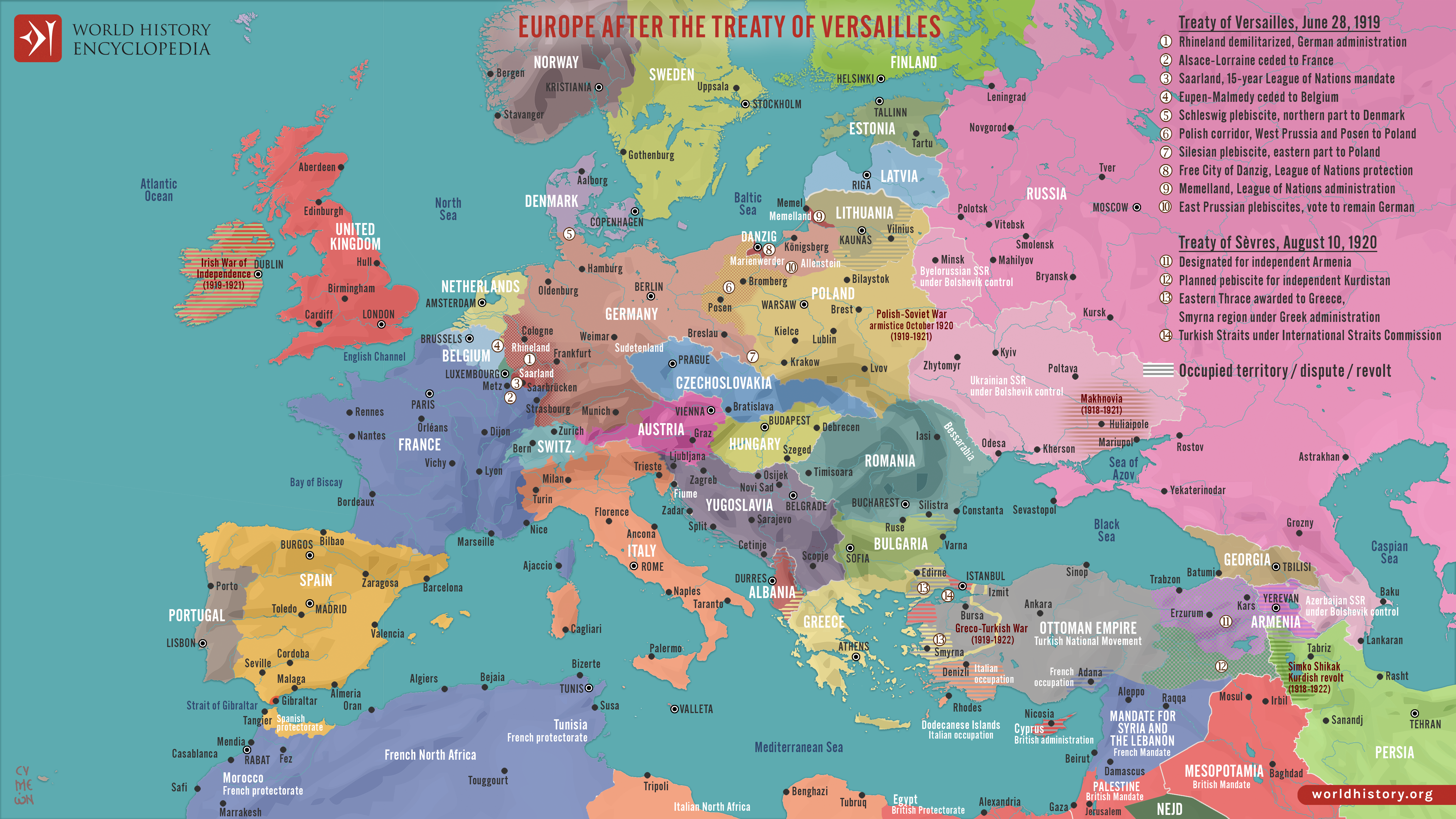
This map illustrates the situation in [Europe](https://www.worldhistory.org/europe/) in November 1920 in the aftermath of First World [War](https://www.worldhistory.org/disambiguation/War/) (1914-18), as the continent was reshaped by the [Treaty of Versailles](https://www.worldhistory.org/Treaty_of_Versailles/) (1919) and the Treaty of Sèvres (1920). The German [Empire](https://www.worldhistory.org/empire/) had collapsed, with Germany forced to cede territories, pay reparations, and accept military restrictions. New states like Poland, Czechoslovakia, and Yugoslavia emerged from the former Austro-Hungarian Empire. The [Ottoman Empire](https://www.worldhistory.org/Ottoman_Empire/) was dismantled under the Treaty of Sèvres, losing vast territories in the Middle East and Europe, with [Turkey](https://www.worldhistory.org/Asia_Minor/) reduced to [Anatolia](https://www.worldhistory.org/Asia_Minor/) and Istanbul. Under the [League of Nations](https://www.worldhistory.org/League_of_Nations/)’ mandate system, France and [Britain](https://www.worldhistory.org/disambiguation/Britain/) gained control over former Ottoman territories, particularly in the Middle East. Having undergone the [Bolshevik Revolution](https://www.worldhistory.org/Bolshevik_Revolution/), the Russian Empire was in civil war, while [Italy](https://www.worldhistory.org/italy/) and other countries experienced internal unrest due to unfulfilled wartime promises. Europe’s political landscape was fragile, marked by territorial adjustments, nationalist movements, and widespread economic instability.
#### Editorial Review
This human-authored image has been reviewed by our editorial team before publication to ensure accuracy, reliability and adherence to academic standards in accordance with our [editorial policy](https://www.worldhistory.org/static/editorial-policy/).
## About the Author
Simeon is a freelance visual designer and history educator, passionate about the human stories that shape the past.
- [Linkedin Profile](https://www.linkedin.com/in/simeon-netchev/)
## Cite This Work
### APA
Netchev, S. (2024, September 23). Europe after The Treaty of Versailles. *World History Encyclopedia*.
### Chicago
Netchev, Simeon. "Europe after The Treaty of Versailles." *World History Encyclopedia*, September 23, 2024. .
### MLA
Netchev, Simeon. "Europe after The Treaty of Versailles." *World History Encyclopedia*, 23 Sep 2024, .
## License & Copyright
Submitted by [Simeon Netchev](https://www.worldhistory.org/user/simeonnetchev/ "User Page: Simeon Netchev"), published on 23 September 2024. The copyright holder has published this content under the following license: [Creative Commons Attribution-NonCommercial-NoDerivs](https://creativecommons.org/licenses/by-nc/4.0deed.en). This licence only allows others to download this content and share it with others as long as the author is credited, but they can't change the content in any way or use it commercially. When republishing on the web a hyperlink back to the original content source URL must be included. Please note that content linked from this page may have different licensing terms.