---
title: The Seven Wonders of the Ancient World
author: Simeon Netchev
source: https://www.worldhistory.org/image/19446/the-seven-wonders-of-the-ancient-world/
format: machine-readable-alternate
license: Creative Commons Attribution-NonCommercial-NoDerivs (https://creativecommons.org/licenses/by-nc/4.0)
updated: 2025-11-13
---
# The Seven Wonders of the Ancient World
_Authored by [Simeon Netchev](https://www.worldhistory.org/user/simeonnetchev/)_
## Image File
[](https://www.worldhistory.org/uploads/images/19446.png)
## Image Caption
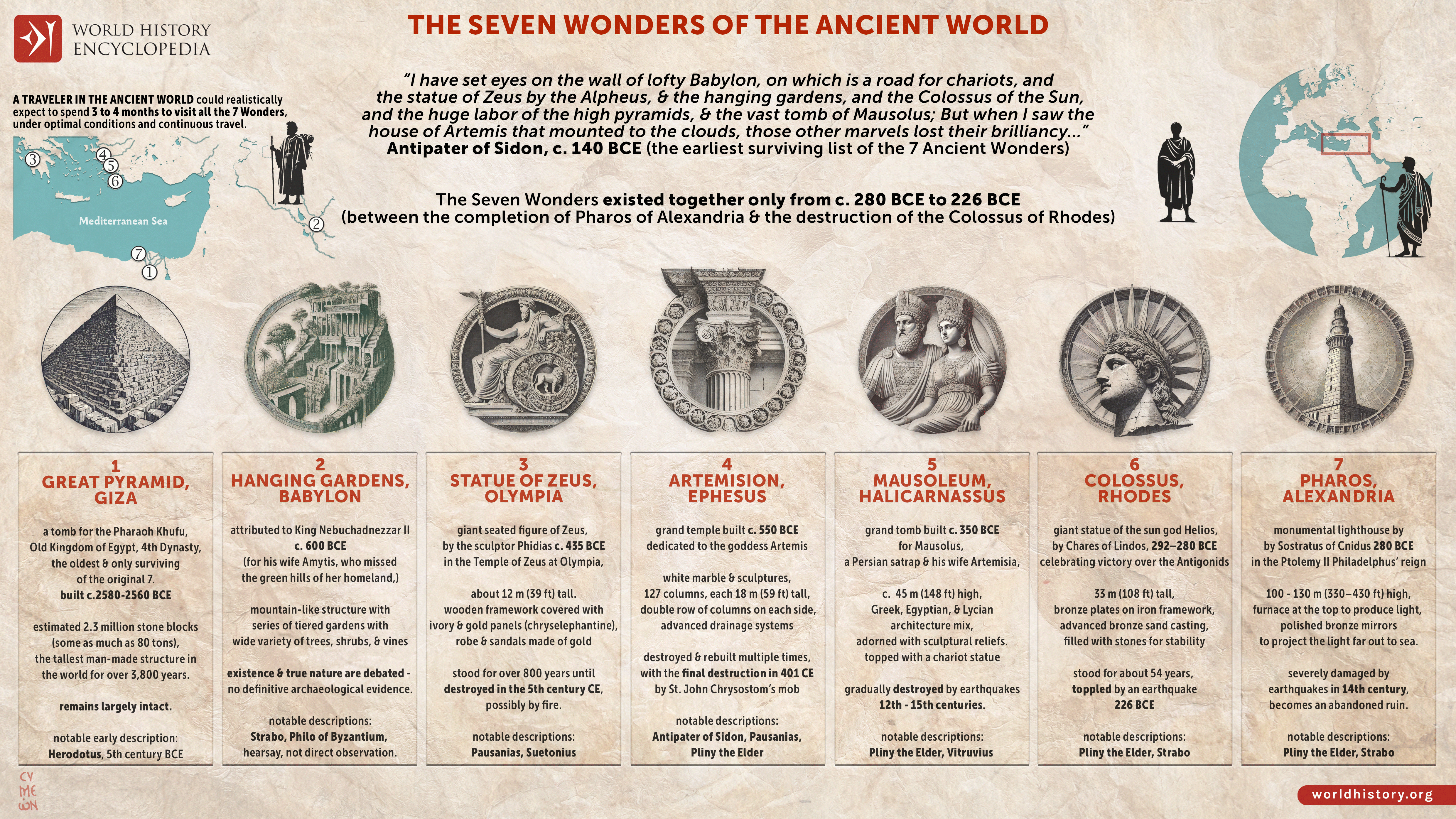
[The Seven Wonders](https://www.worldhistory.org/The_Seven_Wonders/) of the Ancient World represent the pinnacle of human creativity, ambition, and engineering skill in classical antiquity. Compiled by [Greek](https://www.worldhistory.org/disambiguation/greek/) scholars during the [Hellenistic period](https://www.worldhistory.org/Hellenistic_Period/) (c. 3rd century BCE), the list celebrated remarkable architectural and artistic achievements across the [Mediterranean](https://www.worldhistory.org/disambiguation/mediterranean/) and [Near East](https://www.worldhistory.org/Near_East/). Each wonder reflected the cultural ideals and technological mastery of its [civilization](https://www.worldhistory.org/civilization/), serving as both a symbol of divine devotion and political power. The [Great Pyramid of Giza](https://www.worldhistory.org/Great_Pyramid_of_Giza/) (c. 2560 BCE), the only surviving wonder, stood as a monumental [tomb](https://www.worldhistory.org/tomb/) for [Pharaoh](https://www.worldhistory.org/pharaoh/) Khufu, embodying [Egypt](https://www.worldhistory.org/egypt/)’s mastery of stone construction and funerary tradition. The [Hanging Gardens of Babylon](https://www.worldhistory.org/Hanging_Gardens_of_Babylon/), though historically debated, represented the fusion of nature and artifice, an imagined oasis within the arid landscape of [Mesopotamia](https://www.worldhistory.org/Mesopotamia/).
The [Statue of Zeus at Olympia](https://www.worldhistory.org/Statue_of_Zeus_at_Olympia/) (c. 435 BCE) and the [Temple of Artemis at Ephesus](https://www.worldhistory.org/Temple_of_Artemis_at_Ephesus/) (rebuilt c. 550 BCE) demonstrated the Greek devotion to artistry, symmetry, and religious grandeur, while the [Mausoleum at Halicarnassus](https://www.worldhistory.org/Mausoleum_at_Halicarnassus/) (c. 350 BCE) immortalized personal legacy through monumental [architecture](https://www.worldhistory.org/disambiguation/architecture/). The [Colossus of Rhodes](https://www.worldhistory.org/Colossus_of_Rhodes/) (c. 280 BCE) celebrated victory and resilience through the image of the sun [god](https://www.worldhistory.org/God/) [Helios](https://www.worldhistory.org/Helios/) towering over the harbor, and the [Lighthouse of Alexandria](https://www.worldhistory.org/Lighthouse_of_Alexandria/) (c. 280 BCE) symbolized the scientific and maritime prowess of the [Hellenistic world](https://www.worldhistory.org/Hellenistic_Period/) under the Ptolemies. Collectively, these wonders illustrated humanity’s enduring desire to blend artistic imagination, technical innovation, and spiritual meaning, an aspiration that continues to shape architectural heritage to this day.
#### Editorial Review
This human-authored image has been reviewed by our editorial team before publication to ensure accuracy, reliability and adherence to academic standards in accordance with our [editorial policy](https://www.worldhistory.org/static/editorial-policy/).
## About the Author
Simeon is a freelance visual designer and history educator, passionate about the human stories that shape the past.
- [Linkedin Profile](https://www.linkedin.com/in/simeon-netchev/)
## Cite This Work
### APA
Netchev, S. (2024, September 13). The Seven Wonders of the Ancient World. *World History Encyclopedia*.
### Chicago
Netchev, Simeon. "The Seven Wonders of the Ancient World." *World History Encyclopedia*, September 13, 2024. .
### MLA
Netchev, Simeon. "The Seven Wonders of the Ancient World." *World History Encyclopedia*, 13 Sep 2024, .
## License & Copyright
Submitted by [Simeon Netchev](https://www.worldhistory.org/user/simeonnetchev/ "User Page: Simeon Netchev"), published on 13 September 2024. The copyright holder has published this content under the following license: [Creative Commons Attribution-NonCommercial-NoDerivs](https://creativecommons.org/licenses/by-nc/4.0deed.en). This licence only allows others to download this content and share it with others as long as the author is credited, but they can't change the content in any way or use it commercially. When republishing on the web a hyperlink back to the original content source URL must be included. Please note that content linked from this page may have different licensing terms.