---
title: Statue of Penelope from Persepolis
author: Nathalie Choubineh
source: https://www.worldhistory.org/image/19416/statue-of-penelope-from-persepolis/
format: machine-readable-alternate
license: Creative Commons Attribution-NonCommercial-ShareAlike (https://creativecommons.org/licenses/by-nc-sa/4.0/)
updated: 2024-09-03
---
# Statue of Penelope from Persepolis
_Authored by [Nathalie Choubineh](https://www.worldhistory.org/user/nathalie.choubineh/)_
## Image File
[](https://www.worldhistory.org/uploads/images/19416.jpg)
## Image Caption
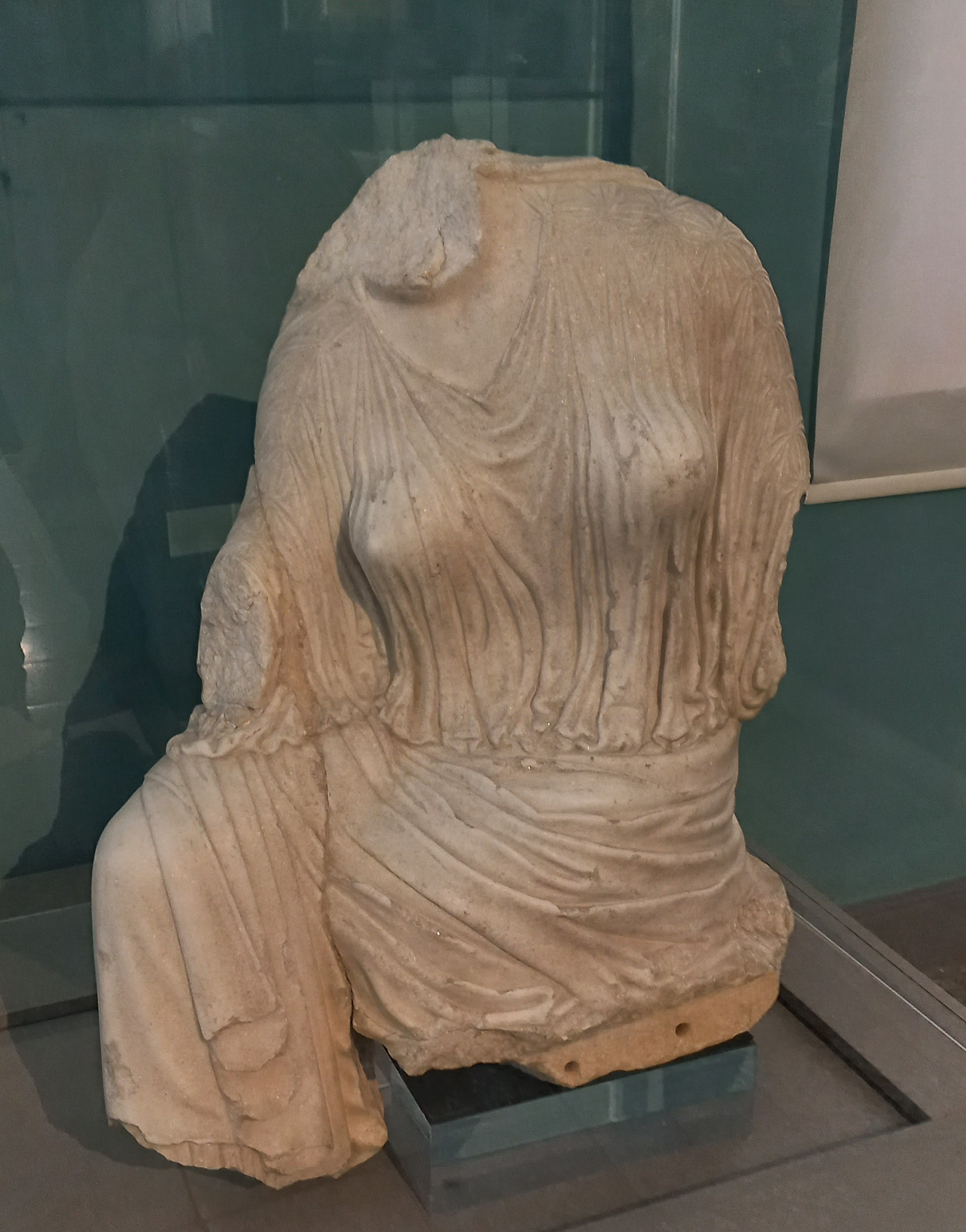
Statue of Penelope, marble copy of the [bronze](https://www.worldhistory.org/disambiguation/bronze/) original, found in [Persepolis](https://www.worldhistory.org/persepolis/) in 1936, dated to c. 450 BCE.
National Museum of Iran, Tehran, acc. no. 1538
This marble torso of a seated woman in sophisticated drapes, with a height of 85 cm, was retrieved from the ruins of the Persepolis Treasury during its excavations in 1936. Her head, hands, and legs were lost, her torso broken into three pieces and found in different parts of the building. The overall signs of invasion, damage, and burning left little doubt about dating the end of the statue's usage in one piece as 330 BCE, in close connection with the sack of Persepolis by [Alexander the Great](https://www.worldhistory.org/Alexander_the_Great/).
In contrast, many questions about the so-called Penelope Statue are still under investigation. Her identity as Penelope, based on the seated position comparable to resembling statues, [Roman](https://www.worldhistory.org/disambiguation/Roman/) copies, and several vase-paintings of [Odysseus](https://www.worldhistory.org/odysseus/)' faithful and patient wife, are challenged by conceivable alternatives, such as [Demeter](https://www.worldhistory.org/demeter/) (like the one in a [Parthenon](https://www.worldhistory.org/parthenon/) frieze), [Aphrodite](https://www.worldhistory.org/Aphrodite/) mourning for [Adonis](https://www.worldhistory.org/Adonis/), or Hellas waiting to be saved from the Persians by the Greeks, among others. Although it is recently confirmed that the building material of this statue is indeed the dolomitic marble from Cape Vathy-Saliara in Thasos, scholars are much less certain about the exact place of her production, since the Thasian marble was widely exported since the 6th century BCE to [Sicily](https://www.worldhistory.org/sicily/) and the west [Mediterranean](https://www.worldhistory.org/disambiguation/mediterranean/) as well as [Asia Minor](https://www.worldhistory.org/Asia_Minor/) and later to the [Roman Empire](https://www.worldhistory.org/Roman_Empire/). Finally, most scholars agree that this remarkable [Greek](https://www.worldhistory.org/disambiguation/greek/) statue was a gift to an [Achaemenid](https://www.worldhistory.org/disambiguation/Achaemenid/) king, most likely [Artaxerxes I](https://www.worldhistory.org/Artaxerxes_I/). And yet, the supportive evidence does not seem to be conclusive enough to rule out the probability of purchase or [trade](https://www.worldhistory.org/disambiguation/trade/) as the main reason behind keeping the life-size figurine of an [Archaic](https://www.worldhistory.org/disambiguation/Archaic/) Greek character in the Persian royal complex of Takht-e Jamshid.
#### Editorial Review
This human-authored image has been reviewed by our editorial team before publication to ensure accuracy, reliability and adherence to academic standards in accordance with our [editorial policy](https://www.worldhistory.org/static/editorial-policy/).
## Bibliography
- Lorenzo Lazzarini, Alessandro Poggio. "The 'Penelope' and its Marble. A Multidisciplinary Research." *Rendiconti. Scienza Morali Storiche e Filologiche*, s.9, vol. 28, 2017, pp. 405-423.
- Olga Palagia. "The Marble of the Penelope from Persepolis and Its Historical Implications." *Ancient Greece and Ancient Iran: Cross-Cultural Encounters*, 2008, pp. 223-237.
## About the Author
Nathalie is a translator and independent researcher of dance in the ancient world with a focus on Ancient Greece and the Near East. She has published works in ancient dance, ethnomusicology, and literature. She loves learning and sharing knowledge.
- [Facebook Profile](https://www.facebook.com/nathalie.choubineh/)
- [Linkedin Profile](https://www.linkedin.com/in/nathalie-choubineh-035a8451/)
## External Links
- [National Museum of Iran – Official Site For National Museum Of Iran](https://irannationalmuseum.ir/en/)
## Cite This Work
### APA
Choubineh, N. (2024, September 03). Statue of Penelope from Persepolis. *World History Encyclopedia*.
### Chicago
Choubineh, Nathalie. "Statue of Penelope from Persepolis." *World History Encyclopedia*, September 03, 2024. .
### MLA
Choubineh, Nathalie. "Statue of Penelope from Persepolis." *World History Encyclopedia*, 03 Sep 2024, .
## License & Copyright
Submitted by [Nathalie Choubineh](https://www.worldhistory.org/user/nathalie.choubineh/ "User Page: Nathalie Choubineh"), published on 03 September 2024. The copyright holder has published this content under the following license: [Creative Commons Attribution-NonCommercial-ShareAlike](https://creativecommons.org/licenses/by-nc-sa/4.0/deed.en). This license lets others remix, tweak, and build upon this content non-commercially, as long as they credit the author and license their new creations under the identical terms. When republishing on the web a hyperlink back to the original content source URL must be included. Please note that content linked from this page may have different licensing terms.