---
title: Macedonian Terracotta Icon of Daniel in the Lions' Den
author: Nathalie Choubineh
source: https://www.worldhistory.org/image/19345/macedonian-terracotta-icon-of-daniel-in-the-lions/
format: machine-readable-alternate
license: Creative Commons Attribution-NonCommercial-ShareAlike (https://creativecommons.org/licenses/by-nc-sa/4.0/)
updated: 2024-08-22
---
# Macedonian Terracotta Icon of Daniel in the Lions' Den
_Authored by [Nathalie Choubineh](https://www.worldhistory.org/user/nathalie.choubineh/)_
## Image File
[](https://www.worldhistory.org/uploads/images/19345.jpg)
## Image Caption
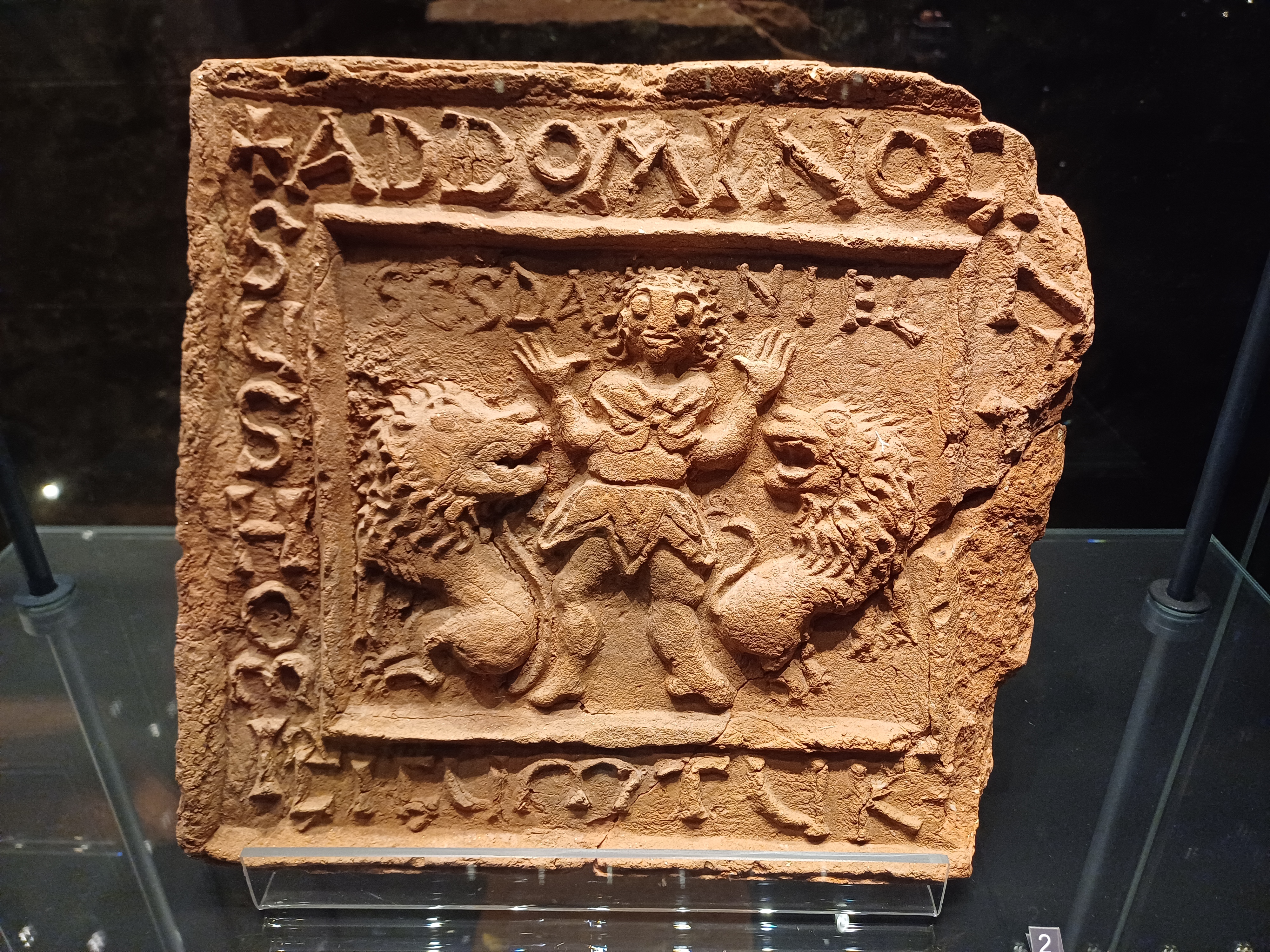
Terracotta icon depicting Daniel in the lions' den, found in Vinicko Kale, North Macedonia, 5th-6th century.
Archaeological Museum of the Republic of North Macedonia, Skopje.
The archaeological site of Vinicko Kale (Fortress of Vinica) is a fortified settlement overlooking the [city](https://www.worldhistory.org/city/) of Vinica in North Macedonia. The site has been inhabited since prehistoric times, as suggested by many [Neolithic](https://www.worldhistory.org/Neolithic/) objects excavated there. Its best documented period of occupation, however, was during the Late Antiquity and early [Byzantine](https://www.worldhistory.org/disambiguation/Byzantine/) era, around the 4th to 6th centuries. The fortress may well have been established at an early stage of this period, strategically positioned to oversee the surrounding valley. The remains of fortifications, residential buildings, and public spaces discovered at the site highlight the importance of Vinicko Kale in the then-[Roman](https://www.worldhistory.org/disambiguation/Roman/) province of Moesia, particularly regarding the militaristic turbulences leading to the conversion of most Balkan territories from the Roman-Byzantine provinces to the Slavic Bulgarian [Empire](https://www.worldhistory.org/empire/) states.
Beginning to come out in 1978, the terracotta icons discovered in Vinicko Kale are amongst the most remarkable religious finds of the early Christian era. These meticulously sculpted clay tablets are typically crafted in a rectangular shape to frame a snapshot of biblical events and characters from the [Old Testament](https://www.worldhistory.org/Old_Testament/) and Psalms. Unearthed originally at the bases of the defensive walls, it is believed that the icons were used as [wall](https://www.worldhistory.org/wall/) decorations in sacred spaces for more than five centuries. Many of these icons are labelled with Latin inscriptions, sometimes mingled with the [Greek](https://www.worldhistory.org/disambiguation/greek/) pronunciations and [alphabet](https://www.worldhistory.org/alphabet/) that can point to the characteristic blend of classical and Christian artistic trends. The icon exemplified here, showing Daniel in the lions' den, is topped with the words: "*Ad Dominoς \[dominus\]*", as a reminder of [God](https://www.worldhistory.org/God/)'s protective presence. The location designated to this event, [Susa](https://www.worldhistory.org/susa/), is mentioned on the left, while the protagonist's name tag, 'SCS \[Sanctus\] Daniel', is carved around his head.
#### Editorial Review
This human-authored image has been reviewed by our editorial team before publication to ensure accuracy, reliability and adherence to academic standards in accordance with our [editorial policy](https://www.worldhistory.org/static/editorial-policy/).
## About the Author
Nathalie is a translator and independent researcher of dance in the ancient world with a focus on Ancient Greece and the Near East. She has published works in ancient dance, ethnomusicology, and literature. She loves learning and sharing knowledge.
- [Facebook Profile](https://www.facebook.com/nathalie.choubineh/)
- [Linkedin Profile](https://www.linkedin.com/in/nathalie-choubineh-035a8451/)
## External Links
- [Viničko Kale – Accessible and Digitalized Heritage of Culture](https://adhoc.ireason.mk/2022/06/08/vinicko-kale/)
- [Vinica’s Fortress | HAEMUS | Center for scientific research and promotion of culture](https://haemus.org.mk/vinicas-fortress/)
## Cite This Work
### APA
Choubineh, N. (2024, August 22). Macedonian Terracotta Icon of Daniel in the Lions' Den. *World History Encyclopedia*.
### Chicago
Choubineh, Nathalie. "Macedonian Terracotta Icon of Daniel in the Lions' Den." *World History Encyclopedia*, August 22, 2024. .
### MLA
Choubineh, Nathalie. "Macedonian Terracotta Icon of Daniel in the Lions' Den." *World History Encyclopedia*, 22 Aug 2024, .
## License & Copyright
Submitted by [Nathalie Choubineh](https://www.worldhistory.org/user/nathalie.choubineh/ "User Page: Nathalie Choubineh"), published on 22 August 2024. The copyright holder has published this content under the following license: [Creative Commons Attribution-NonCommercial-ShareAlike](https://creativecommons.org/licenses/by-nc-sa/4.0/deed.en). This license lets others remix, tweak, and build upon this content non-commercially, as long as they credit the author and license their new creations under the identical terms. When republishing on the web a hyperlink back to the original content source URL must be included. Please note that content linked from this page may have different licensing terms.