---
title: Map of the Scramble for Africa after the Berlin Conference
author: Simeon Netchev
source: https://www.worldhistory.org/image/19247/map-of-the-scramble-for-africa-after-the-berlin-co/
format: machine-readable-alternate
license: Creative Commons Attribution-NonCommercial-NoDerivs (https://creativecommons.org/licenses/by-nc/4.0)
updated: 2025-10-17
---
# Map of the Scramble for Africa after the Berlin Conference
_Authored by [Simeon Netchev](https://www.worldhistory.org/user/simeonnetchev/)_
## Image File
[](https://www.worldhistory.org/uploads/images/19247.png)
## Image Caption
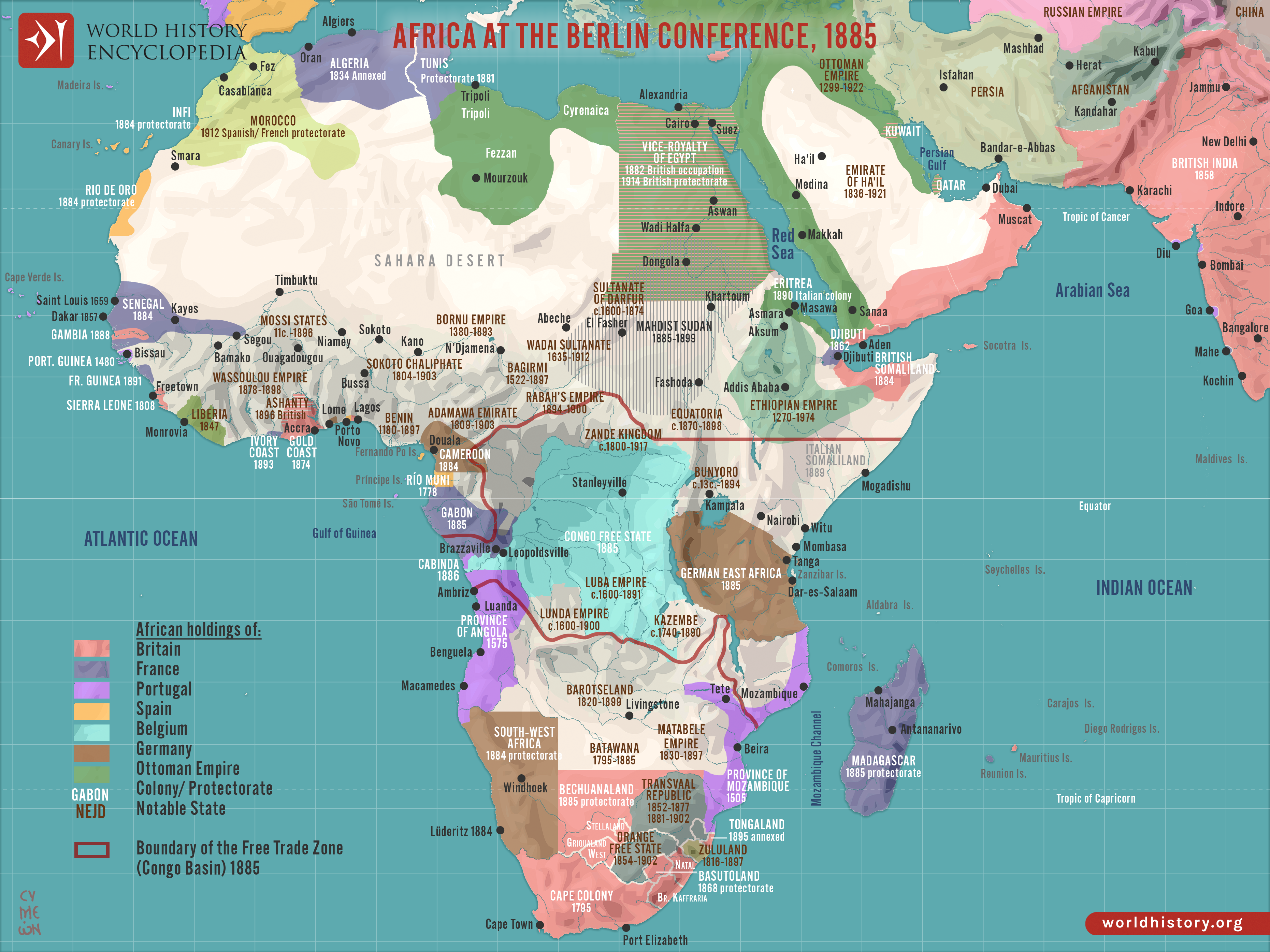
The Berlin Conference (1884–1885), also known as the Congo Conference, marked a defining moment in the Scramble for [Africa](https://www.worldhistory.org/disambiguation/africa/)—the competitive [colonization](https://www.worldhistory.org/disambiguation/colonization/) of the continent by European powers during the late 19th century. Convened in Berlin under the leadership of German Chancellor Otto von Bismarck (reign of Wilhelm I, 1871–1888) at the request of King Leopold II of Belgium (r. 1865–1909), the conference sought to formalize the process of territorial acquisition and [trade](https://www.worldhistory.org/disambiguation/trade/) regulation in Africa. Its stated aim was to avoid conflict among European states, but its deeper motivations were rooted in industrial competition, imperial prestige, and access to raw materials. The resulting General Act of Berlin established rules for “effective occupation,” giving diplomatic legitimacy to [conquest](https://www.worldhistory.org/warfare/) and paving the way for accelerated colonization.
The decisions made in Berlin reshaped Africa without African participation. Artificial borders divided ethnic, linguistic, and cultural groups, while new colonial economies prioritized extraction over development. Traditional governance structures were undermined, and the continent’s political and social fabric was permanently altered. In the decades that followed, nearly 90% of Africa came under European control, setting the stage for both the exploitation and modernization that would define colonial rule—and leaving enduring legacies of inequality, resistance, and contested identity that continue to shape the continent’s postcolonial history.
#### Editorial Review
This human-authored image has been reviewed by our editorial team before publication to ensure accuracy, reliability and adherence to academic standards in accordance with our [editorial policy](https://www.worldhistory.org/static/editorial-policy/).
## About the Author
Simeon is a freelance visual designer and history educator, passionate about the human stories that shape the past.
- [Linkedin Profile](https://www.linkedin.com/in/simeon-netchev/)
## External Links
- [Schizzo delle Colonie Europee](https://digital.library.illinois.edu/items/3d622520-e946-0133-1d3d-0050569601ca-6#?c=0&m=0&s=0&cv=0&r=0&xywh=-3720%2C0%2C11439%2C3750)
- [A Map of Africa Showing the Boundaries Settled by International Treaties and Agreements](https://www.geographicus.com/P/AntiqueMap/africa-royalgeographical-1890)
## Cite This Work
### APA
Netchev, S. (2024, July 21). Map of the Scramble for Africa after the Berlin Conference. *World History Encyclopedia*.
### Chicago
Netchev, Simeon. "Map of the Scramble for Africa after the Berlin Conference." *World History Encyclopedia*, July 21, 2024. .
### MLA
Netchev, Simeon. "Map of the Scramble for Africa after the Berlin Conference." *World History Encyclopedia*, 21 Jul 2024, .
## License & Copyright
Submitted by [Simeon Netchev](https://www.worldhistory.org/user/simeonnetchev/ "User Page: Simeon Netchev"), published on 21 July 2024. The copyright holder has published this content under the following license: [Creative Commons Attribution-NonCommercial-NoDerivs](https://creativecommons.org/licenses/by-nc/4.0deed.en). This licence only allows others to download this content and share it with others as long as the author is credited, but they can't change the content in any way or use it commercially. When republishing on the web a hyperlink back to the original content source URL must be included. Please note that content linked from this page may have different licensing terms.