---
title: Roman Rule in the Balkans, c. 200 CE
author: Simeon Netchev
source: https://www.worldhistory.org/image/19102/roman-rule-in-the-balkans-c-200-ce/
format: machine-readable-alternate
license: Creative Commons Attribution-NonCommercial-NoDerivs (https://creativecommons.org/licenses/by-nc/4.0)
updated: 2024-06-14
---
# Roman Rule in the Balkans, c. 200 CE
_Authored by [Simeon Netchev](https://www.worldhistory.org/user/simeonnetchev/)_
## Image File
[](https://www.worldhistory.org/uploads/images/19102.png)
## Image Caption
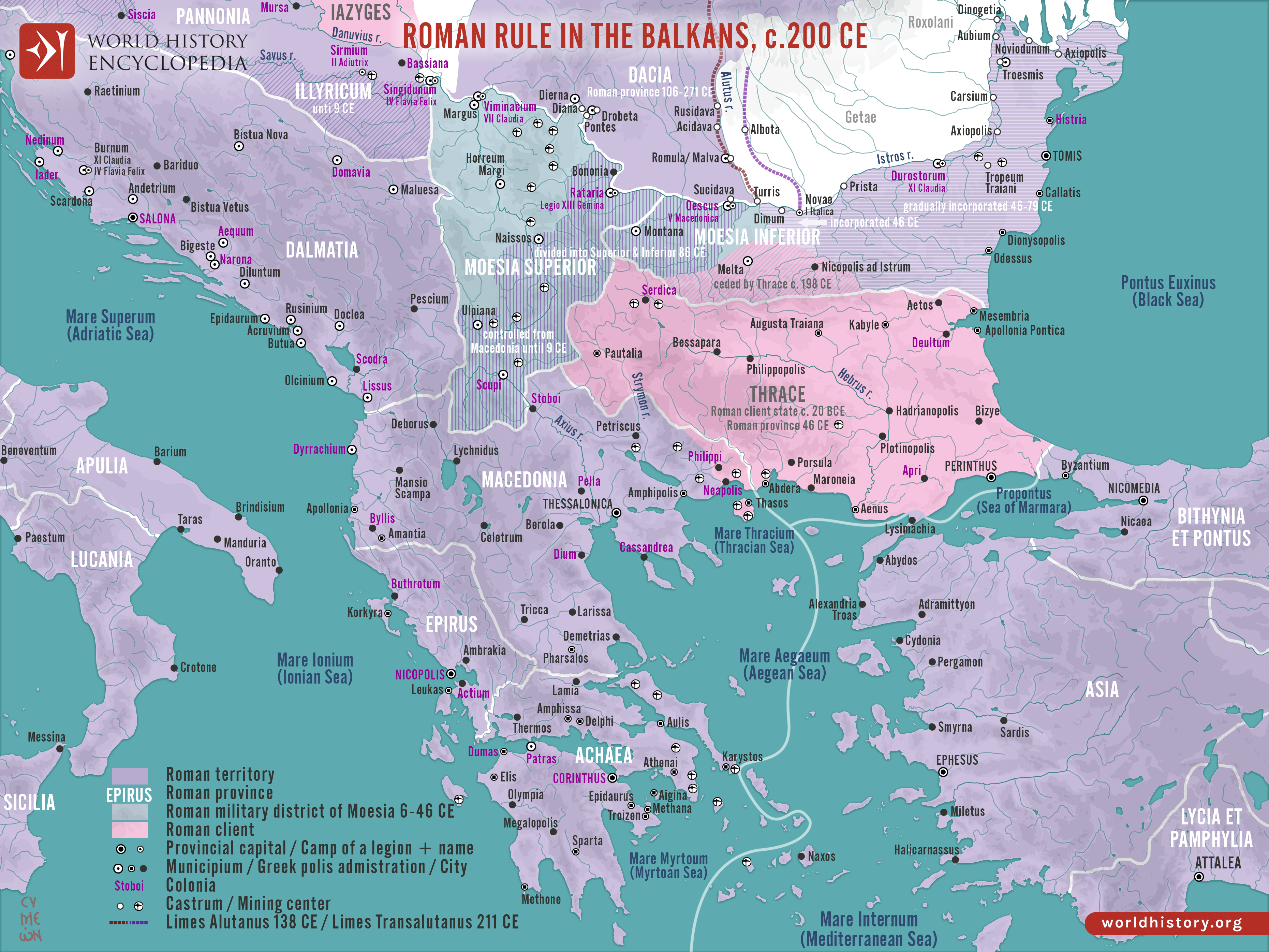
A map illustrating [Roman](https://www.worldhistory.org/disambiguation/Roman/) rule in the Balkans around 200 CE, characterized by significant administrative, military, and cultural integration into the [Empire](https://www.worldhistory.org/empire/). The region was divided into several provinces (Moesia Superior, Moesia Inferior, Thrace, [Dacia](https://www.worldhistory.org/dacia/), Dalmatia, Achaea, Macedonia, and Epirus,) each governed by Roman officials who oversaw local administration, justice, and tax collection.
Urban centres with diverse forms of governance flourished, featuring forums, [Roman baths](https://www.worldhistory.org/Roman_Baths/), amphitheatres, and [aqueducts](https://www.worldhistory.org/aqueduct/). The Balkans served as a critical military frontier, with numerous legions stationed along the Danube River to defend against invasions. Notable forts along the Danube and inland ensured robust defence against significant threats from Germanic, Dacian, and Sarmatian tribes, as well as internal rebellions and coastal [piracy](https://www.worldhistory.org/Piracy/). Economically, the region benefited from extensive [trade](https://www.worldhistory.org/disambiguation/trade/) networks. The spread of [Roman law](https://www.worldhistory.org/Roman_Law/), language, and [culture](https://www.worldhistory.org/disambiguation/culture/) led to a significant degree of Romanization, though local customs and traditions persisted. Despite occasional internal strife and external threats, the Balkans experienced relative stability and prosperity under Roman rule.
#### Editorial Review
This human-authored image has been reviewed by our editorial team before publication to ensure accuracy, reliability and adherence to academic standards in accordance with our [editorial policy](https://www.worldhistory.org/static/editorial-policy/).
## About the Author
Simeon is a freelance visual designer and history educator, passionate about the human stories that shape the past.
- [Linkedin Profile](https://www.linkedin.com/in/simeon-netchev/)
## External Links
- [Digital Atlas of the Roman Empire](https://imperium.ahlfeldt.se/)
- [The Roman Empire’s Cosmopolitan Frontier](https://www.harvardmagazine.com/2023/12/roman-empire-genetic-research-harvard)
## Cite This Work
### APA
Netchev, S. (2024, June 14). Roman Rule in the Balkans, c. 200 CE. *World History Encyclopedia*.
### Chicago
Netchev, Simeon. "Roman Rule in the Balkans, c. 200 CE." *World History Encyclopedia*, June 14, 2024. .
### MLA
Netchev, Simeon. "Roman Rule in the Balkans, c. 200 CE." *World History Encyclopedia*, 14 Jun 2024, .
## License & Copyright
Submitted by [Simeon Netchev](https://www.worldhistory.org/user/simeonnetchev/ "User Page: Simeon Netchev"), published on 14 June 2024. The copyright holder has published this content under the following license: [Creative Commons Attribution-NonCommercial-NoDerivs](https://creativecommons.org/licenses/by-nc/4.0deed.en). This licence only allows others to download this content and share it with others as long as the author is credited, but they can't change the content in any way or use it commercially. When republishing on the web a hyperlink back to the original content source URL must be included. Please note that content linked from this page may have different licensing terms.