---
title: Bronze Hairpin Depicting 'Master of Animals' from Iron Age Zagros
author: National Museum of Iran
source: https://www.worldhistory.org/image/18769/bronze-hairpin-depicting-master-of-animals-from-ir/
format: machine-readable-alternate
updated: 2024-04-05
---
# Bronze Hairpin Depicting 'Master of Animals' from Iron Age Zagros
_Authored by National Museum of Iran_
## Image File
[](https://www.worldhistory.org/uploads/images/18769.jpg)
## Image Caption
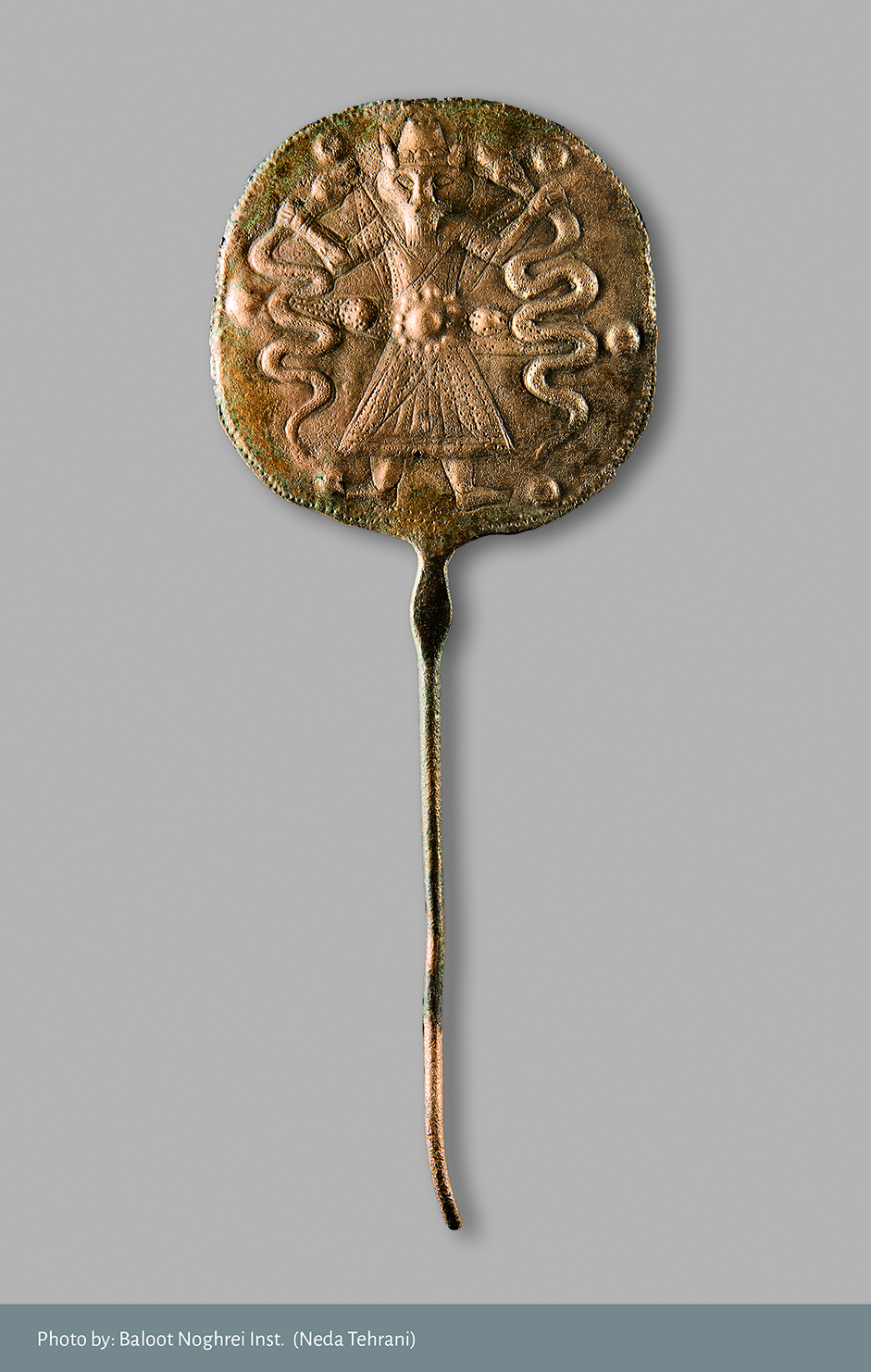
[Bronze](https://www.worldhistory.org/disambiguation/bronze/) Hairpin Depicting 'Master of Animals', found in Luristan (central Zagros), c. 950 to c. 650 BCE.
National Museum of Iran, Tehran, acc. no. 1459.
Photo by Neda Tehrani (Baloot Noghrei)
Long bronze hairpins crowned with a large disk are among the remarkable artefacts retrieved from Luristan, western Iran. Perhaps to serve a unisex function, or even made in two kinds for men and [women](https://www.worldhistory.org/disambiguation/women/), [metal](https://www.worldhistory.org/disambiguation/metal/) pins were used to fasten long curls, particularly of the nobility. The disks could bear decorations of geometric or representative content, such as the snake-clutching character above that may remind us of [Hercules](https://www.worldhistory.org/hercules/). However, a human figure, most likely a deity, sided by a pair of conquered beasts appears in the art of many ancient cultures from [Egypt](https://www.worldhistory.org/egypt/) to the [Near East](https://www.worldhistory.org/Near_East/) and the [Aegean](https://www.worldhistory.org/aegean/). Known as the 'Master of Animals', the beast-fighting and monster-ruling male figure, sometimes with bovine features, such as horns and/or pointed ears, appears in the [Mesopotamian art](https://www.worldhistory.org/Mesopotamian_Art_and_Architecture/) from the Ubaid period, with some earliest examples on stamp seals from the 5th-millennium BCE Tappeh Giyan not far from Luristan. The presence of this motif on the chlorite vessels of south-eastern Iran in the 3rd millennium BCE vouches for the vastness of [Elamite](https://www.worldhistory.org/elam/) influence connecting its two distanced capitals of [Susa](https://www.worldhistory.org/susa/) and Anshan.
Serpent monsters in Mesopotamian [mythology](https://www.worldhistory.org/mythology/) were venomous children of [Tiamat](https://www.worldhistory.org/Tiamat/), closely tied with the notions of the underworld and [death](https://www.worldhistory.org/disambiguation/Death/). Although all the demonic commanders of Tiamat were finally defeated by [Marduk](https://www.worldhistory.org/Marduk/) and became servants of him and other benevolent gods, keeping them permanently in check was regarded as a principal duty for a ruler, as symbolised in the [Myth of Etana](https://www.worldhistory.org/article/224/the-myth-of-etana/). In the first half of the 1st millennium BCE, an already declining [Elam](https://www.worldhistory.org/elam/) had to confront external invasions, most devastatingly from the [Neo-Assyrian Empire](https://www.worldhistory.org/Neo-Assyrian_Empire/), and internal disintegration of the land, with territories lost to the [Medes](https://www.worldhistory.org/Medes/), the Persians, and the local state of Anshan. Therefore, it would seem appropriate for art to reflect the idea of appealing for protection to kingly deities such as Marduk and Inshushinak, the tutelary [god](https://www.worldhistory.org/God/) of Susa.
#### Editorial Review
This human-authored image has been reviewed by our editorial team before publication to ensure accuracy, reliability and adherence to academic standards in accordance with our [editorial policy](https://www.worldhistory.org/static/editorial-policy/).
## Bibliography
- François Desset, Meisam Shahsavari, and Massimo Vidale. "THE MARḪAŠEAN TWO-FACED 'GOD': NEW INSIGHTS INTO THE ICONOGRAPHIC AND RELIGIOUS LANDSCAPES OF THE HALIL RUD VALLEY CIVILIZATION AND THIRD MILLENNIUM BCE SOUTH- EASTERN IRAN." *Journal of Sistan and Balouchistan Studies*, no. 1 vol. 1 2021, pp. 49-85.
- Mehmet Ali Ataç. *The Mythology of Kingship in Neo-Assyrian Art.* Cambridge University Press, 2010
## External Links
- [National Museum of Iran – Official Site For National Museum Of Iran](https://irannationalmuseum.ir/en/)
## Cite This Work
### APA
Iran, N. M. o. (2024, April 05). Bronze Hairpin Depicting 'Master of Animals' from Iron Age Zagros. *World History Encyclopedia*.
### Chicago
Iran, National Museum of. "Bronze Hairpin Depicting 'Master of Animals' from Iron Age Zagros." *World History Encyclopedia*, April 05, 2024. .
### MLA
Iran, National Museum of. "Bronze Hairpin Depicting 'Master of Animals' from Iron Age Zagros." *World History Encyclopedia*, 05 Apr 2024, .
## License & Copyright
Original image by **National Museum of Iran**. Submitted by [Nathalie Choubineh](https://www.worldhistory.org/user/nathalie.choubineh/ "User Page: Nathalie Choubineh"), published on 05 April 2024. The copyright holder has published this content under the following license: [Copyright](http://en.wikipedia.org/wiki/Copyright). You cannot use, copy, distribute, or modify this item without explicit permission from the author. Please note that content linked from this page may have different licensing terms.