---
title: Terracotta Goblet with Gazelles and Ibexes from Shahr-e Sukhteh, Iran
author: National Museum of Iran
source: https://www.worldhistory.org/image/18741/terracotta-goblet-with-gazelles-and-ibexes-from-sh/
format: machine-readable-alternate
updated: 2024-03-26
---
# Terracotta Goblet with Gazelles and Ibexes from Shahr-e Sukhteh, Iran
_Authored by National Museum of Iran_
## Image File
[](https://www.worldhistory.org/uploads/images/18741.jpg)
## Image Caption
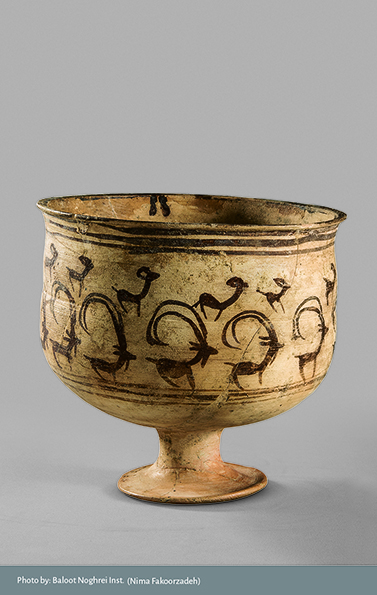
Terracotta goblet with gazelles and ibexes, found in [grave](https://www.worldhistory.org/burial/) no. 725 in Shahr-e Sukhteh, southern Iran, Early [Bronze Age](https://www.worldhistory.org/disambiguation/Bronze_Age/), c. 2800-2400 BCE.
National Museum of Iran, Tehran, acc. no. 12947.
Photo by Nima Fakoorzadeh (Baloot Noghrei)
Shahr-e Sukhteh (lit. = the burnt [city](https://www.worldhistory.org/city/)) in southern Iran is the site of an ancient [city-state](https://www.worldhistory.org/Polis/) dating back to the Late Chalcolithic or Early [Bronze](https://www.worldhistory.org/disambiguation/bronze/) Age periods. Several [Sumerian](https://www.worldhistory.org/Sumerians/) mythical epics and hymns, resonated by archaeological evidence, have illuminated Shahr-e Sukhteh as a lustrous hob for industrial activities and trading goods, including precious metals and gemstones. Although hot and mostly arid today, the region used to accommodate overcovering populations of plants and animals thanks to the then much greater Helmand River and its natural reservoir, Lake Hamun. The artistic reflections of proliferating plains and valleys can be watched today on a hoard of painted terracotta vessels retrieved from Shahr-e Sukhteh.
A common motif on these painted pieces is that of the male adult ibex, quite frequent in Near Eastern rock art since thousands of years before its transference to pot-painting first emerged on the Samarran ware c. 5500 BCE in [Mesopotamia](https://www.worldhistory.org/Mesopotamia/). Many scholars have considered the ibex motif as bearing a symbolic, religious content that can converse with a variety of concepts including the (worship of) Mesopotamian moon [god](https://www.worldhistory.org/God/), Sin; power and strength; rejuvenation and fertility; and the Tree of Life (often depicted in the form of a palm tree). The ibex motifs from the proto-[Elamite](https://www.worldhistory.org/elam/) Shahr-e Sukhte, however, are distinctive from their earlier Mesopotamian peers in terms of the animated style of their illustration that delivers a sense of motion, particularly on spinnable goblets like the one exhibited here.
#### Editorial Review
This human-authored image has been reviewed by our editorial team before publication to ensure accuracy, reliability and adherence to academic standards in accordance with our [editorial policy](https://www.worldhistory.org/static/editorial-policy/).
## Bibliography
- Federico Mailland. "Ibex, Crescent, and Swastika as Symbols of Lunar God in the Ancient Near East and Mesopotamia." *Expression*, no. 10, 2015.
- Richard Dibon-Smith. "The ibex as an Iconographic Symbol in the Ancient Near East." *self-published*, 2015.
## External Links
- [National Museum of Iran – Official Site For National Museum Of Iran](https://irannationalmuseum.ir/en/)
## Cite This Work
### APA
Iran, N. M. o. (2024, March 26). Terracotta Goblet with Gazelles and Ibexes from Shahr-e Sukhteh, Iran. *World History Encyclopedia*.
### Chicago
Iran, National Museum of. "Terracotta Goblet with Gazelles and Ibexes from Shahr-e Sukhteh, Iran." *World History Encyclopedia*, March 26, 2024. .
### MLA
Iran, National Museum of. "Terracotta Goblet with Gazelles and Ibexes from Shahr-e Sukhteh, Iran." *World History Encyclopedia*, 26 Mar 2024, .
## License & Copyright
Original image by **National Museum of Iran**. Submitted by [Nathalie Choubineh](https://www.worldhistory.org/user/nathalie.choubineh/ "User Page: Nathalie Choubineh"), published on 26 March 2024. The copyright holder has published this content under the following license: [Copyright](http://en.wikipedia.org/wiki/Copyright). You cannot use, copy, distribute, or modify this item without explicit permission from the author. Please note that content linked from this page may have different licensing terms.